413-13-1
Parking Aid
413-13-1
.
SECTION 413-13 Parking Aid
VEHICLE APPLICATION: 2011.50 Ranger
CONTENTS
DESCRIPTION AND OPERATION
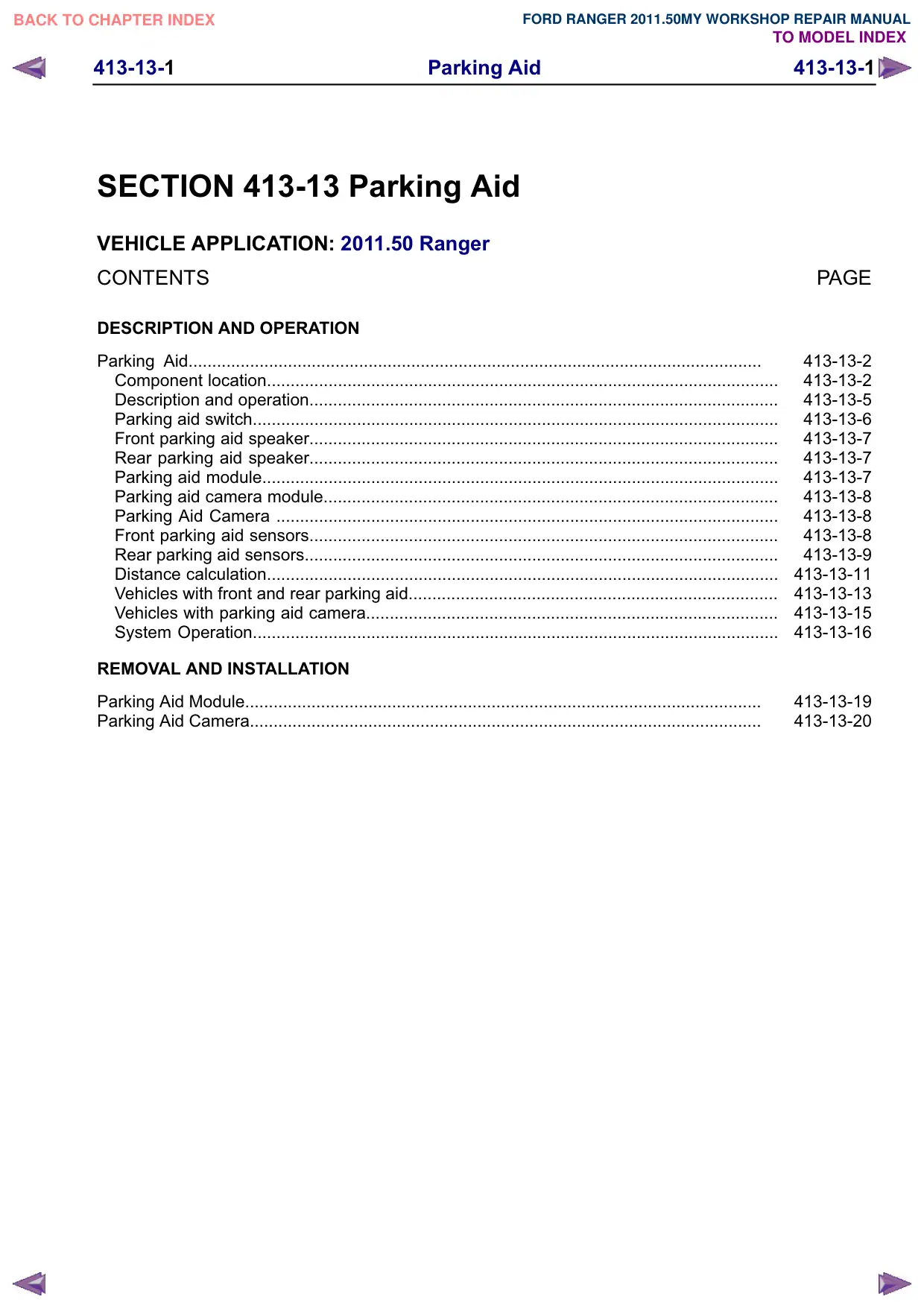
Parking Aid.........................................................................................................................
Component location............................................................................................................
Description and operation...................................................................................................
Parking aid switch...............................................................................................................
Front parking aid speaker...................................................................................................
Rear parking aid speaker...................................................................................................
Parking aid module.............................................................................................................
Parking aid camera module................................................................................................
Parking Aid Camera ..........................................................................................................
Front parking aid sensors...................................................................................................
Rear parking aid sensors....................................................................................................
Distance calculation............................................................................................................
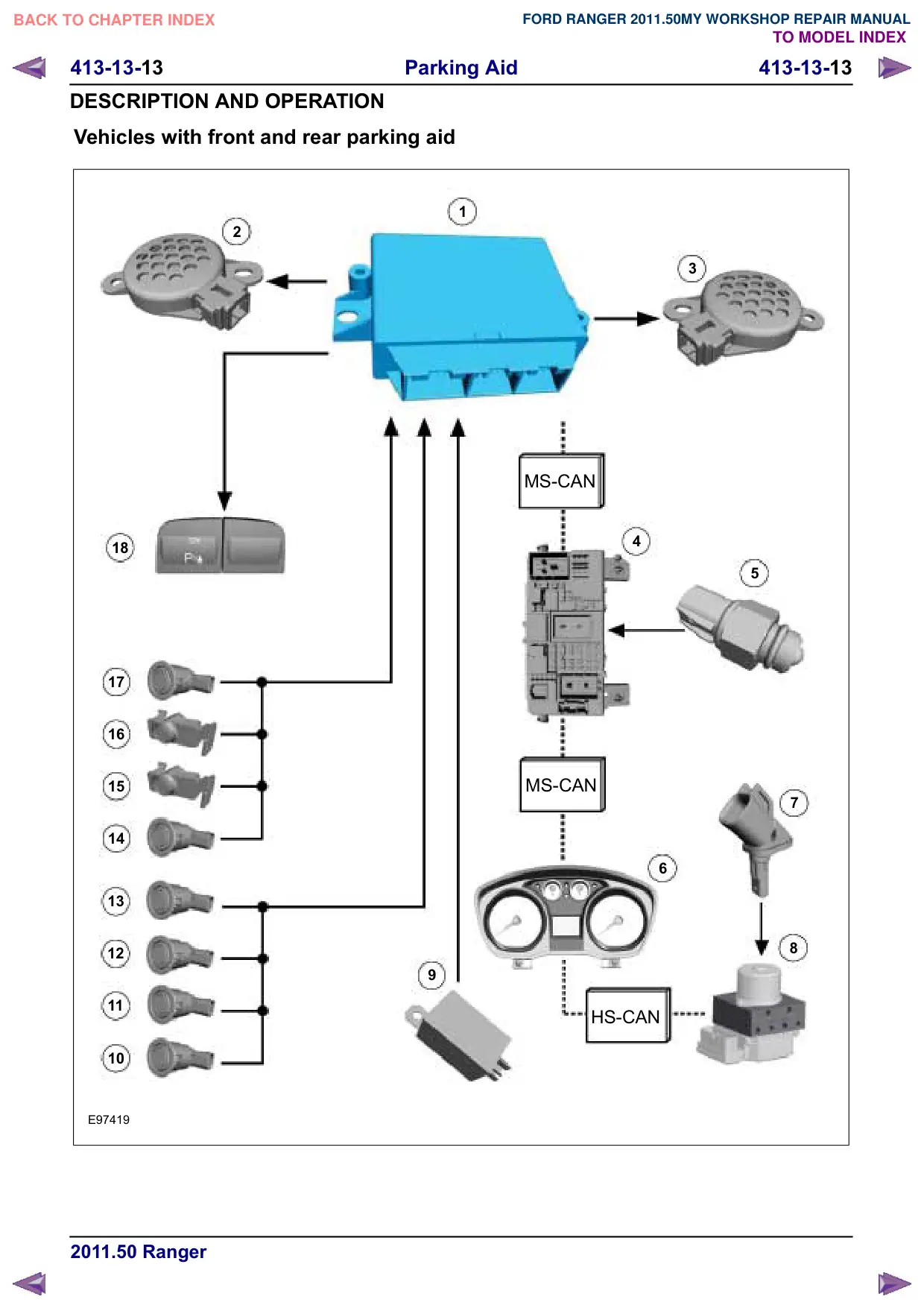
Vehicles with front and rear parking aid..............................................................................
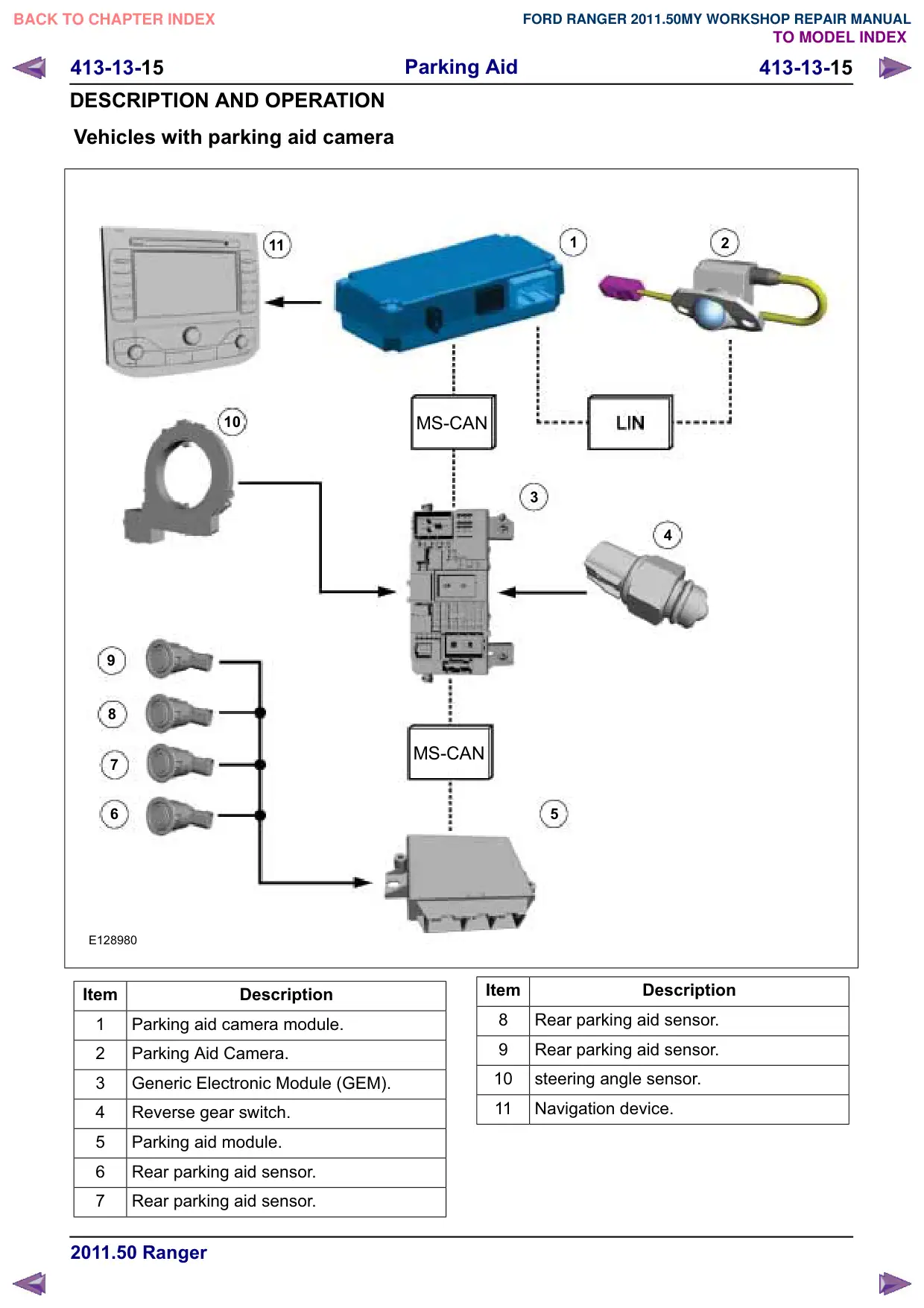
Vehicles with parking aid camera.......................................................................................
System Operation...............................................................................................................
REMOVAL AND INSTALLATION
Parking Aid Module.............................................................................................................
Parking Aid Camera............................................................................................................
PAGE
413-13-2
413-13-2
413-13-5
413-13-6
413-13-7
413-13-7
413-13-7
413-13-8
413-13-8
413-13-8
413-13-9
413-13-11
413-13-13
413-13-15
413-13-16
413-13-19
413-13-20
413-13-3
Parking Aid
413-13-3
DESCRIPTION AND OPERATION
Item
Description
8
Front outer parking aid sensor and holder.
5-Door with parking aid camera
1
E129006
Item
Description
1
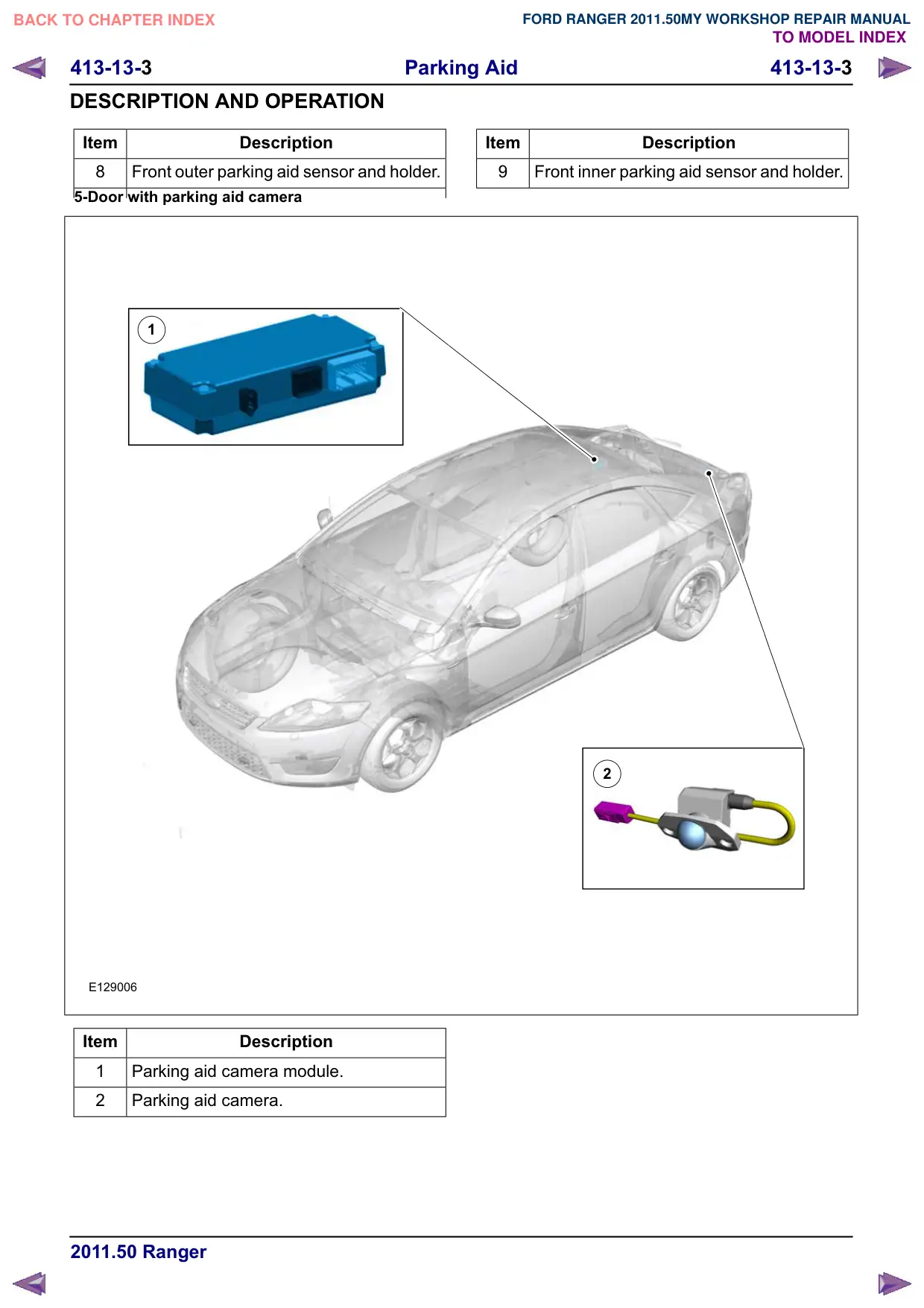
Parking aid camera module.
2
Parking aid camera.
Item
Description
Front inner parking aid sensor and holder.
2
413-13-4
Parking Aid
413-13-4
DESCRIPTION AND OPERATION
Wagon
2
1
8
7
E92008
Item
Description
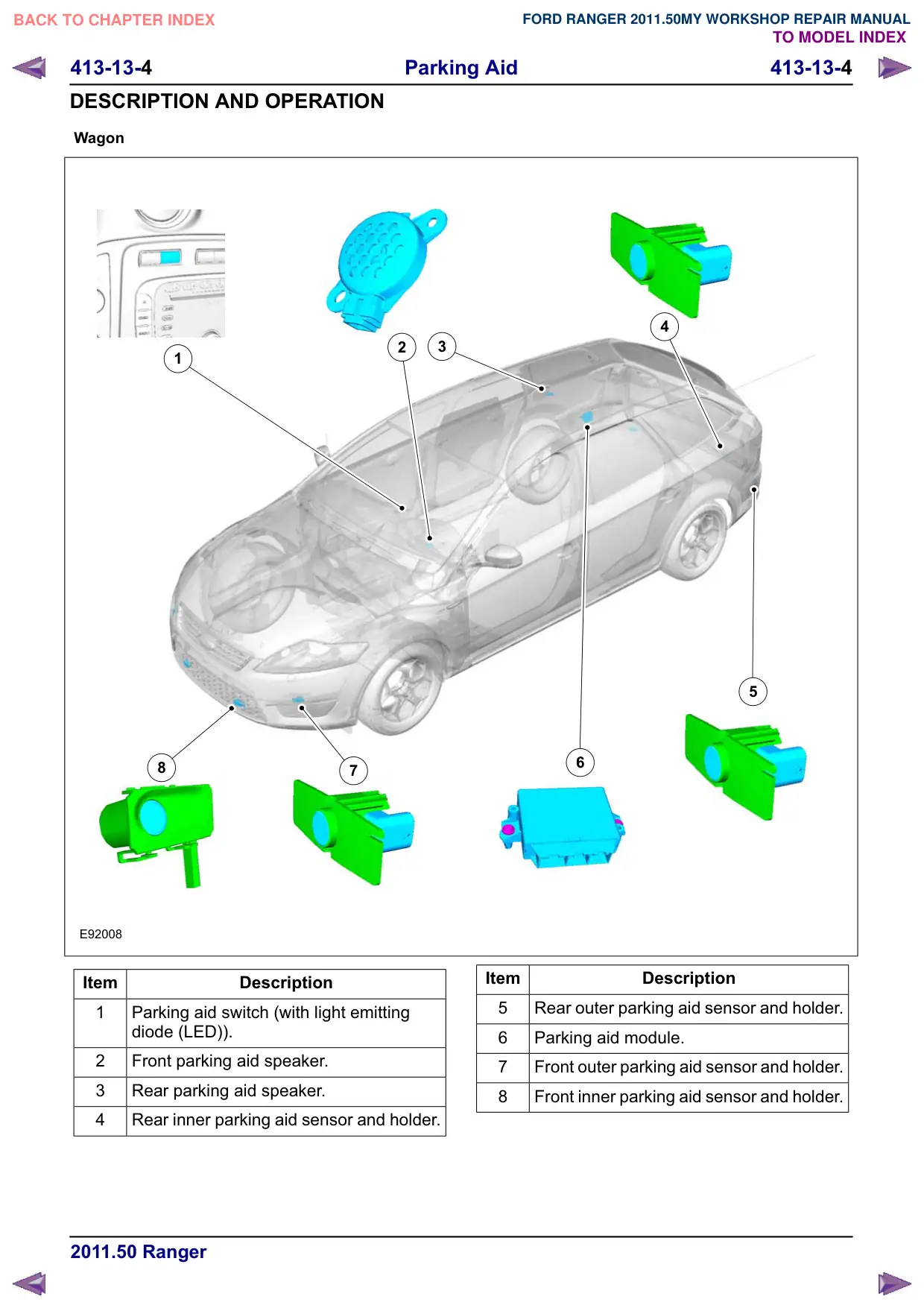
1
Parking aid switch (with light emitting
diode (LED)).
2
Front parking aid speaker.
3
Rear parking aid speaker.
4
Rear inner parking aid sensor and holder.
4
3
5
6
Item
Description
5
Rear outer parking aid sensor and holder.
6
Parking aid module.
7
Front outer parking aid sensor and holder.
8
Front inner parking aid sensor and holder.
413-13-5
Parking Aid
413-13-5
DESCRIPTION AND OPERATION
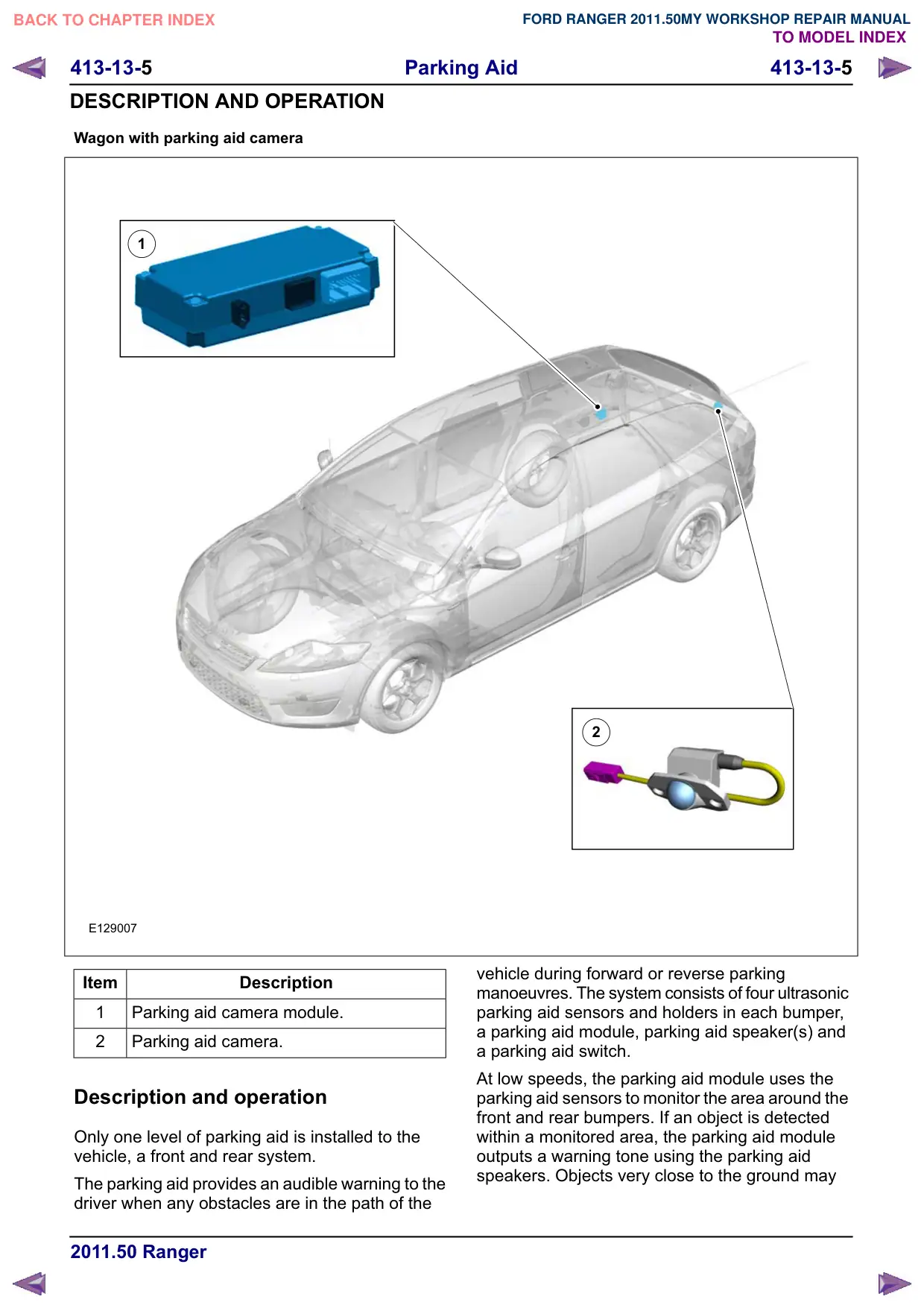
Wagon with parking aid camera
1
E129007
Item
Description
1
Parking aid camera module.
2
Parking aid camera.
Description and operation
Only one level of parking aid is installed to the
vehicle, a front and rear system.
The parking aid provides an audible warning to the
driver when any obstacles are in the path of the
2
vehicle during forward or reverse parking
manoeuvres. The system consists of four ultrasonic
parking aid sensors and holders in each bumper,
a parking aid module, parking aid speaker(s) and
a parking aid switch.
At low speeds, the parking aid module uses the
parking aid sensors to monitor the area around the
front and rear bumpers. If an object is detected
within a monitored area, the parking aid module
outputs a warning tone using the parking aid
speakers. Objects very close to the ground may
413-13-6
Parking Aid
413-13-6
DESCRIPTION AND OPERATION
not be detected, but because of their low height
will not cause damage to the vehicle.
The parking aid module communicates through
discrete signals with the parking aid speakers. The
parking aid speakers output the applicable warning
tones when an object is detected. The medium
speed controller area network (CAN) bus is used
to collect vehicle data from other vehicle systems.
When the parking aid module activates the system,
the parking aid switch LED is illuminated. The
parking aid module processes signals received
from the parking aid sensor(s) to determine if there
is an object within the detection range of the
parking aid sensor(s).
In the combined mode, the parking aid sensor(s)
emit a series of ultrasonic impulses and switch to
receiver mode to receive the echo reflected by an
obstacle within the detection range. The received
echo signals are amplified and converted from an
analogue signal to a digital signal by the parking
aid sensor. The digital signal is passed to the
parking aid module and compared with
pre-programmed data stored in an EEPROM within
the parking aid module. The parking aid module
receives this data through the signal line from the
parking aid sensor and calculates the distance from
the object using the elapsed time between the
transmitted and received impulse.
In receiver mode, the parking aid sensor receives
impulses that were emitted by adjacent parking aid
sensors. The parking aid module uses this
information to determine the distance of the object.
If no objects are detected there are no further
warning tones. If an object is detected, repeated
audible tones are emitted from either parking aid
speaker(s) as appropriate. The time delay between
the tones decreases as the distance between the
object and the vehicle decreases, until at
approximately 250 mm (10 inches), the audible
tone becomes continuous.
If, after the initial detection of an object, there is no
decrease in distance between the object and the
vehicle, the audible warning tones remain constant
if the object is detected by a inner parking aid
sensor or stops after 3 seconds if the object is
detected by an outer parking aid sensor.
The parking aid module continues to monitor the
distance and will resume the warning tones if a
decrease in distance is detected.
The parking aid is activated when the driver
presses the parking aid switch and the vehicle
speed is below 16 km/h (10 mph) or selects reverse
gear.
Front and rear parking aid sensors are activated
and deactivated together.
On vehicles with automatic transmission, the
parking aid is always inactive in the PARK position.
The parking aid can detect when a trailer is
connected to the vehicle by a message output on
the medium speed CAN bus. When the parking
aid module detects that a trailer is connected to
the vehicle, the rear parking aid sensors are
disabled to prevent constant warnings due to the
close proximity of the trailer.
Parking aid switch
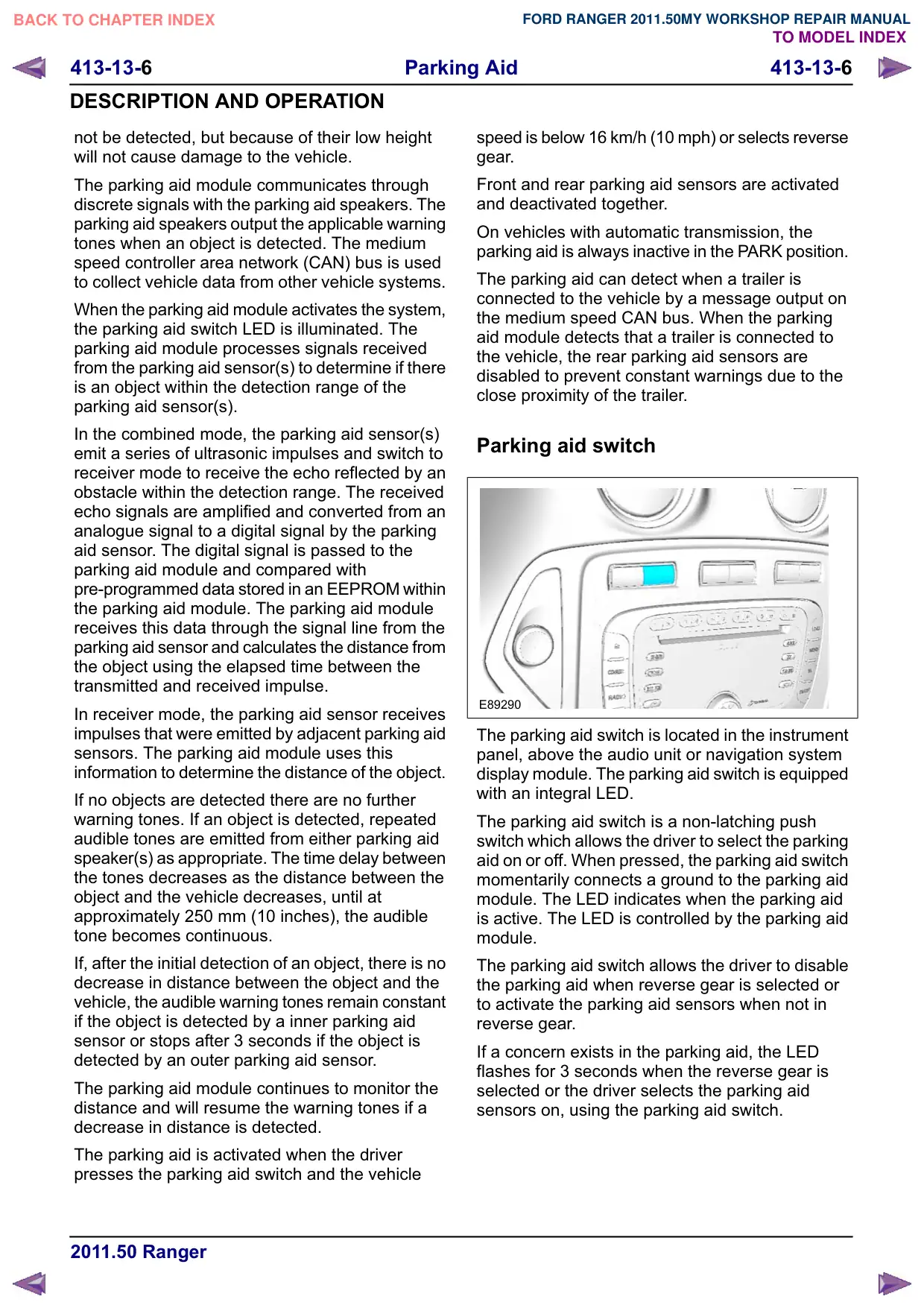
E89290
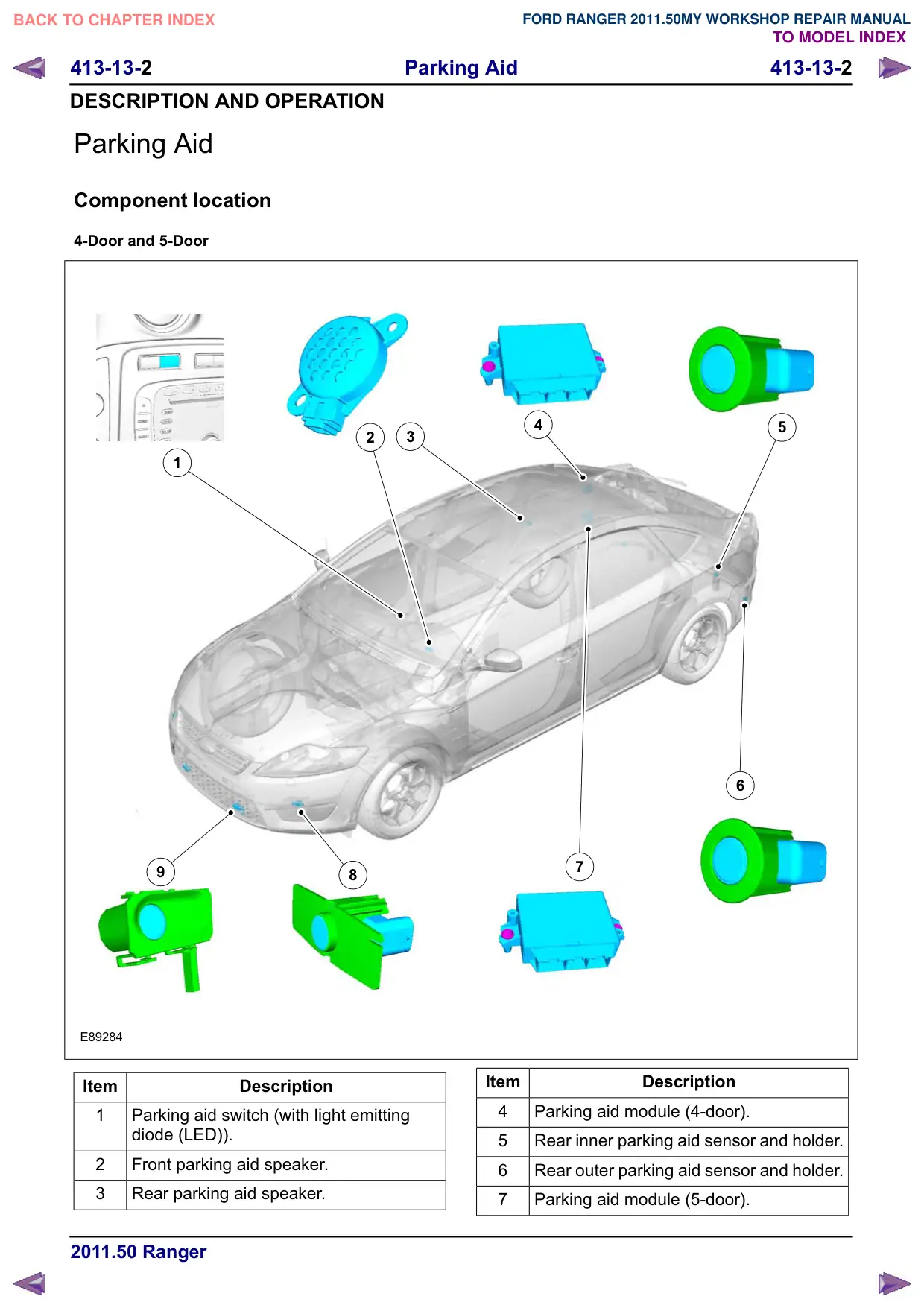
The parking aid switch is located in the instrument
panel, above the audio unit or navigation system
display module. The parking aid switch is equipped
with an integral LED.
The parking aid switch is a non-latching push
switch which allows the driver to select the parking
aid on or off. When pressed, the parking aid switch
momentarily connects a ground to the parking aid
module. The LED indicates when the parking aid
is active. The LED is controlled by the parking aid
module.
The parking aid switch allows the driver to disable
the parking aid when reverse gear is selected or
to activate the parking aid sensors when not in
reverse gear.
If a concern exists in the parking aid, the LED
flashes for 3 seconds when the reverse gear is
selected or the driver selects the parking aid
sensors on, using the parking aid switch.
413-13-7
Parking Aid
413-13-7
DESCRIPTION AND OPERATION
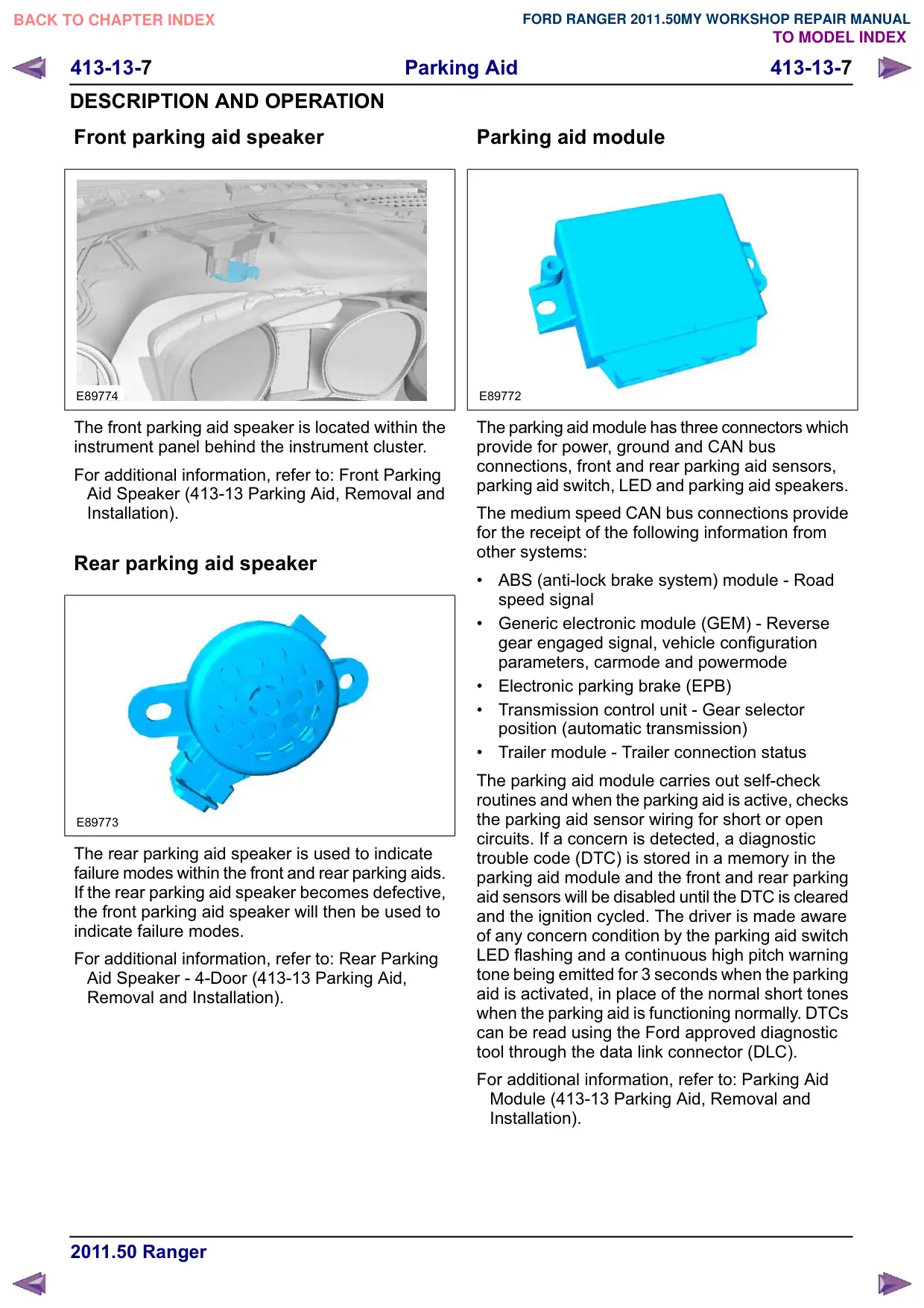
Front parking aid speaker
E89774
The front parking aid speaker is located within the
instrument panel behind the instrument cluster.
For additional information, refer to: Front Parking
Aid Speaker (413-13 Parking Aid, Removal and
Installation).
Rear parking aid speaker
E89773
The rear parking aid speaker is used to indicate
failure modes within the front and rear parking aids.
If the rear parking aid speaker becomes defective,
the front parking aid speaker will then be used to
indicate failure modes.
For additional information, refer to: Rear Parking
Aid Speaker - 4-Door (413-13 Parking Aid,
Removal and Installation).
Parking aid module
E89772
The parking aid module has three connectors which
provide for power, ground and CAN bus
connections, front and rear parking aid sensors,
parking aid switch, LED and parking aid speakers.
The medium speed CAN bus connections provide
for the receipt of the following information from
other systems:
ABS (anti-lock brake system) module - Road
speed signal
Generic electronic module (GEM) - Reverse
gear engaged signal, vehicle configuration
parameters, carmode and powermode
Electronic parking brake (EPB)
Transmission control unit - Gear selector
position (automatic transmission)
Trailer module - Trailer connection status
The parking aid module carries out self-check
routines and when the parking aid is active, checks
the parking aid sensor wiring for short or open
circuits. If a concern is detected, a diagnostic
trouble code (DTC) is stored in a memory in the
parking aid module and the front and rear parking
aid sensors will be disabled until the DTC is cleared
and the ignition cycled. The driver is made aware
of any concern condition by the parking aid switch
LED flashing and a continuous high pitch warning
tone being emitted for 3 seconds when the parking
aid is activated, in place of the normal short tones
when the parking aid is functioning normally. DTCs
can be read using the Ford approved diagnostic
tool through the data link connector (DLC).
For additional information, refer to: Parking Aid
Module (413-13 Parking Aid, Removal and
Installation).
413-13-8
Parking Aid
413-13-8
DESCRIPTION AND OPERATION
Parking aid camera module
E97856
The data from the optional parking aid is sent to
the module via the Mid Speed CAN data bus. The
module is connected to the navigation device via
a video-in/out cable.
It is necessary to programme the module withIDS
(Integrated Diagnostic System) after changing it.
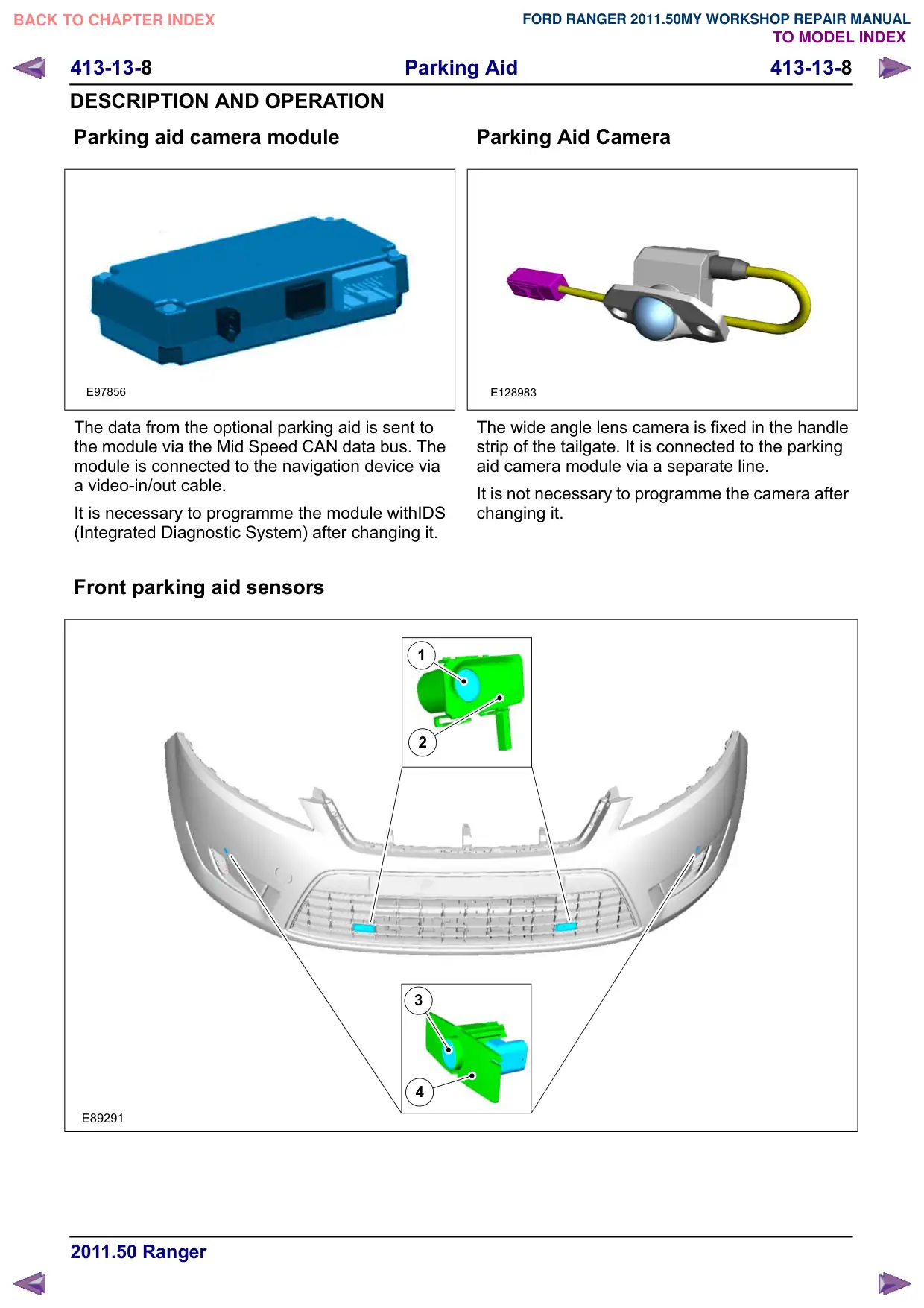
Front parking aid sensors
1
2
3
4
E89291
Parking Aid Camera
E128983
The wide angle lens camera is fixed in the handle
strip of the tailgate. It is connected to the parking
aid camera module via a separate line.
It is not necessary to programme the camera after
changing it.
413-13-
Parking Aid
413-13-
DESCRIPTION AND OPERATION
Item
Description
1
Front inner parking aid sensor(s).
2
Front inner parking aid sensor holder(s).
3
Front outer parking aid sensor(s).
4
Front outer parking aid sensor holder(s).
The parking aid sensor consists of a sensor and a
holder. The holder makes sure that each parking
aid sensor is correctly orientated in relation to its
location in the front bumper.
For additional information, refer to: Front Parking
Aid Sensor (413-13 Parking Aid, Removal and
Installation).
Each parking aid sensor has a three pin connector
which connects with the front bumper wiring
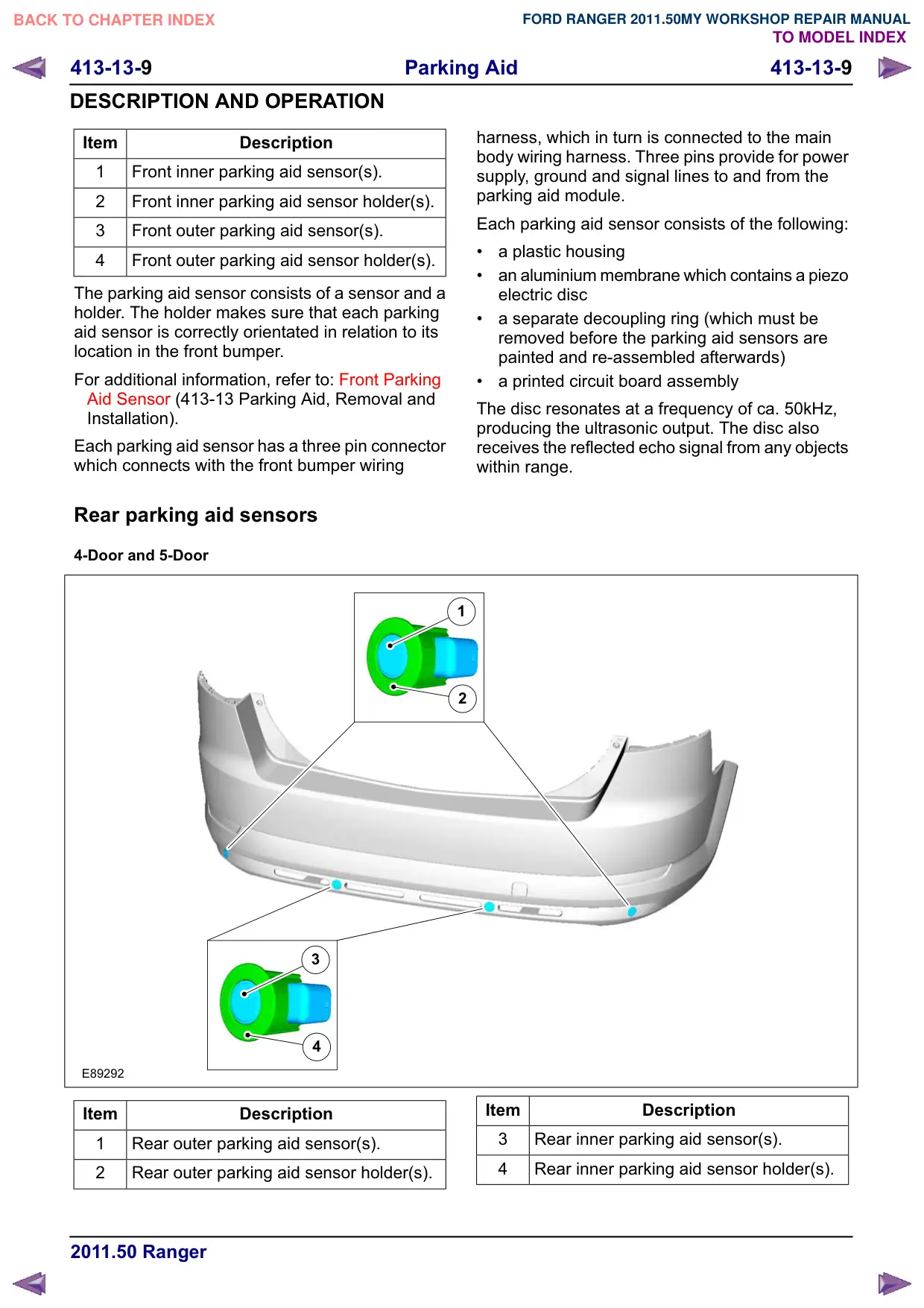
Rear parking aid sensors
4-Door and 5-Door
3
4
E89292
Item
Description
1
Rear outer parking aid sensor(s).
2
Rear outer parking aid sensor holder(s).
harness, which in turn is connected to the main
body wiring harness. Three pins provide for power
supply, ground and signal lines to and from the
parking aid module.
Each parking aid sensor consists of the following:
a plastic housing
an aluminium membrane which contains a piezo
electric disc
a separate decoupling ring (which must be
removed before the parking aid sensors are
painted and re-assembled afterwards)
a printed circuit board assembly
The disc resonates at a frequency of ca. 50kHz,
producing the ultrasonic output. The disc also
receives the reflected echo signal from any objects
within range.
1
2
Item
Description
3
Rear inner parking aid sensor(s).
4
Rear inner parking aid sensor holder(s).
413-13-10
Parking Aid
413-13-10
DESCRIPTION AND OPERATION
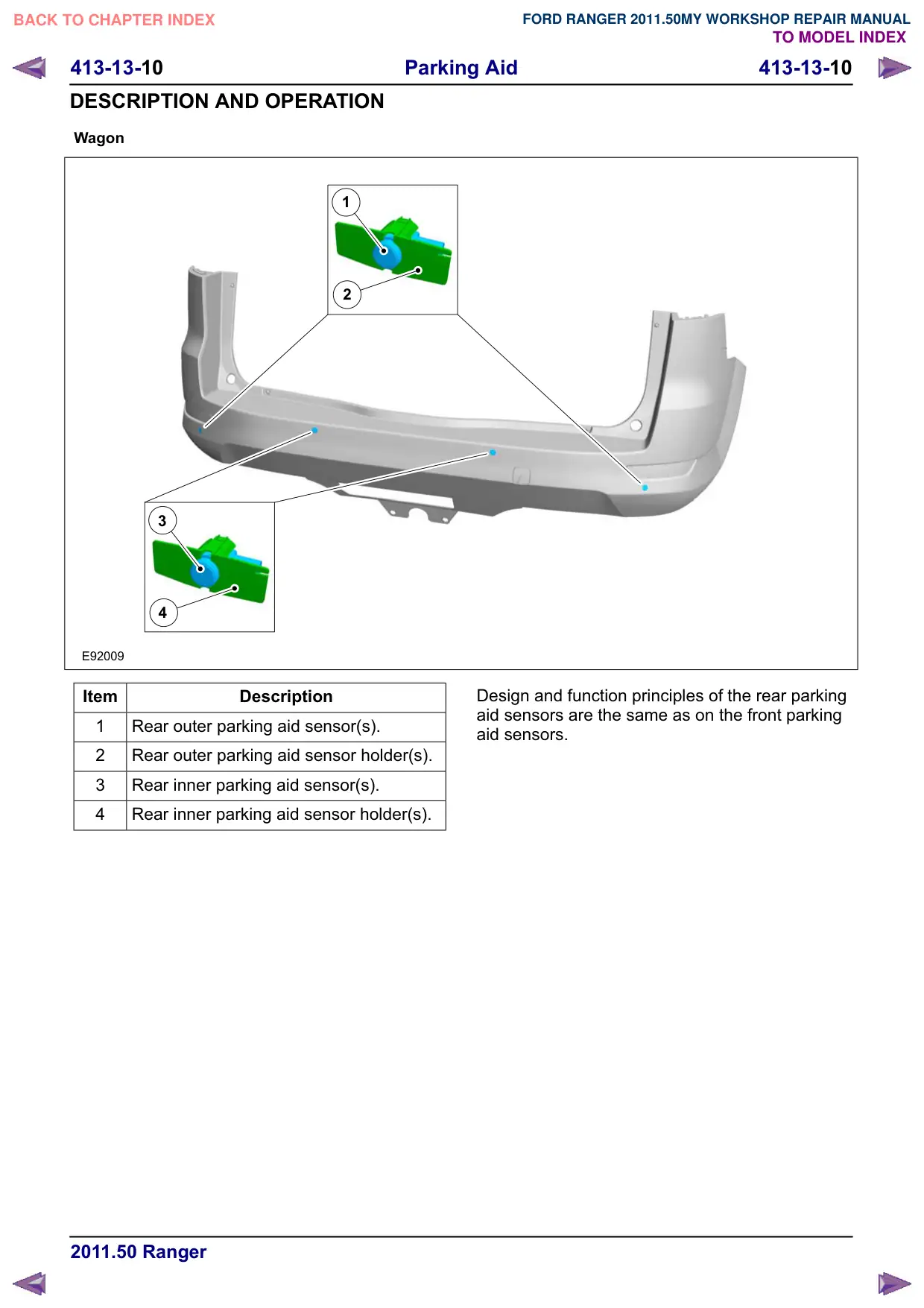
Wagon
1
2
3
4
E92009
Item
Description
1
Rear outer parking aid sensor(s).
2
Rear outer parking aid sensor holder(s).
3
Rear inner parking aid sensor(s).
4
Rear inner parking aid sensor holder(s).
Design and function principles of the rear parking
aid sensors are the same as on the front parking
aid sensors.
413-13-11
Parking Aid
413-13-11
DESCRIPTION AND OPERATION
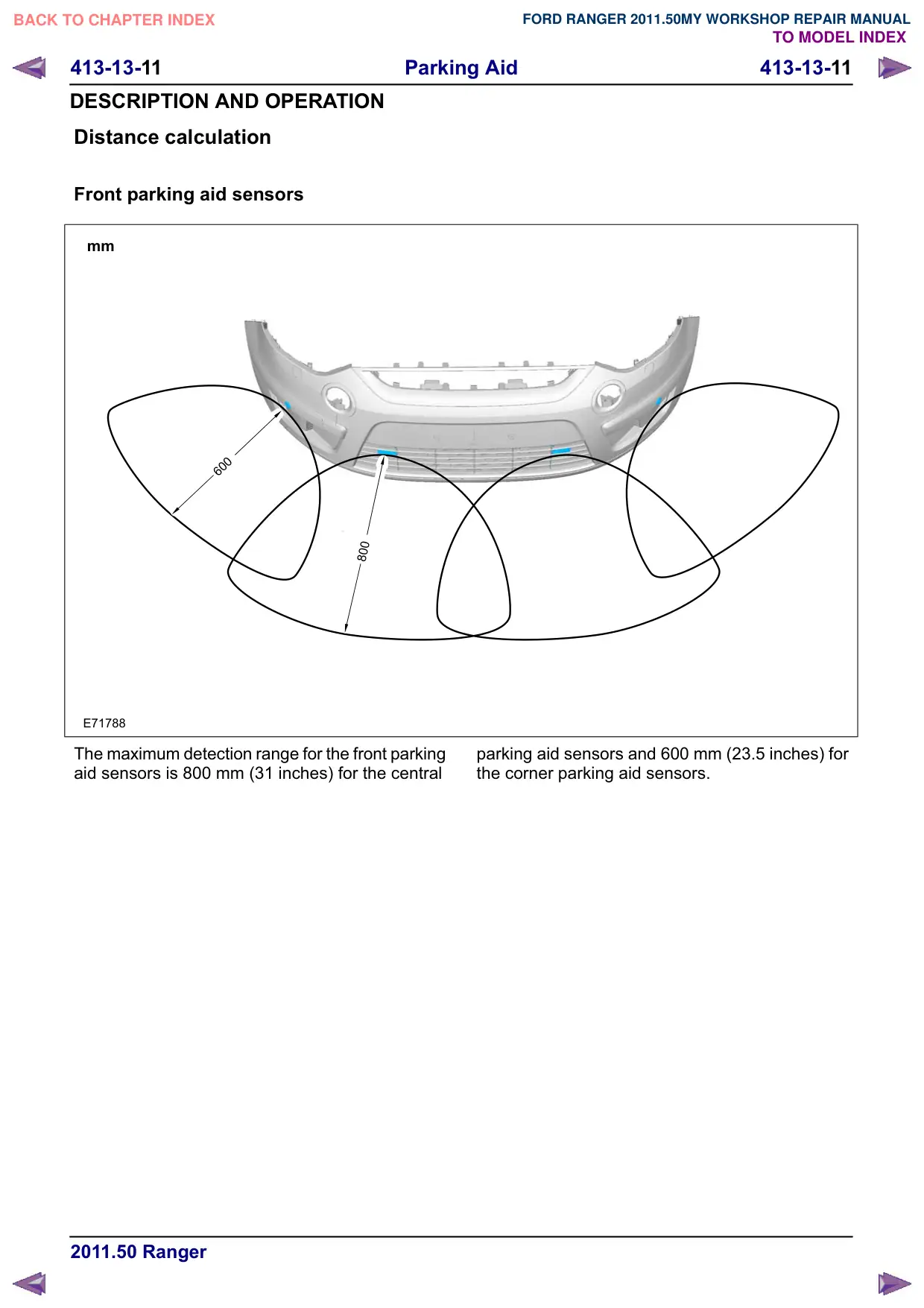
Distance calculation
Front parking aid sensors
mm
600
800
E71788
The maximum detection range for the front parking
aid sensors is 800 mm (31 inches) for the central
parking aid sensors and 600 mm (23.5 inches) for
the corner parking aid sensors.
413-13-12
Parking Aid
413-13-12
DESCRIPTION AND OPERATION
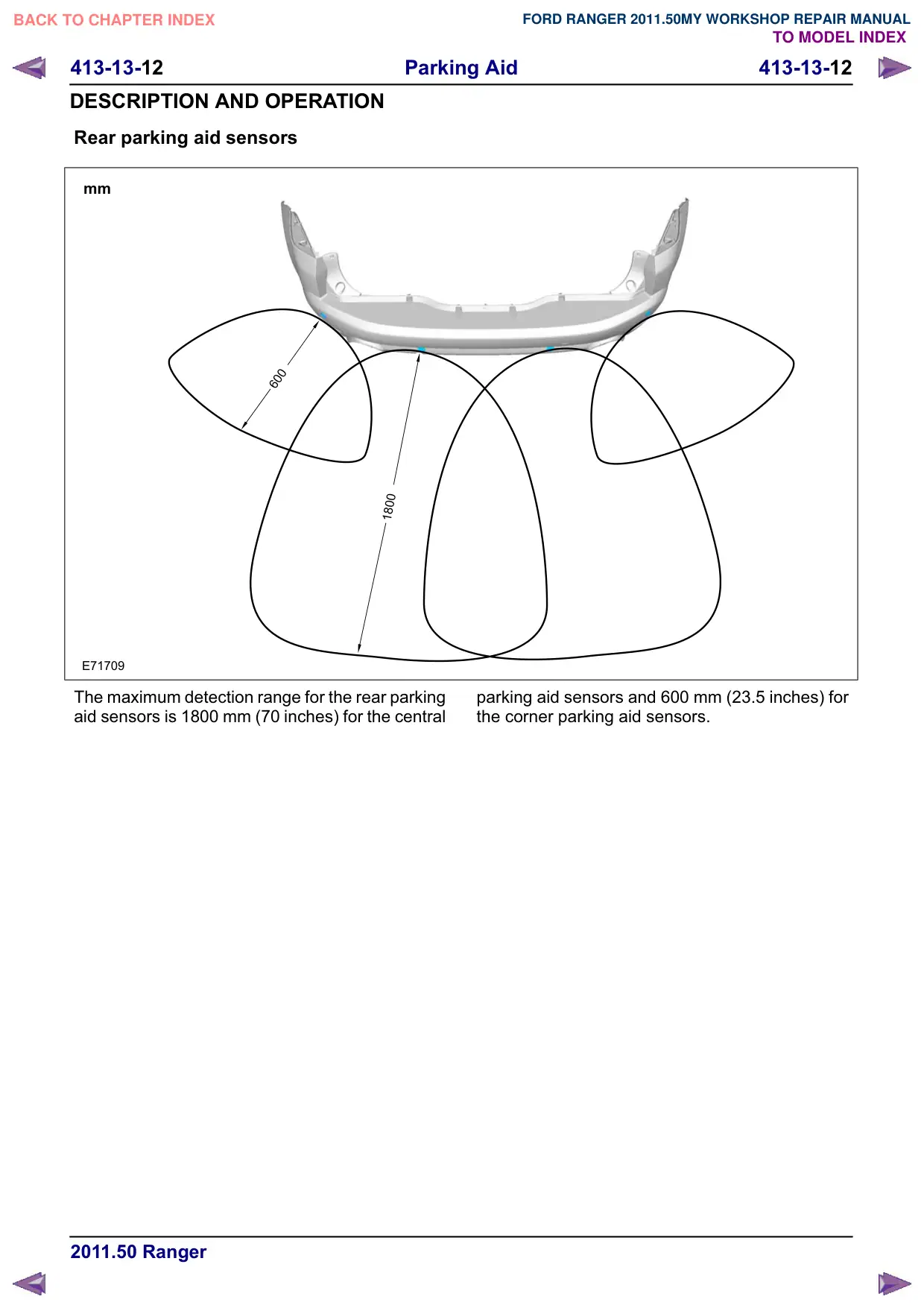
Rear parking aid sensors
mm
600
1800
E71709
The maximum detection range for the rear parking
aid sensors is 1800 mm (70 inches) for the central
parking aid sensors and 600 mm (23.5 inches) for
the corner parking aid sensors.
413-13-14
Parking Aid
413-13-14
DESCRIPTION AND OPERATION
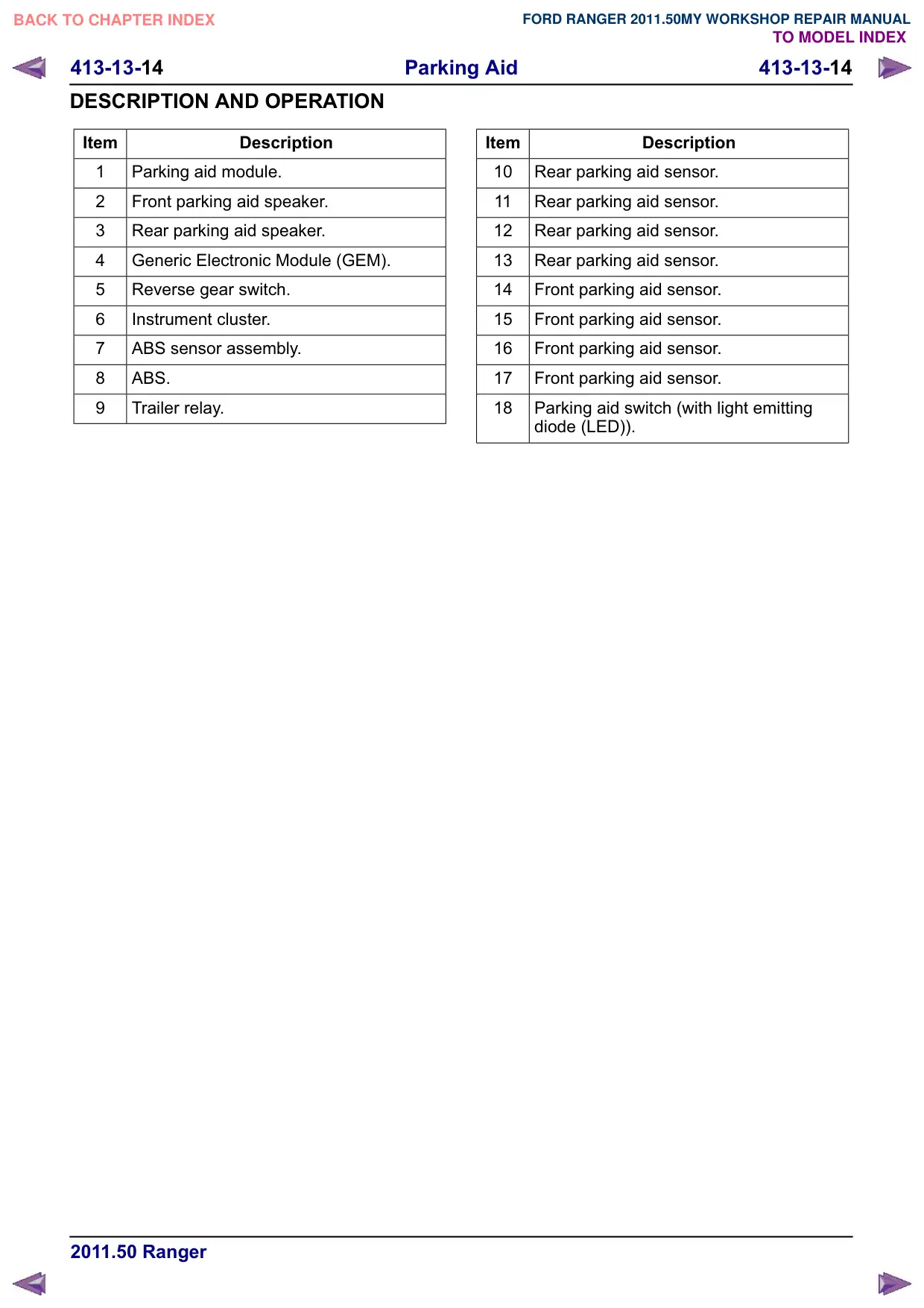
Item
Description
1
Parking aid module.
2
Front parking aid speaker.
3
Rear parking aid speaker.
4
Generic Electronic Module (GEM).
5
Reverse gear switch.
6
Instrument cluster.
7
ABS sensor assembly.
8
ABS.
Trailer relay.
Item
Description
10
Rear parking aid sensor.
11
Rear parking aid sensor.
12
Rear parking aid sensor.
13
Rear parking aid sensor.
14
Front parking aid sensor.
15
Front parking aid sensor.
16
Front parking aid sensor.
17
Front parking aid sensor.
18
Parking aid switch (with light emitting
diode (LED)).
413-13-16
Parking Aid
413-13-16
DESCRIPTION AND OPERATION
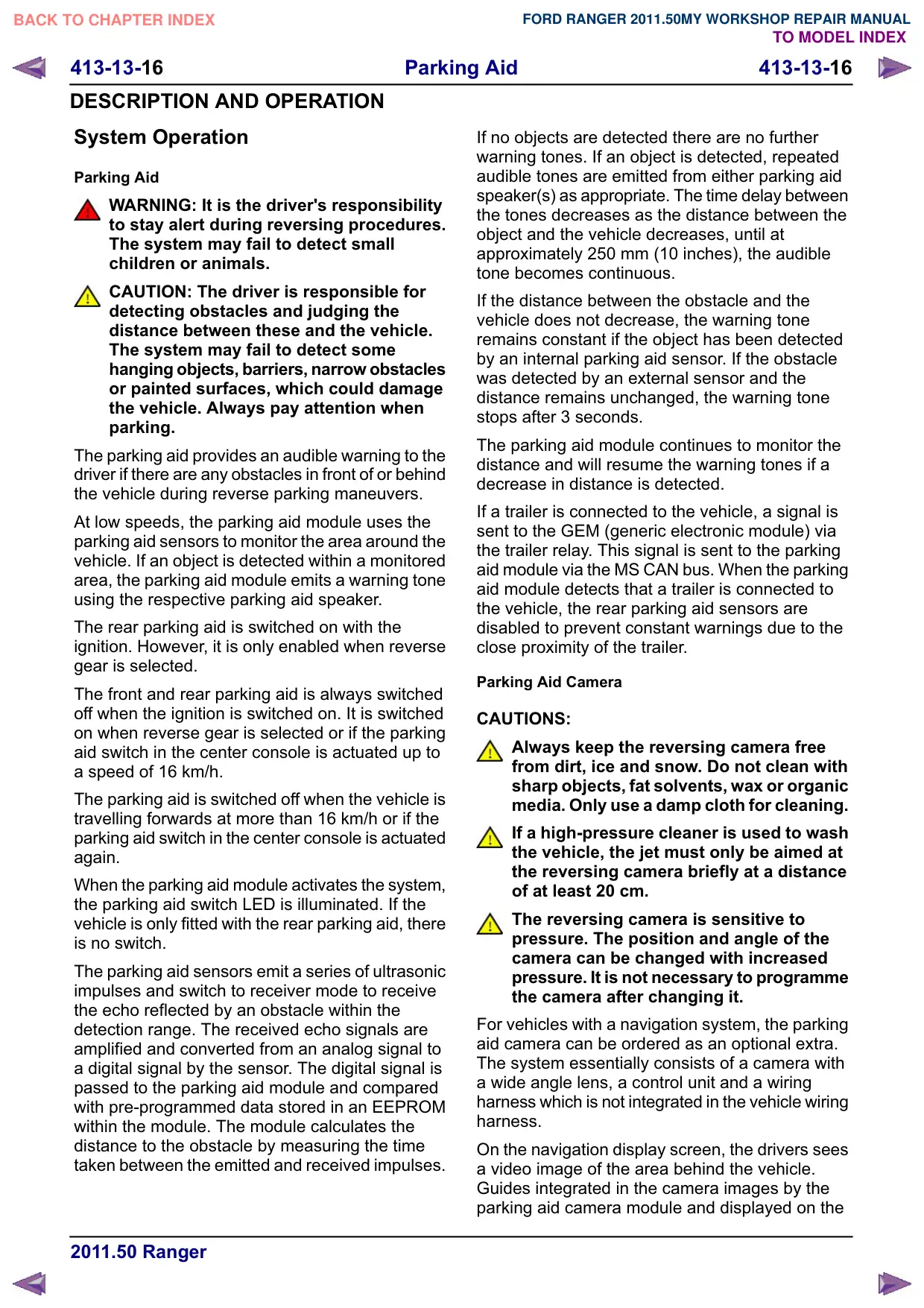
System Operation
Parking Aid
WARNING: It is the driver's responsibility
to stay alert during reversing procedures.
The system may fail to detect small
children or animals.
CAUTION: The driver is responsible for
detecting obstacles and judging the
distance between these and the vehicle.
The system may fail to detect some
hanging objects, barriers, narrow obstacles
or painted surfaces, which could damage
the vehicle. Always pay attention when
parking.
The parking aid provides an audible warning to the
driver if there are any obstacles in front of or behind
the vehicle during reverse parking maneuvers.
At low speeds, the parking aid module uses the
parking aid sensors to monitor the area around the
vehicle. If an object is detected within a monitored
area, the parking aid module emits a warning tone
using the respective parking aid speaker.
The rear parking aid is switched on with the
ignition. However, it is only enabled when reverse
gear is selected.
The front and rear parking aid is always switched
off when the ignition is switched on. It is switched
on when reverse gear is selected or if the parking
aid switch in the center console is actuated up to
a speed of 16 km/h.
The parking aid is switched off when the vehicle is
travelling forwards at more than 16 km/h or if the
parking aid switch in the center console is actuated
again.
When the parking aid module activates the system,
the parking aid switch LED is illuminated. If the
vehicle is only fitted with the rear parking aid, there
is no switch.
The parking aid sensors emit a series of ultrasonic
impulses and switch to receiver mode to receive
the echo reflected by an obstacle within the
detection range. The received echo signals are
amplified and converted from an analog signal to
a digital signal by the sensor. The digital signal is
passed to the parking aid module and compared
with pre-programmed data stored in an EEPROM
within the module. The module calculates the
distance to the obstacle by measuring the time
taken between the emitted and received impulses.
If no objects are detected there are no further
warning tones. If an object is detected, repeated
audible tones are emitted from either parking aid
speaker(s) as appropriate. The time delay between
the tones decreases as the distance between the
object and the vehicle decreases, until at
approximately 250 mm (10 inches), the audible
tone becomes continuous.
If the distance between the obstacle and the
vehicle does not decrease, the warning tone
remains constant if the object has been detected
by an internal parking aid sensor. If the obstacle
was detected by an external sensor and the
distance remains unchanged, the warning tone
stops after 3 seconds.
The parking aid module continues to monitor the
distance and will resume the warning tones if a
decrease in distance is detected.
If a trailer is connected to the vehicle, a signal is
sent to the GEM (generic electronic module) via
the trailer relay. This signal is sent to the parking
aid module via the MS CAN bus. When the parking
aid module detects that a trailer is connected to
the vehicle, the rear parking aid sensors are
disabled to prevent constant warnings due to the
close proximity of the trailer.
Parking Aid Camera
CAUTIONS:
Always keep the reversing camera free
from dirt, ice and snow. Do not clean with
sharp objects, fat solvents, wax or organic
media. Only use a damp cloth for cleaning.
If a high-pressure cleaner is used to wash
the vehicle, the jet must only be aimed at
the reversing camera briefly at a distance
of at least 20 cm.
The reversing camera is sensitive to
pressure. The position and angle of the
camera can be changed with increased
pressure. It is not necessary to programme
the camera after changing it.
For vehicles with a navigation system, the parking
aid camera can be ordered as an optional extra.
The system essentially consists of a camera with
a wide angle lens, a control unit and a wiring
harness which is not integrated in the vehicle wiring
harness.
On the navigation display screen, the drivers sees
a video image of the area behind the vehicle.
Guides integrated in the camera images by the
parking aid camera module and displayed on the
413-13-17
Parking Aid
413-13-17
DESCRIPTION AND OPERATION
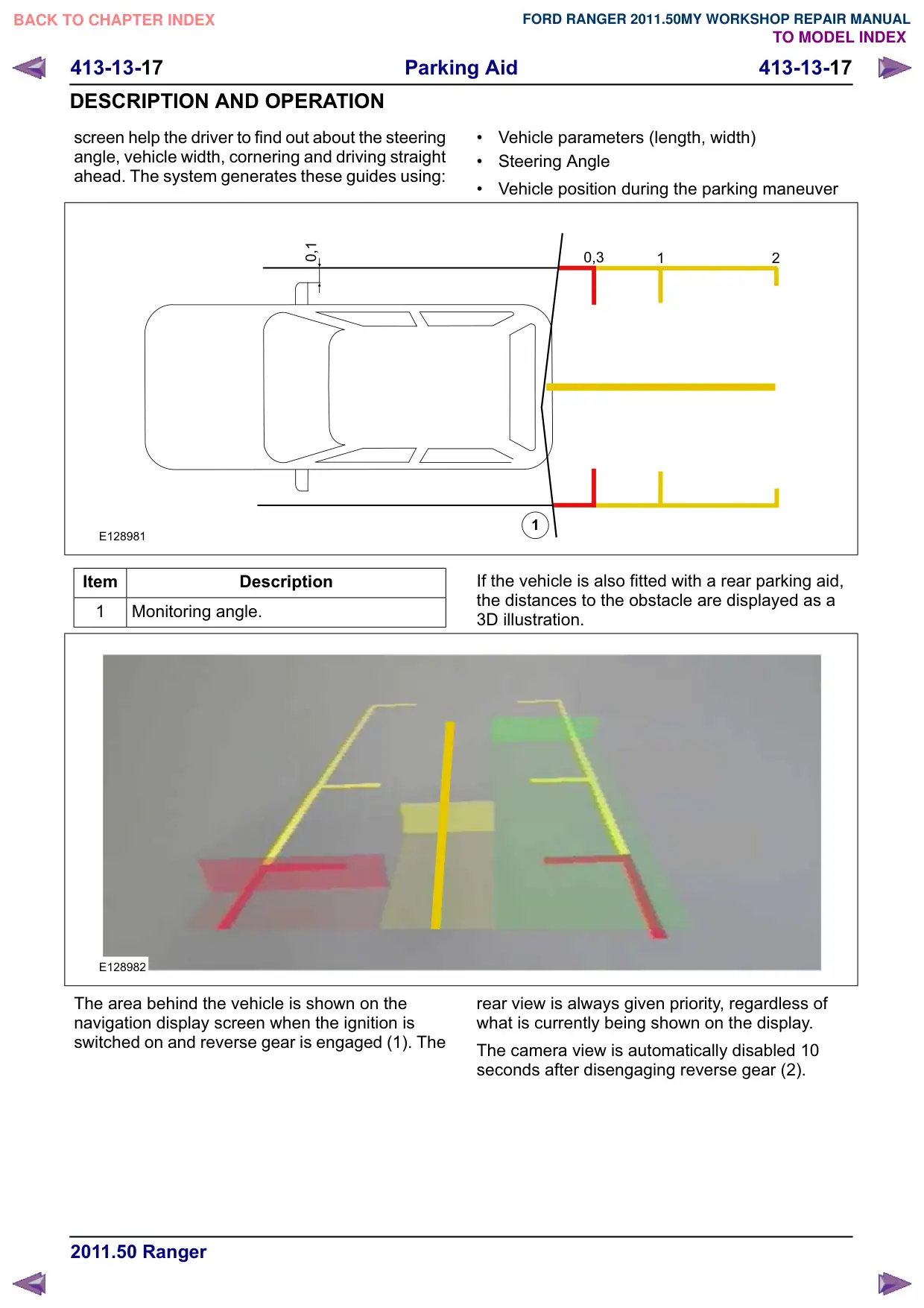
screen help the driver to find out about the steering
angle, vehicle width, cornering and driving straight
ahead. The system generates these guides using:
0,1
E128981
Item
Description
1
Monitoring angle.
E128982
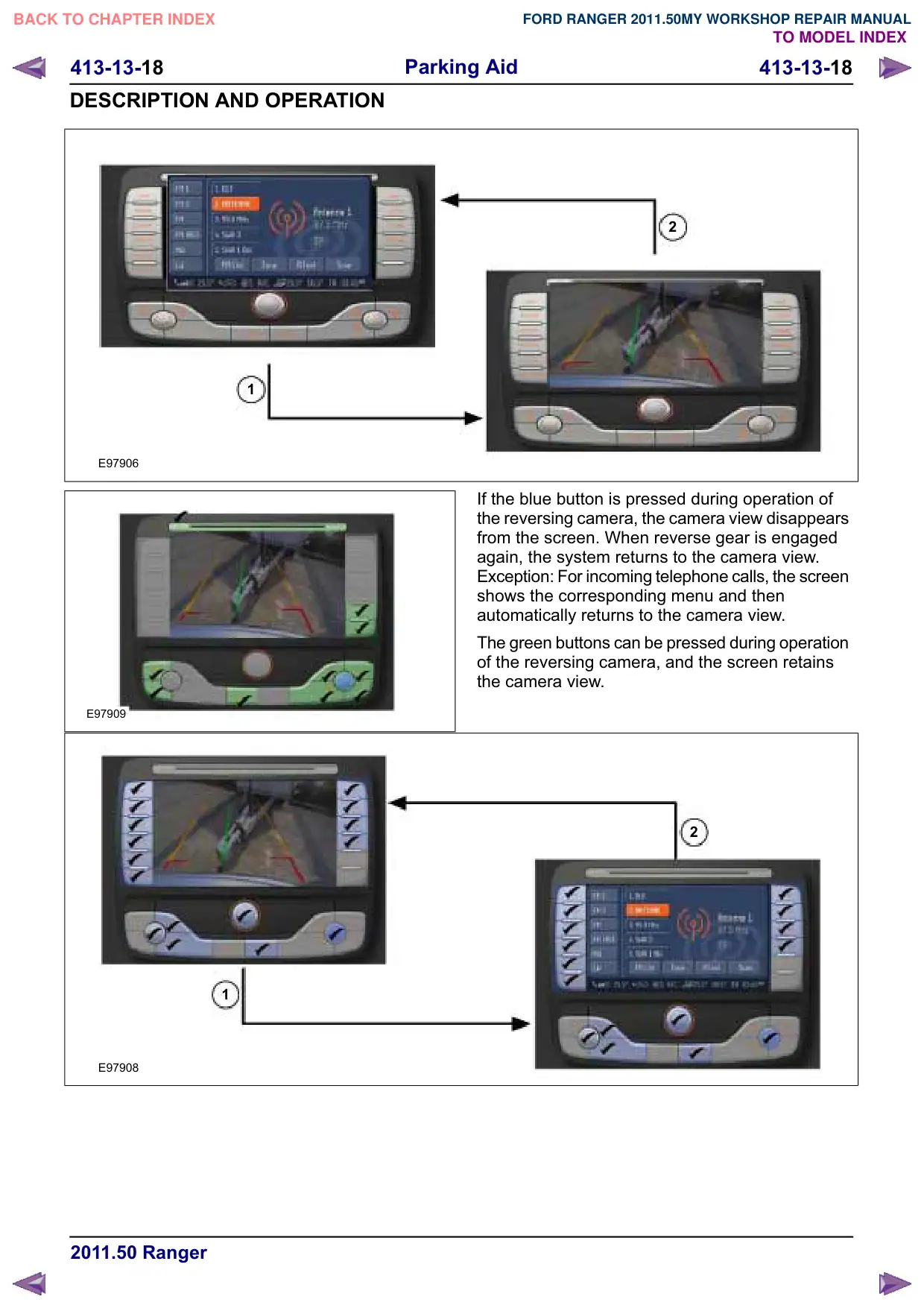
The area behind the vehicle is shown on the
navigation display screen when the ignition is
switched on and reverse gear is engaged (1). The
Vehicle parameters (length, width)
Steering Angle
Vehicle position during the parking maneuver
0,3
1
2
1
If the vehicle is also fitted with a rear parking aid,
the distances to the obstacle are displayed as a
3D illustration.
rear view is always given priority, regardless of
what is currently being shown on the display.
The camera view is automatically disabled 10
seconds after disengaging reverse gear (2).
413-13-18
Parking Aid
413-13-18
DESCRIPTION AND OPERATION
1
E97906
E97909
1
E97908
2
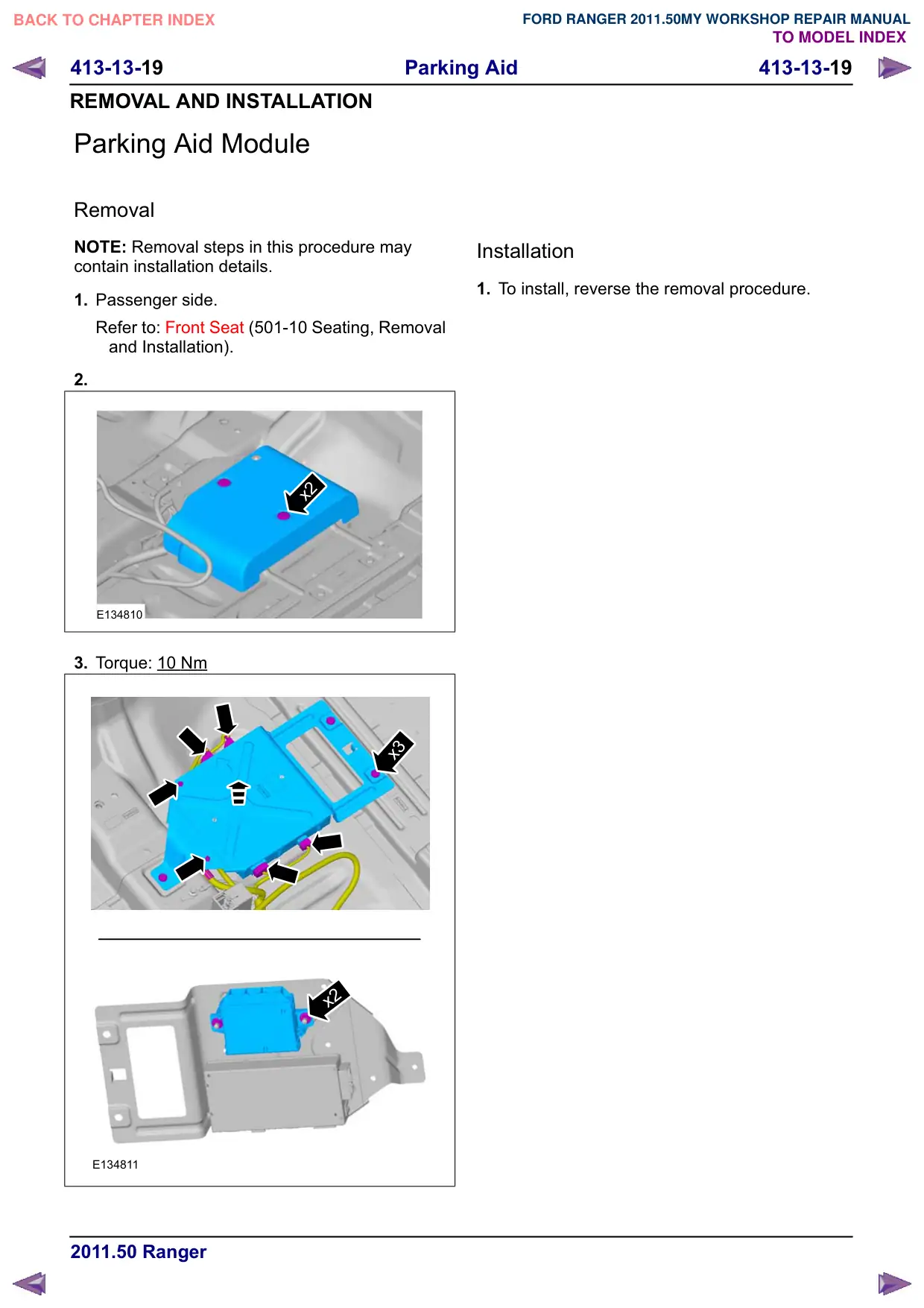
If the blue button is pressed during operation of
the reversing camera, the camera view disappears
from the screen. When reverse gear is engaged
again, the system returns to the camera view.
Exception: For incoming telephone calls, the screen
shows the corresponding menu and then
automatically returns to the camera view.
The green buttons can be pressed during operation
of the reversing camera, and the screen retains
the camera view.
2
413-13-19
Parking Aid
413-13-19
REMOVAL AND INSTALLATION
Parking Aid Module
Removal
NOTE: Removal steps in this procedure may
contain installation details.
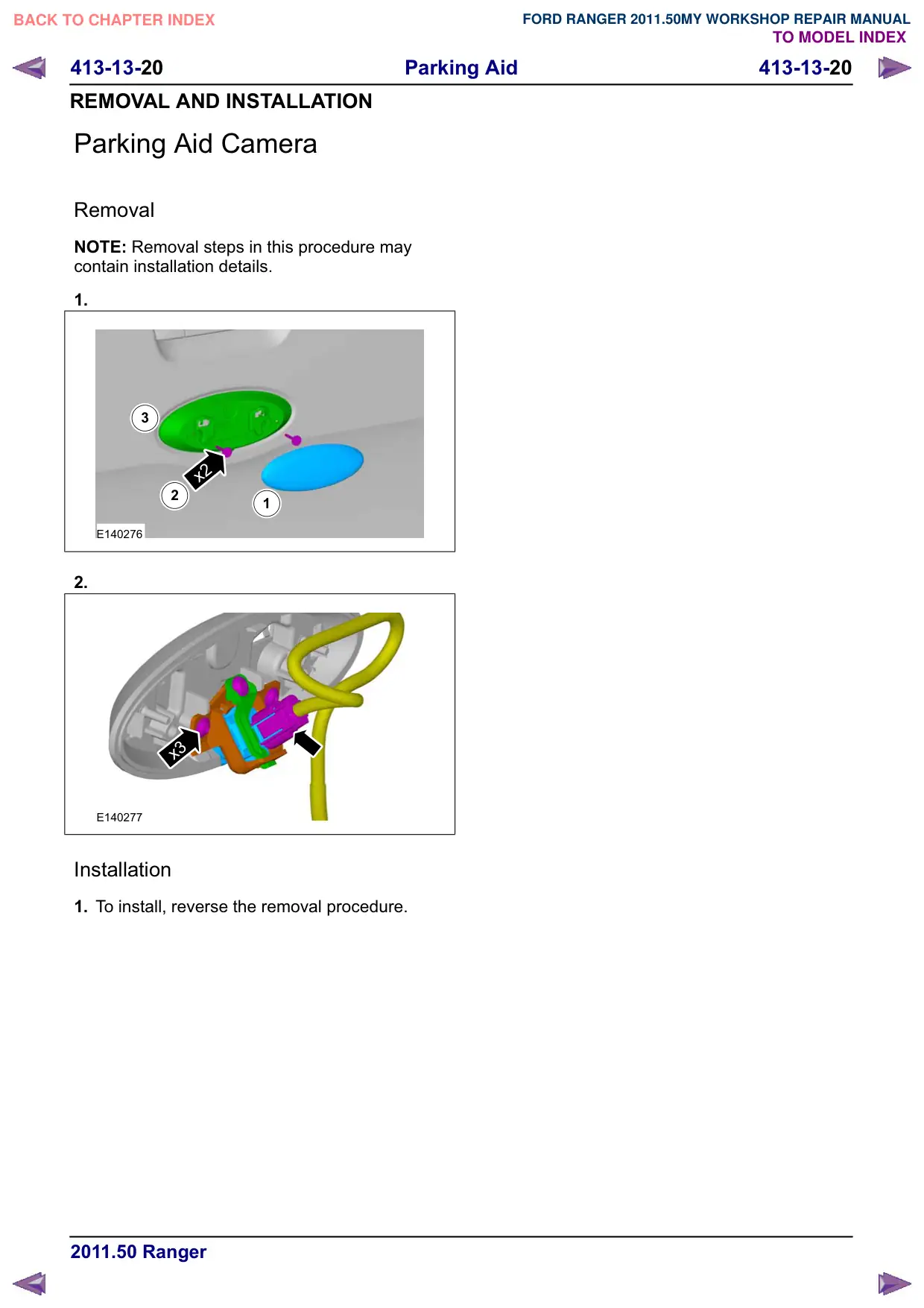
1. Passenger side.
Refer to: Front Seat (501-10 Seating, Removal
and Installation).
2.
x2
E134810
3. Torque: 10 Nm
x3
x2
E134811
Installation
1. To install, reverse the removal procedure.
413-13-20
Parking Aid
413-13-20
REMOVAL AND INSTALLATION
Parking Aid Camera
Removal
NOTE: Removal steps in this procedure may
contain installation details.
1.
3
x2
2
1
E140276
2.
x3
E140277
Installation
1. To install, reverse the removal procedure.