Auxílio de estacionamento
Parking Aid
Texto da página
Link desta página: https://ranger.mbrace.com.br/oficina/1225
Imagem: https://ranger.mbrace.com.br/img/oficina/1225.webp
413-13-6
Parking Aid
413-13-6
DESCRIPTION AND OPERATION
not be detected, but because of their low height
will not cause damage to the vehicle.
The parking aid module communicates through
discrete signals with the parking aid speakers. The
parking aid speakers output the applicable warning
tones when an object is detected. The medium
speed controller area network (CAN) bus is used
to collect vehicle data from other vehicle systems.
When the parking aid module activates the system,
the parking aid switch LED is illuminated. The
parking aid module processes signals received
from the parking aid sensor(s) to determine if there
is an object within the detection range of the
parking aid sensor(s).
In the combined mode, the parking aid sensor(s)
emit a series of ultrasonic impulses and switch to
receiver mode to receive the echo reflected by an
obstacle within the detection range. The received
echo signals are amplified and converted from an
analogue signal to a digital signal by the parking
aid sensor. The digital signal is passed to the
parking aid module and compared with
pre-programmed data stored in an EEPROM within
the parking aid module. The parking aid module
receives this data through the signal line from the
parking aid sensor and calculates the distance from
the object using the elapsed time between the
transmitted and received impulse.
In receiver mode, the parking aid sensor receives
impulses that were emitted by adjacent parking aid
sensors. The parking aid module uses this
information to determine the distance of the object.
If no objects are detected there are no further
warning tones. If an object is detected, repeated
audible tones are emitted from either parking aid
speaker(s) as appropriate. The time delay between
the tones decreases as the distance between the
object and the vehicle decreases, until at
approximately 250 mm (10 inches), the audible
tone becomes continuous.
If, after the initial detection of an object, there is no
decrease in distance between the object and the
vehicle, the audible warning tones remain constant
if the object is detected by a inner parking aid
sensor or stops after 3 seconds if the object is
detected by an outer parking aid sensor.
The parking aid module continues to monitor the
distance and will resume the warning tones if a
decrease in distance is detected.
The parking aid is activated when the driver
presses the parking aid switch and the vehicle
speed is below 16 km/h (10 mph) or selects reverse
gear.
Front and rear parking aid sensors are activated
and deactivated together.
On vehicles with automatic transmission, the
parking aid is always inactive in the PARK position.
The parking aid can detect when a trailer is
connected to the vehicle by a message output on
the medium speed CAN bus. When the parking
aid module detects that a trailer is connected to
the vehicle, the rear parking aid sensors are
disabled to prevent constant warnings due to the
close proximity of the trailer.
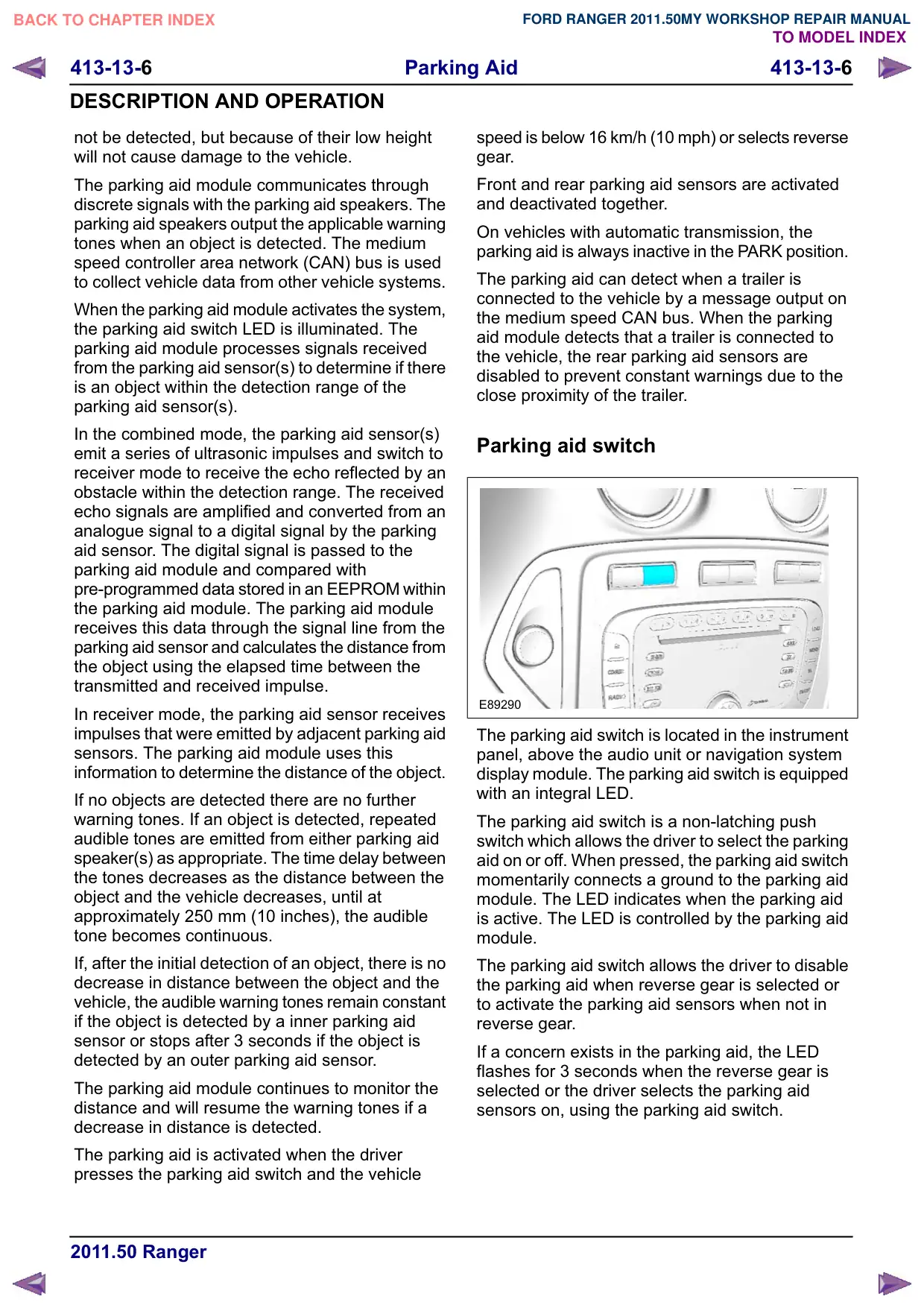
Parking aid switch
E89290
The parking aid switch is located in the instrument
panel, above the audio unit or navigation system
display module. The parking aid switch is equipped
with an integral LED.
The parking aid switch is a non-latching push
switch which allows the driver to select the parking
aid on or off. When pressed, the parking aid switch
momentarily connects a ground to the parking aid
module. The LED indicates when the parking aid
is active. The LED is controlled by the parking aid
module.
The parking aid switch allows the driver to disable
the parking aid when reverse gear is selected or
to activate the parking aid sensors when not in
reverse gear.
If a concern exists in the parking aid, the LED
flashes for 3 seconds when the reverse gear is
selected or the driver selects the parking aid
sensors on, using the parking aid switch.