Técnicas de união
Joining Techniques
Texto da página
Link desta página: https://ranger.mbrace.com.br/carroceria/318
Imagem: https://ranger.mbrace.com.br/img/carroceria/318.webp
501-25-60
Body Repairs - General Information
501-25-60
DESCRIPTION AND OPERATION
Only in limited cases can welding errors in
resistance spot weld joints be detected from the
outside . Therefore, a test weld should be carried
out before each repair weld. The peel test carried
out after the welding gives information on the
quality of the welding. The spot weld itself must
never separate, it must tear away leaving a hole.
MIG welding
Basically, three methods of MIG welding are used:
Puddle weld.
Continuous bead welding
Intermittent bead welding
Fields of application
Any joins that are MIG welded in production
must also be replaced by MIG welds.
Puddle welding may be used in certain cases,
if there is insufficient access.
If the overall panel thickness is greater than 3
mm, without correspondingly powerful spot
welding equipment, puddle welding should be
used.
When dealing with any MIG brazed joints which
are present, follow the vehicle-specific repair
instructions.
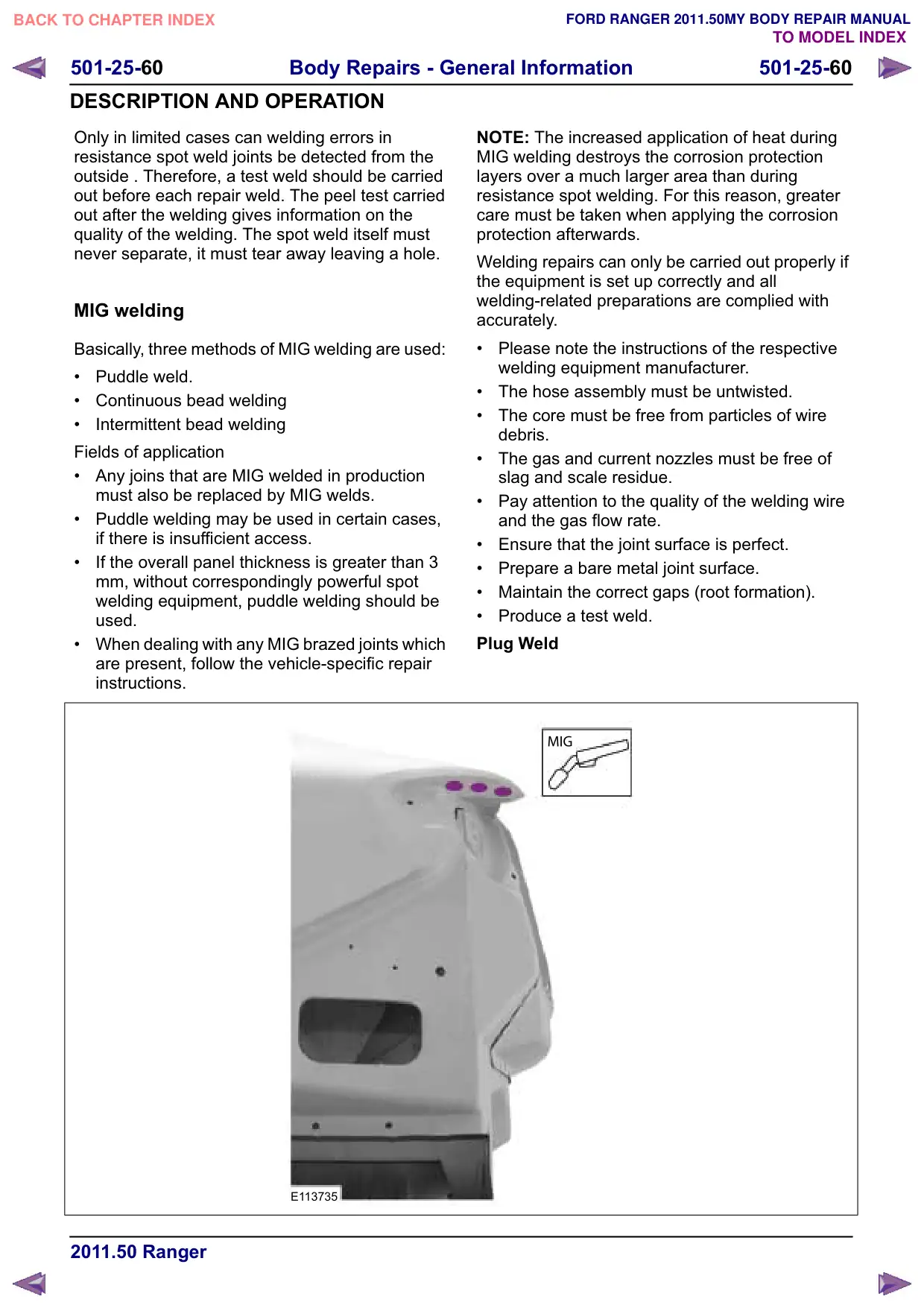
E113735
NOTE: The increased application of heat during
MIG welding destroys the corrosion protection
layers over a much larger area than during
resistance spot welding. For this reason, greater
care must be taken when applying the corrosion
protection afterwards.
Welding repairs can only be carried out properly if
the equipment is set up correctly and all
welding-related preparations are complied with
accurately.
Please note the instructions of the respective
welding equipment manufacturer.
The hose assembly must be untwisted.
The core must be free from particles of wire
debris.
The gas and current nozzles must be free of
slag and scale residue.
Pay attention to the quality of the welding wire
and the gas flow rate.
Ensure that the joint surface is perfect.
Prepare a bare metal joint surface.
Maintain the correct gaps (root formation).
Produce a test weld.
Plug Weld