Técnicas de união
Joining Techniques
Texto da página
Link desta página: https://ranger.mbrace.com.br/carroceria/317
Imagem: https://ranger.mbrace.com.br/img/carroceria/317.webp
501-25-59
Body Repairs - General Information
501-25-59
DESCRIPTION AND OPERATION
Joining Techniques
Welding
Before welding work is performed on a vehicle
body, all safety measures for the protection of
people, modules and electrical components must
be observed.
NOTE: Before beginning the work, please refer to
the safety instructions and warnings in the chapter
Safety Instructions. Please also note the warnings
of the respective equipment manufacturer.
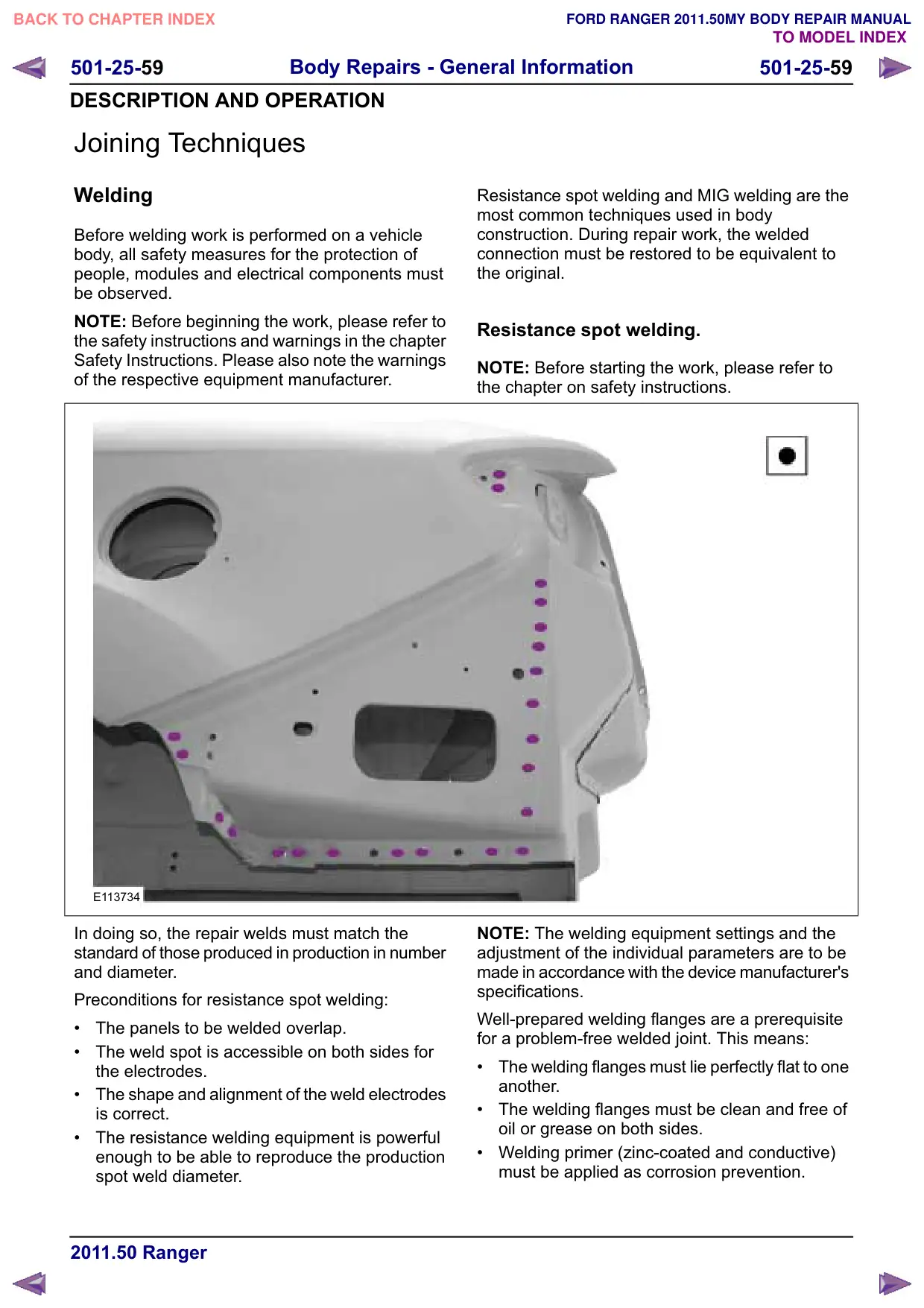
E113734
In doing so, the repair welds must match the
standard of those produced in production in number
and diameter.
Preconditions for resistance spot welding:
The panels to be welded overlap.
The weld spot is accessible on both sides for
the electrodes.
The shape and alignment of the weld electrodes
is correct.
The resistance welding equipment is powerful
enough to be able to reproduce the production
spot weld diameter.
Resistance spot welding and MIG welding are the
most common techniques used in body
construction. During repair work, the welded
connection must be restored to be equivalent to
the original.
Resistance spot welding.
NOTE: Before starting the work, please refer to
the chapter on safety instructions.
NOTE: The welding equipment settings and the
adjustment of the individual parameters are to be
made in accordance with the device manufacturer's
specifications.
Well-prepared welding flanges are a prerequisite
for a problem-free welded joint. This means:
The welding flanges must lie perfectly flat to one
another.
The welding flanges must be clean and free of
oil or grease on both sides.
Welding primer (zinc-coated and conductive)
must be applied as corrosion prevention.