Reparos em plástico
Plastic Repairs
Texto da página
Link desta página: https://ranger.mbrace.com.br/carroceria/311
Imagem: https://ranger.mbrace.com.br/img/carroceria/311.webp
501-25-53
Body Repairs - General Information
501-25-53
DESCRIPTION AND OPERATION
As with all other welding processes, only certain
material combinations can be joined together using
plastic welding.
NOTE: Basic and in-depth training is offered on
the following topics. You will find an overview of
the complete range listed in the Training brochure
published by the Ford Service Organization.
NOTE: The manufacturer's data must be taken into
account when choosing welding materials and the
correct temperature setting of the hot air gun.
Repair sequence during plastic welding:
To prepare the location for welding, remove
paint residues and sand the weld area.
If parts of the material have been pushed in by
an impact, the damaged area can be brought
back to shape by heating.
Drill out the ends of the split to stop it spreading
further. Machine the location of the weld into a
90° V-shaped groove, to accept the welding rod.
Lay the welding rod in the groove.
Perform the welding. Hot air draw welding or
hot air fanning welding.
Rework the weld seam. After cooling, sand the
raised weld seam.
Clean the sanded repair surface using plastic
cleaner. Apply plastic primer thinly to the repair
surface and paint it.
Despite good preparation and the correct choice
of welding materials, weld faults may occur.
The following points must be noted when welding
plastic:
Weld together like with like:
œ With very few exceptions, only the same
materials can be welded together, e.g. PP
with PP.
Correct temperature:
œ The correct choice of temperature is
important for the success of the repair. The
plastic must be warmed until it plasticizes
(dough-like, soft).
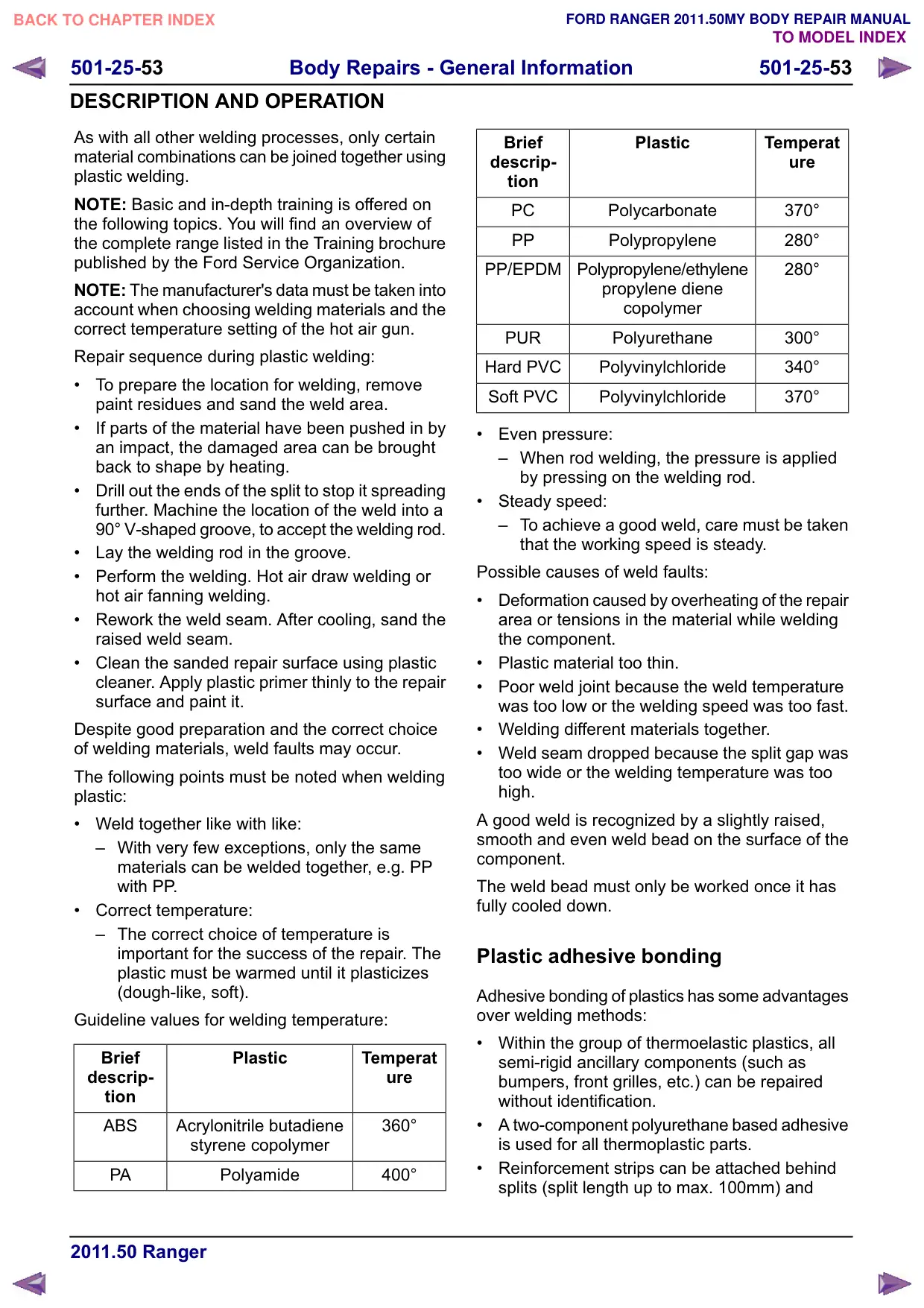
Guideline values for welding temperature:
Brief
Plastic
Temperat
descrip-
ure
WLRQ
ABS
Acrylonitrile butadiene
360°
styrene copolymer
PA
Polyamide
400°
Brief
Plastic
Temperat
descrip-
ure
WLRQ
3&
Polycarbonate
370°
33
Polypropylene
280°
PP/EPDM
Polypropylene/ethylene
280°
propylene diene
copolymer
385
Polyurethane
300°
Hard PVC
Polyvinylchloride
340°
Soft PVC
Polyvinylchloride
370°
Even pressure:
œ When rod welding, the pressure is applied
by pressing on the welding rod.
Steady speed:
œ To achieve a good weld, care must be taken
that the working speed is steady.
Possible causes of weld faults:
Deformation caused by overheating of the repair
area or tensions in the material while welding
the component.
Plastic material too thin.
Poor weld joint because the weld temperature
was too low or the welding speed was too fast.
Welding different materials together.
Weld seam dropped because the split gap was
too wide or the welding temperature was too
high.
A good weld is recognized by a slightly raised,
smooth and even weld bead on the surface of the
component.
The weld bead must only be worked once it has
fully cooled down.
Plastic adhesive bonding
Adhesive bonding of plastics has some advantages
over welding methods:
Within the group of thermoelastic plastics, all
semi-rigid ancillary components (such as
bumpers, front grilles, etc.) can be repaired
without identification.
A two-component polyurethane based adhesive
is used for all thermoplastic parts.
Reinforcement strips can be attached behind
splits (split length up to max. 100mm) and