Reparos em plástico
Plastic Repairs
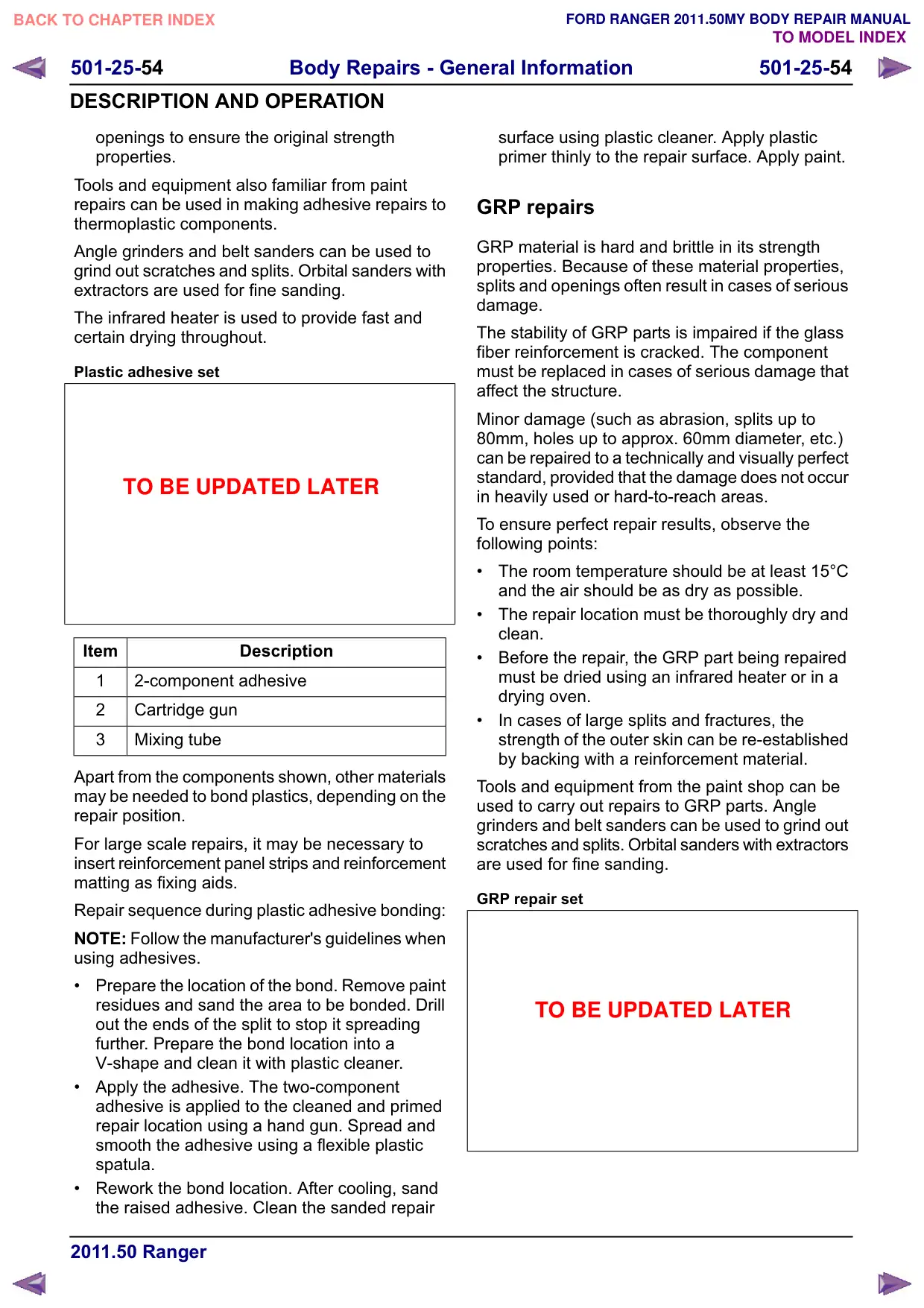
Texto da página
Link desta página: https://ranger.mbrace.com.br/carroceria/312
Imagem: https://ranger.mbrace.com.br/img/carroceria/312.webp
501-25-54
Body Repairs - General Information
501-25-54
DESCRIPTION AND OPERATION
openings to ensure the original strength
properties.
Tools and equipment also familiar from paint
repairs can be used in making adhesive repairs to
thermoplastic components.
Angle grinders and belt sanders can be used to
grind out scratches and splits. Orbital sanders with
extractors are used for fine sanding.
The infrared heater is used to provide fast and
certain drying throughout.
Plastic adhesive set
TO BE UPDATED LATER
Item
Description
1
2-component adhesive
2
Cartridge gun
3
Mixing tube
Apart from the components shown, other materials
may be needed to bond plastics, depending on the
repair position.
For large scale repairs, it may be necessary to
insert reinforcement panel strips and reinforcement
matting as fixing aids.
Repair sequence during plastic adhesive bonding:
NOTE: Follow the manufacturer's guidelines when
using adhesives.
Prepare the location of the bond. Remove paint
residues and sand the area to be bonded. Drill
out the ends of the split to stop it spreading
further. Prepare the bond location into a
V-shape and clean it with plastic cleaner.
Apply the adhesive. The two-component
adhesive is applied to the cleaned and primed
repair location using a hand gun. Spread and
smooth the adhesive using a flexible plastic
spatula.
Rework the bond location. After cooling, sand
the raised adhesive. Clean the sanded repair
surface using plastic cleaner. Apply plastic
primer thinly to the repair surface. Apply paint.
GRP repairs
GRP material is hard and brittle in its strength
properties. Because of these material properties,
splits and openings often result in cases of serious
damage.
The stability of GRP parts is impaired if the glass
fiber reinforcement is cracked. The component
must be replaced in cases of serious damage that
affect the structure.
Minor damage (such as abrasion, splits up to
80mm, holes up to approx. 60mm diameter, etc.)
can be repaired to a technically and visually perfect
standard, provided that the damage does not occur
in heavily used or hard-to-reach areas.
To ensure perfect repair results, observe the
following points:
The room temperature should be at least 15°C
and the air should be as dry as possible.
The repair location must be thoroughly dry and
clean.
Before the repair, the GRP part being repaired
must be dried using an infrared heater or in a
drying oven.
In cases of large splits and fractures, the
strength of the outer skin can be re-established
by backing with a reinforcement material.
Tools and equipment from the paint shop can be
used to carry out repairs to GRP parts. Angle
grinders and belt sanders can be used to grind out
scratches and splits. Orbital sanders with extractors
are used for fine sanding.
GRP repair set
TO BE UPDATED LATER