Reparos em plástico
Plastic Repairs
Texto da página
Link desta página: https://ranger.mbrace.com.br/carroceria/310
Imagem: https://ranger.mbrace.com.br/img/carroceria/310.webp
501-25-52
Body Repairs - General Information
501-25-52
DESCRIPTION AND OPERATION
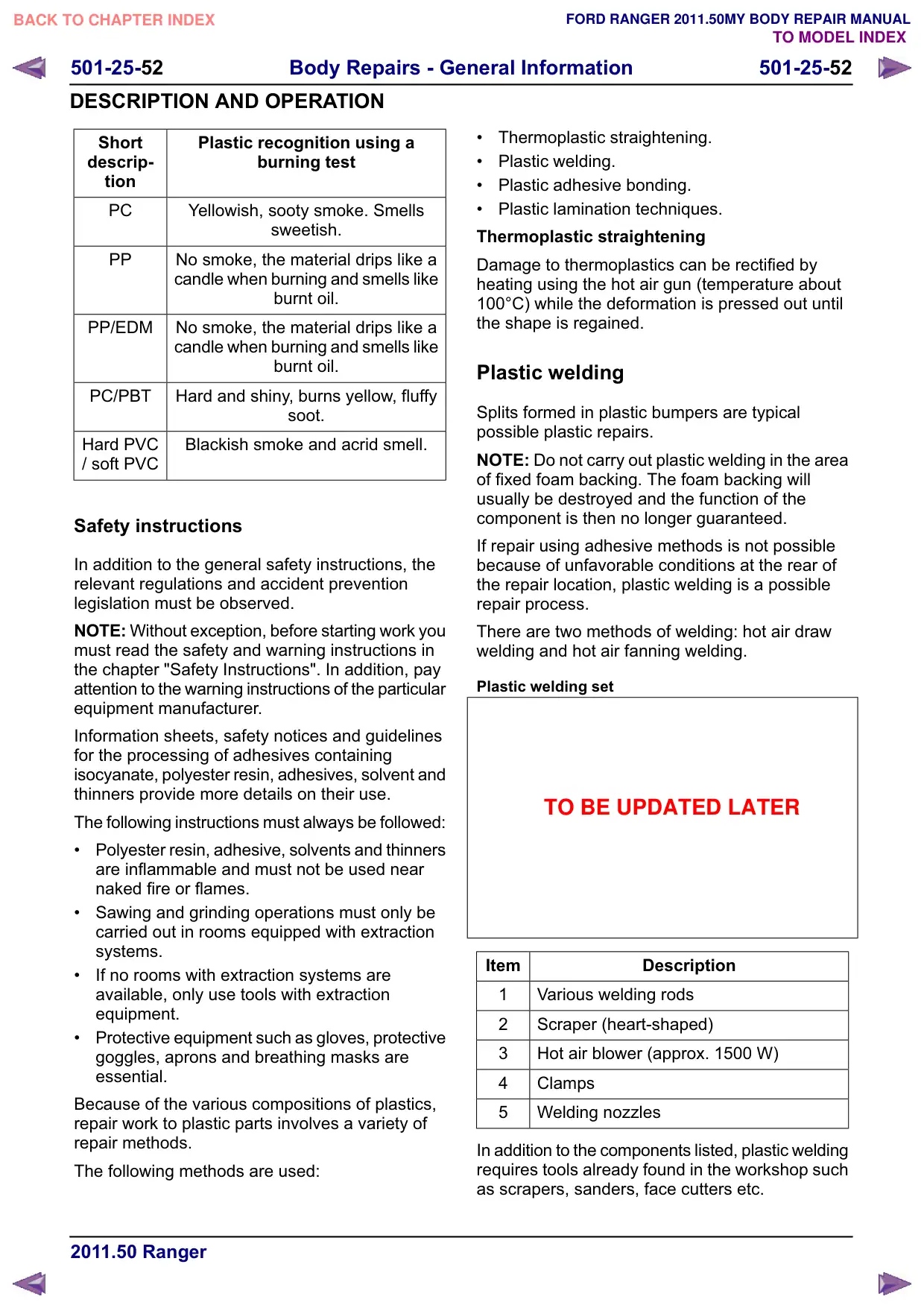
Short
Plastic recognition using a
descrip-
burning test
WLRQ
3&
Yellowish, sooty smoke. Smells
sweetish.
33
No smoke, the material drips like a
candle when burning and smells like
burnt oil.
PP/EDM
No smoke, the material drips like a
candle when burning and smells like
burnt oil.
PC/PBT
Hard and shiny, burns yellow, fluffy
soot.
Hard PVC
Blackish smoke and acrid smell.
/ soft PVC
Safety instructions
In addition to the general safety instructions, the
relevant regulations and accident prevention
legislation must be observed.
NOTE: Without exception, before starting work you
must read the safety and warning instructions in
the chapter "Safety Instructions". In addition, pay
attention to the warning instructions of the particular
equipment manufacturer.
Information sheets, safety notices and guidelines
for the processing of adhesives containing
isocyanate, polyester resin, adhesives, solvent and
thinners provide more details on their use.
The following instructions must always be followed:
Polyester resin, adhesive, solvents and thinners
are inflammable and must not be used near
naked fire or flames.
Sawing and grinding operations must only be
carried out in rooms equipped with extraction
systems.
If no rooms with extraction systems are
available, only use tools with extraction
equipment.
Protective equipment such as gloves, protective
goggles, aprons and breathing masks are
essential.
Because of the various compositions of plastics,
repair work to plastic parts involves a variety of
repair methods.
The following methods are used:
Thermoplastic straightening.
Plastic welding.
Plastic adhesive bonding.
Plastic lamination techniques.
Thermoplastic straightening
Damage to thermoplastics can be rectified by
heating using the hot air gun (temperature about
100°C) while the deformation is pressed out until
the shape is regained.
Plastic welding
Splits formed in plastic bumpers are typical
possible plastic repairs.
NOTE: Do not carry out plastic welding in the area
of fixed foam backing. The foam backing will
usually be destroyed and the function of the
component is then no longer guaranteed.
If repair using adhesive methods is not possible
because of unfavorable conditions at the rear of
the repair location, plastic welding is a possible
repair process.
There are two methods of welding: hot air draw
welding and hot air fanning welding.
Plastic welding set
TO BE UPDATED LATER
Item
Description
1
Various welding rods
2
Scraper (heart-shaped)
3
Hot air blower (approx. 1500 W)
4
Clamps
5
Welding nozzles
In addition to the components listed, plastic welding
requires tools already found in the workshop such
as scrapers, sanders, face cutters etc.