Defeitos e danos na pintura
Paintwork Defects and Damage
Texto da página
Link desta página: https://ranger.mbrace.com.br/carroceria/480
Imagem: https://ranger.mbrace.com.br/img/carroceria/480.webp
501-36-18
Paint - General Information
501-36-18
DESCRIPTION AND OPERATION
Cause/damage pattern:
The temperature and contact time are critical.
Splashes lead to loss of shine and lightening of
color.
TO BE UPDATED LATER
Repair of damage:
Flush immediately with plenty of water.
The swellings can often be made to recede
completely by treatment with the radiant heater
or in the paint drying oven at max. 60°C for
about 1 hour.
Mechanical damage
Stone impact damage or mechanical
damage
Mechanical damage caused by impact of stones
or other hard objects and extending down to the
metal panel lead very quickly to corrosion and
rusting under the paint on the adjoining surface.
Cause/damage pattern:
Paint damage caused from the outside, down
to filler, primer or metal panel.
TO BE UPDATED LATER
Repair of damage:
Sand or blast out.
Use anti-corrosion primer.
Apply top coat.
Damage due to corrosion
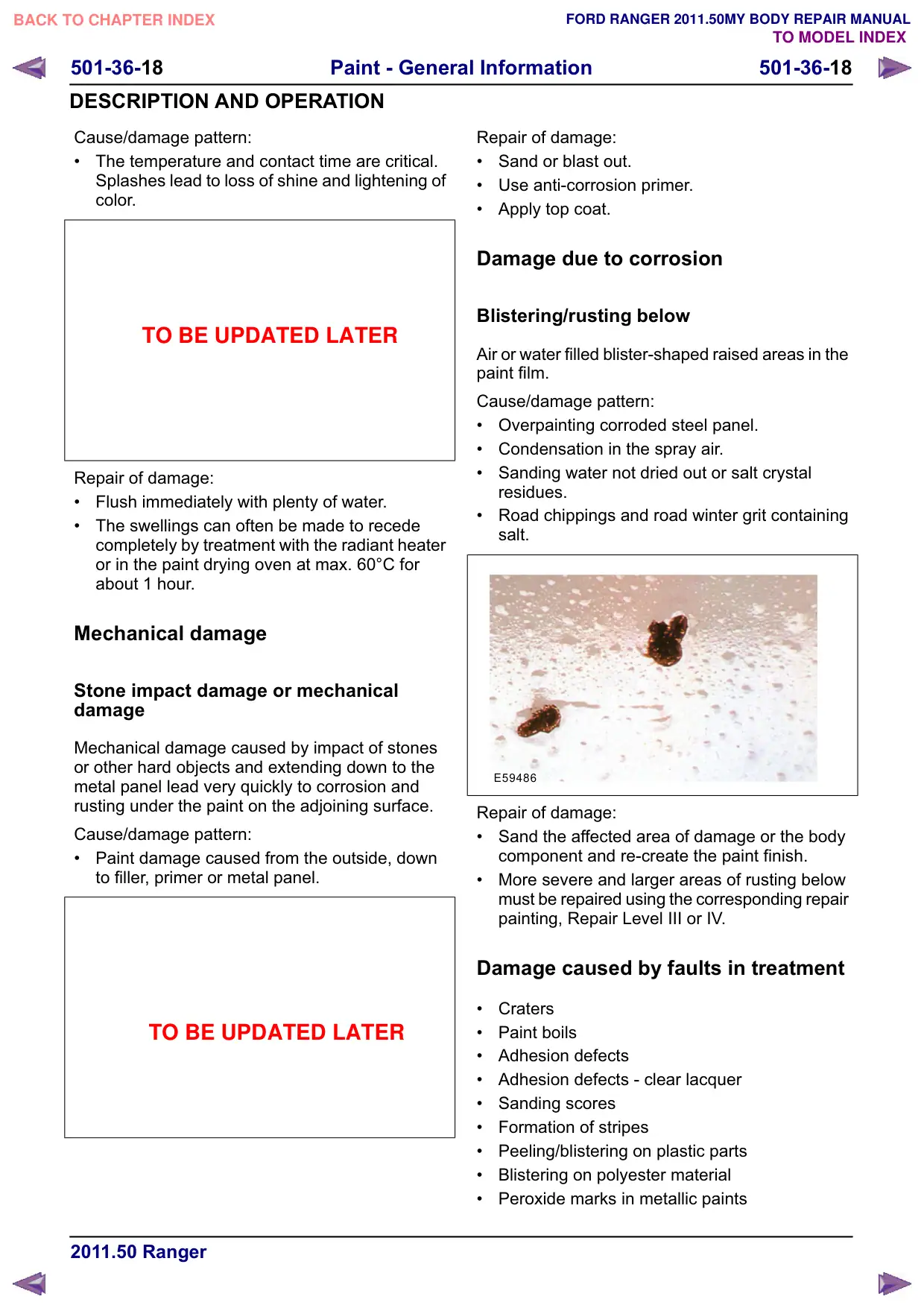
Blistering/rusting below
Air or water filled blister-shaped raised areas in the
paint film.
Cause/damage pattern:
Overpainting corroded steel panel.
Condensation in the spray air.
Sanding water not dried out or salt crystal
residues.
Road chippings and road winter grit containing
salt.
E59486
Repair of damage:
Sand the affected area of damage or the body
component and re-create the paint finish.
More severe and larger areas of rusting below
must be repaired using the corresponding repair
painting, Repair Level III or IV.
Damage caused by faults in treatment
Craters
Paint boils
Adhesion defects
Adhesion defects - clear lacquer
Sanding scores
Formation of stripes
Peeling/blistering on plastic parts
Blistering on polyester material
Peroxide marks in metallic paints