Defeitos e danos na pintura
Paintwork Defects and Damage
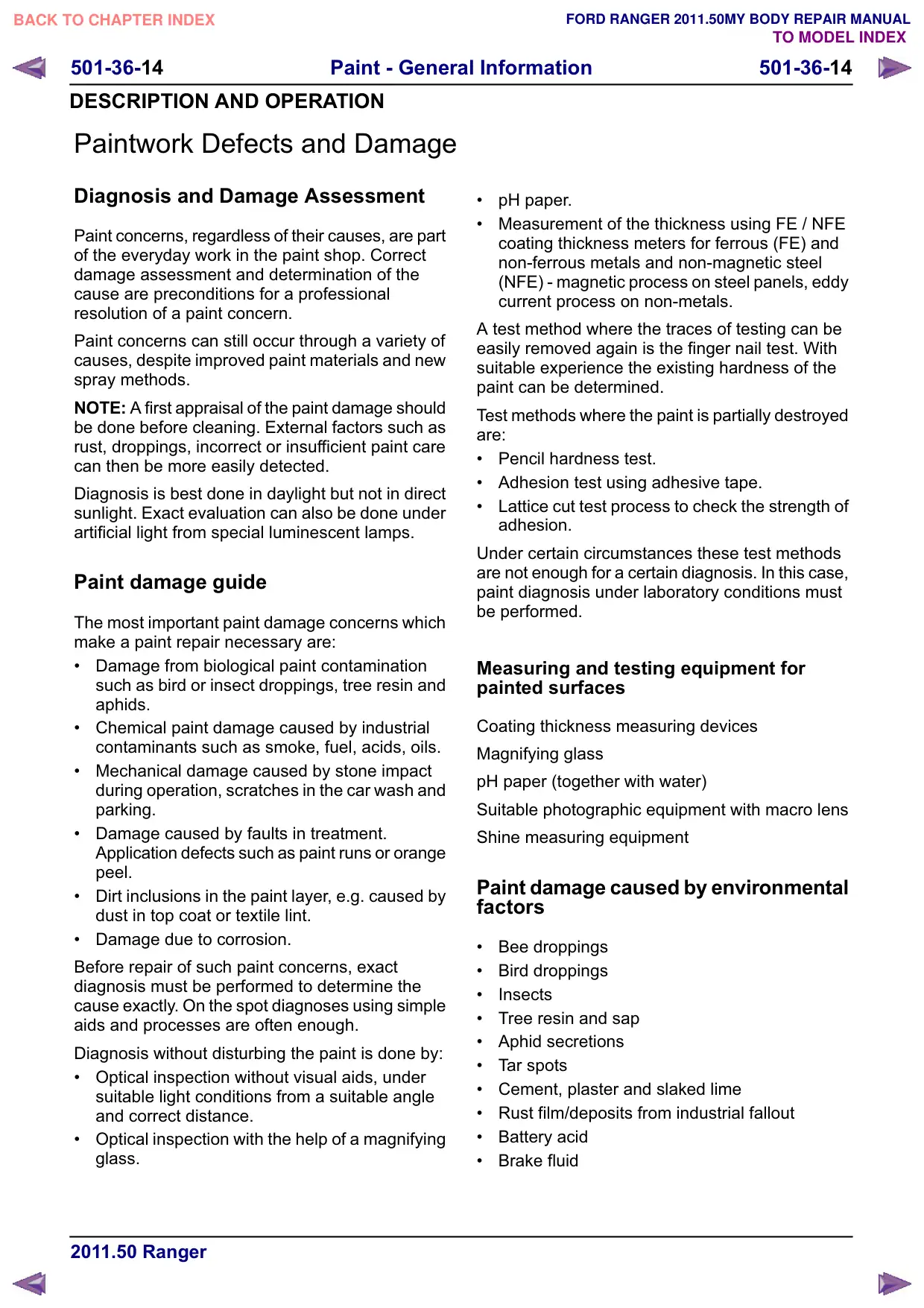
Texto da página
Link desta página: https://ranger.mbrace.com.br/carroceria/476
Imagem: https://ranger.mbrace.com.br/img/carroceria/476.webp
501-36-14
Paint - General Information
501-36-14
DESCRIPTION AND OPERATION
Paintwork Defects and Damage
Diagnosis and Damage Assessment
Paint concerns, regardless of their causes, are part
of the everyday work in the paint shop. Correct
damage assessment and determination of the
cause are preconditions for a professional
resolution of a paint concern.
Paint concerns can still occur through a variety of
causes, despite improved paint materials and new
spray methods.
NOTE: A first appraisal of the paint damage should
be done before cleaning. External factors such as
rust, droppings, incorrect or insufficient paint care
can then be more easily detected.
Diagnosis is best done in daylight but not in direct
sunlight. Exact evaluation can also be done under
artificial light from special luminescent lamps.
Paint damage guide
The most important paint damage concerns which
make a paint repair necessary are:
Damage from biological paint contamination
such as bird or insect droppings, tree resin and
aphids.
Chemical paint damage caused by industrial
contaminants such as smoke, fuel, acids, oils.
Mechanical damage caused by stone impact
during operation, scratches in the car wash and
parking.
Damage caused by faults in treatment.
Application defects such as paint runs or orange
peel.
Dirt inclusions in the paint layer, e.g. caused by
dust in top coat or textile lint.
Damage due to corrosion.
Before repair of such paint concerns, exact
diagnosis must be performed to determine the
cause exactly. On the spot diagnoses using simple
aids and processes are often enough.
Diagnosis without disturbing the paint is done by:
Optical inspection without visual aids, under
suitable light conditions from a suitable angle
and correct distance.
Optical inspection with the help of a magnifying
glass.
pH paper.
Measurement of the thickness using FE / NFE
coating thickness meters for ferrous (FE) and
non-ferrous metals and non-magnetic steel
(NFE) - magnetic process on steel panels, eddy
current process on non-metals.
A test method where the traces of testing can be
easily removed again is the finger nail test. With
suitable experience the existing hardness of the
paint can be determined.
Test methods where the paint is partially destroyed
are:
Pencil hardness test.
Adhesion test using adhesive tape.
Lattice cut test process to check the strength of
adhesion.
Under certain circumstances these test methods
are not enough for a certain diagnosis. In this case,
paint diagnosis under laboratory conditions must
be performed.
Measuring and testing equipment for
painted surfaces
Coating thickness measuring devices
Magnifying glass
pH paper (together with water)
Suitable photographic equipment with macro lens
Shine measuring equipment
Paint damage caused by environmental
factors
Bee droppings
Bird droppings
Insects
Tree resin and sap
Aphid secretions
Tar spots
Cement, plaster and slaked lime
Rust film/deposits from industrial fallout
Battery acid
Brake fluid