Ruído do vento
Wind Noise
Texto da página
Link desta página: https://ranger.mbrace.com.br/carroceria/341
Imagem: https://ranger.mbrace.com.br/img/carroceria/341.webp
501-25-83
Body Repairs - General Information
501-25-83
DESCRIPTION AND OPERATION
Test method
The test procedures given in the chapter Noise,
Vibration and Harshness can also be used to
diagnose wind noises.
Road tests
Wind noises can usually only be localized by road
tests
NOTE: There should always be two people present
during road tests to find noises. A driver who
reconstructs the situation causing the noise, and
a person to carry out the checks.
The following points should be taken into account
for such road tests:
Check that the tire pressure is correct.
Remove non-standard ancillary components
from the vehicle.
Choose a dry, flat road with as little traffic as
possible.
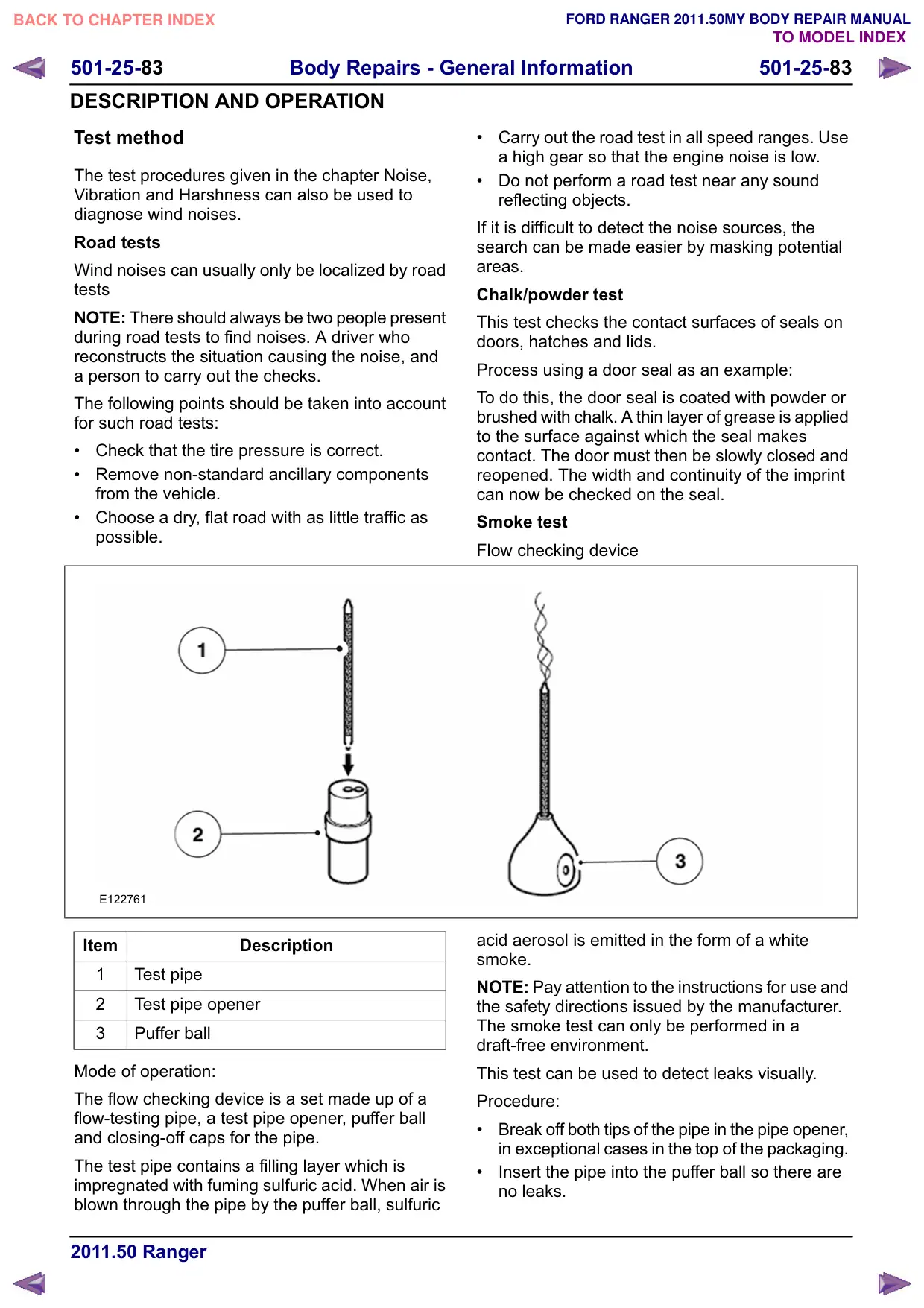
E122761
Item
Description
1
Test pipe
2
Test pipe opener
3
Puffer ball
Mode of operation:
The flow checking device is a set made up of a
flow-testing pipe, a test pipe opener, puffer ball
and closing-off caps for the pipe.
The test pipe contains a filling layer which is
impregnated with fuming sulfuric acid. When air is
blown through the pipe by the puffer ball, sulfuric
Carry out the road test in all speed ranges. Use
a high gear so that the engine noise is low.
Do not perform a road test near any sound
reflecting objects.
If it is difficult to detect the noise sources, the
search can be made easier by masking potential
areas.
Chalk/powder test
This test checks the contact surfaces of seals on
doors, hatches and lids.
Process using a door seal as an example:
To do this, the door seal is coated with powder or
brushed with chalk. A thin layer of grease is applied
to the surface against which the seal makes
contact. The door must then be slowly closed and
reopened. The width and continuity of the imprint
can now be checked on the seal.
Smoke test
Flow checking device
acid aerosol is emitted in the form of a white
smoke.
NOTE: Pay attention to the instructions for use and
the safety directions issued by the manufacturer.
The smoke test can only be performed in a
draft-free environment.
This test can be used to detect leaks visually.
Procedure:
Break off both tips of the pipe in the pipe opener,
in exceptional cases in the top of the packaging.
Insert the pipe into the puffer ball so there are
no leaks.