Ruído do vento
Wind Noise
Texto da página
Link desta página: https://ranger.mbrace.com.br/carroceria/340
Imagem: https://ranger.mbrace.com.br/img/carroceria/340.webp
501-25-82
Body Repairs - General Information
501-25-82
DESCRIPTION AND OPERATION
roof, doors and side windows. When the vehicle is
moving fast, air layers (turbulence) form, which
cause variations in air pressure. These variations
in air pressure spread in the form of sound waves
and are transferred to the vehicle interior via the
side windows and seals.
Noises caused by deviations in air flow and
circulation around separate components:
If air flows over an edge on a vehicle, the air flow
cannot follow the shape of the surface, but
separates at the edge. Eddies are formed, which
collapse again after a certain time or distance. The
associated fluctuations in air pressure create a
corresponding sound wave which is noticeable by
for instance a rushing noise at the A-pillar or the
outside mirror.
Turbulence and the associated radiation of noise
can also occur at the vehicle underbody. Air
circulation around small components and also flow
through small gaps (e.g. the radiator grille) cause
the rushing noise to change to a whistling, which
rises and becomes louder as the vehicle speed
increases.
Noises caused by vibrating seals:
Seals which do not make firm contact at the door
or window area can be made to vibrate by pressure
variations outside the vehicle, which in turn mean
noise radiating into the interior of the vehicle.
Noises caused by air flowing out:
Noises caused by air flowing out are created by
leaks at the vehicle interior sealing system, when
stationary air mixes with flowing air. As a result,
the noise increases as the speed of the air flowing
out increases. Example: Letting air out of a tire.
Cavity noises:
Cavity noises are those created when the air
volumes found in bodywork cavities are caused to
vibrate by an opening located in the airflow. The
frequency of the tone does not vary with the vehicle
speed but depends on the volume of the cavity and
the size of the opening. Example: Blowing across
the top of a bottle.
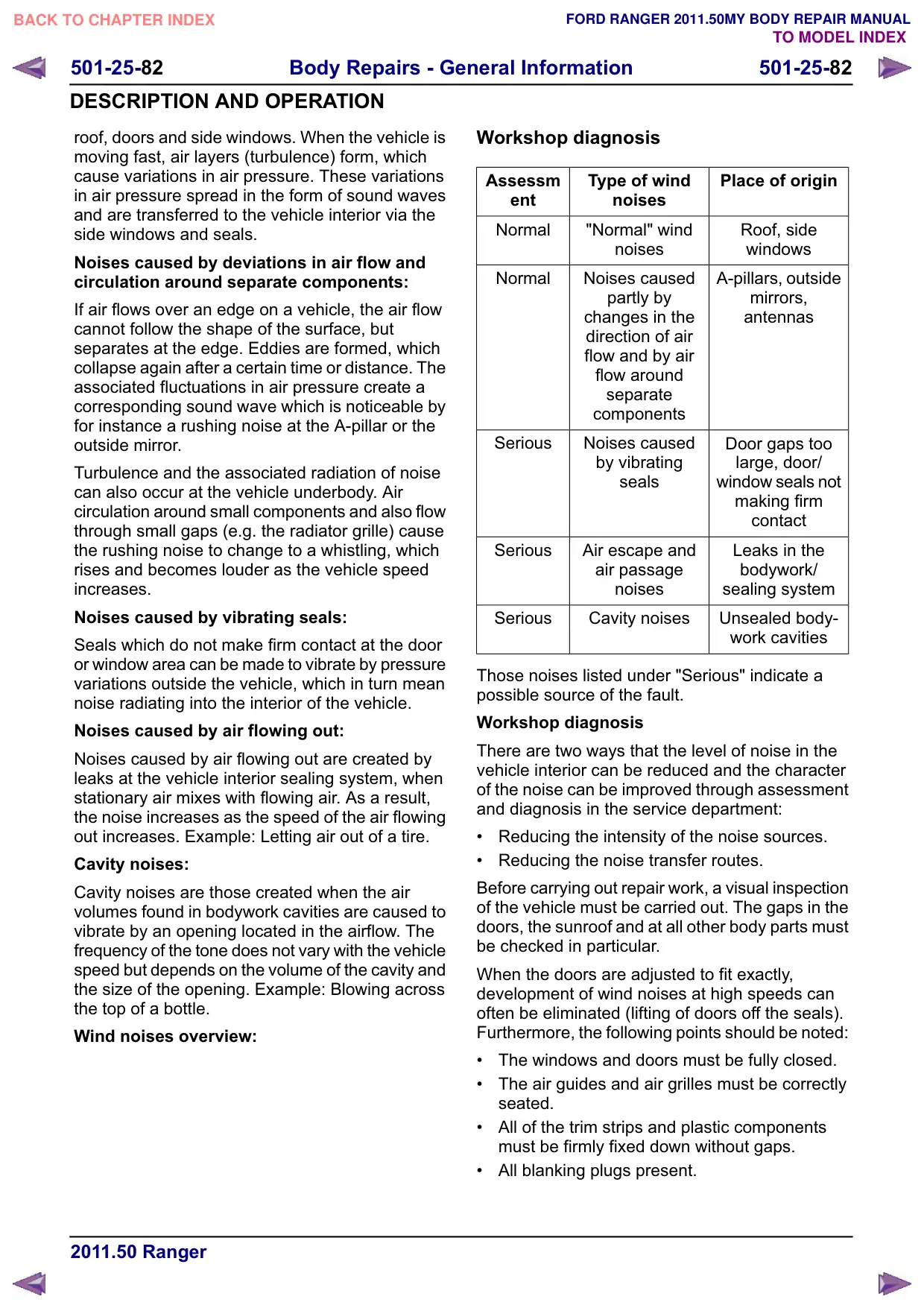
Wind noises overview:
Workshop diagnosis
Assessm
Type of wind
Place of origin
HQW
noises
Normal
"Normal" wind
Roof, side
noises
windows
Normal
Noises caused
A-pillars, outside
partly by
mirrors,
changes in the
antennas
direction of air
flow and by air
flow around
separate
components
Serious
Noises caused
Door gaps too
by vibrating
large, door/
seals
window seals not
making firm
contact
Serious
Air escape and
Leaks in the
air passage
bodywork/
noises
sealing system
Serious
Cavity noises
Unsealed body-
work cavities
Those noises listed under "Serious" indicate a
possible source of the fault.
Workshop diagnosis
There are two ways that the level of noise in the
vehicle interior can be reduced and the character
of the noise can be improved through assessment
and diagnosis in the service department:
Reducing the intensity of the noise sources.
Reducing the noise transfer routes.
Before carrying out repair work, a visual inspection
of the vehicle must be carried out. The gaps in the
doors, the sunroof and at all other body parts must
be checked in particular.
When the doors are adjusted to fit exactly,
development of wind noises at high speeds can
often be eliminated (lifting of doors off the seals).
Furthermore, the following points should be noted:
The windows and doors must be fully closed.
The air guides and air grilles must be correctly
seated.
All of the trim strips and plastic components
must be firmly fixed down without gaps.
All blanking plugs present.