Vazamentos de água
Water Leaks
Texto da página
Link desta página: https://ranger.mbrace.com.br/carroceria/332
Imagem: https://ranger.mbrace.com.br/img/carroceria/332.webp
501-25-74
Body Repairs - General Information
501-25-74
DESCRIPTION AND OPERATION
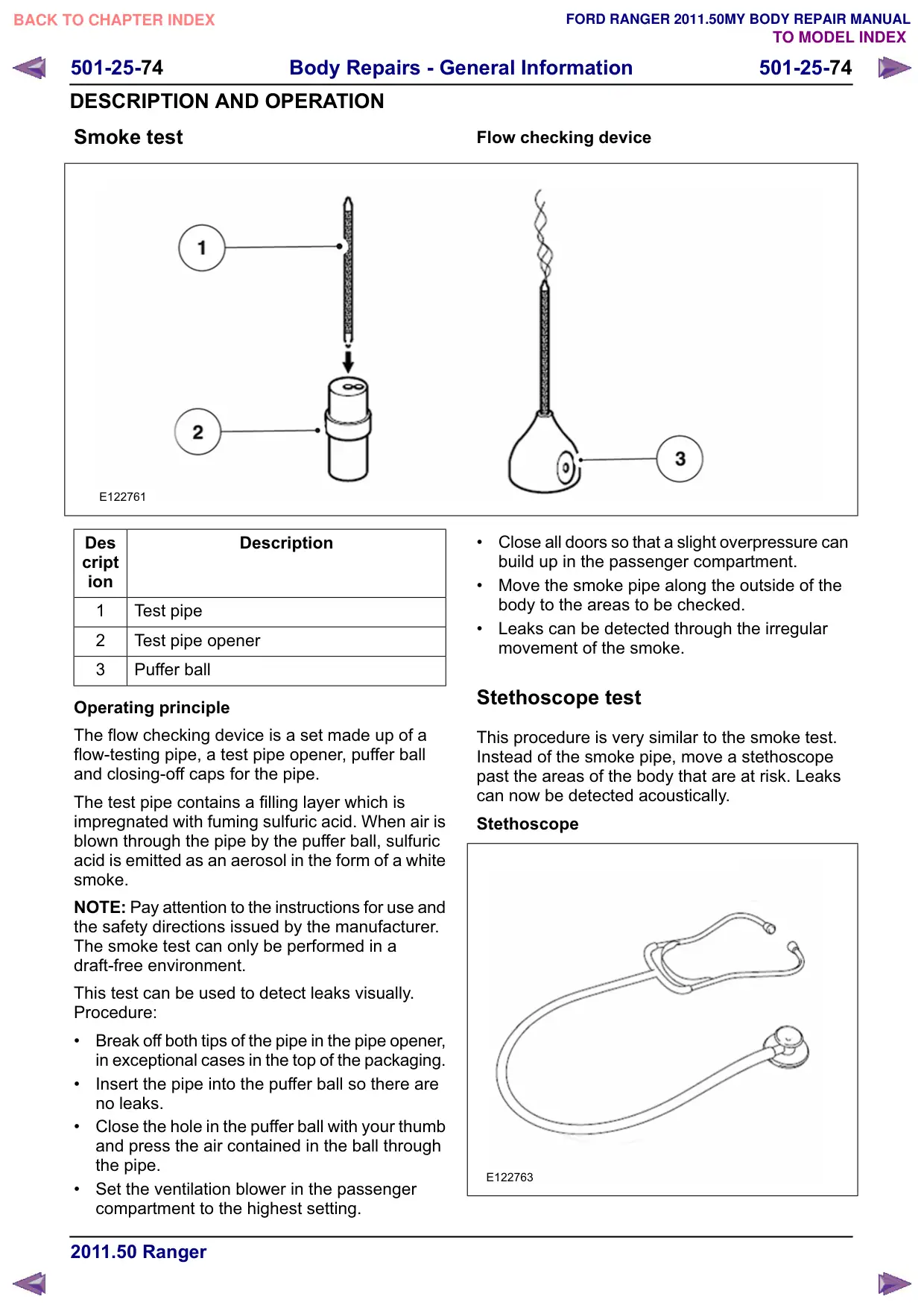
Smoke test
E122761
Des
Description
FULSW
ion
1
Test pipe
2
Test pipe opener
3
Puffer ball
Operating principle
The flow checking device is a set made up of a
flow-testing pipe, a test pipe opener, puffer ball
and closing-off caps for the pipe.
The test pipe contains a filling layer which is
impregnated with fuming sulfuric acid. When air is
blown through the pipe by the puffer ball, sulfuric
acid is emitted as an aerosol in the form of a white
smoke.
NOTE: Pay attention to the instructions for use and
the safety directions issued by the manufacturer.
The smoke test can only be performed in a
draft-free environment.
This test can be used to detect leaks visually.
Procedure:
Break off both tips of the pipe in the pipe opener,
in exceptional cases in the top of the packaging.
Insert the pipe into the puffer ball so there are
no leaks.
Close the hole in the puffer ball with your thumb
and press the air contained in the ball through
the pipe.
Set the ventilation blower in the passenger
compartment to the highest setting.
Flow checking device
Close all doors so that a slight overpressure can
build up in the passenger compartment.
Move the smoke pipe along the outside of the
body to the areas to be checked.
Leaks can be detected through the irregular
movement of the smoke.
Stethoscope test
This procedure is very similar to the smoke test.
Instead of the smoke pipe, move a stethoscope
past the areas of the body that are at risk. Leaks
can now be detected acoustically.
Stethoscope
E122763