Vazamentos de água
Water Leaks
Texto da página
Link desta página: https://ranger.mbrace.com.br/carroceria/331
Imagem: https://ranger.mbrace.com.br/img/carroceria/331.webp
501-25-73
Body Repairs - General Information
501-25-73
DESCRIPTION AND OPERATION
0.5 m
0.5 m
E105337
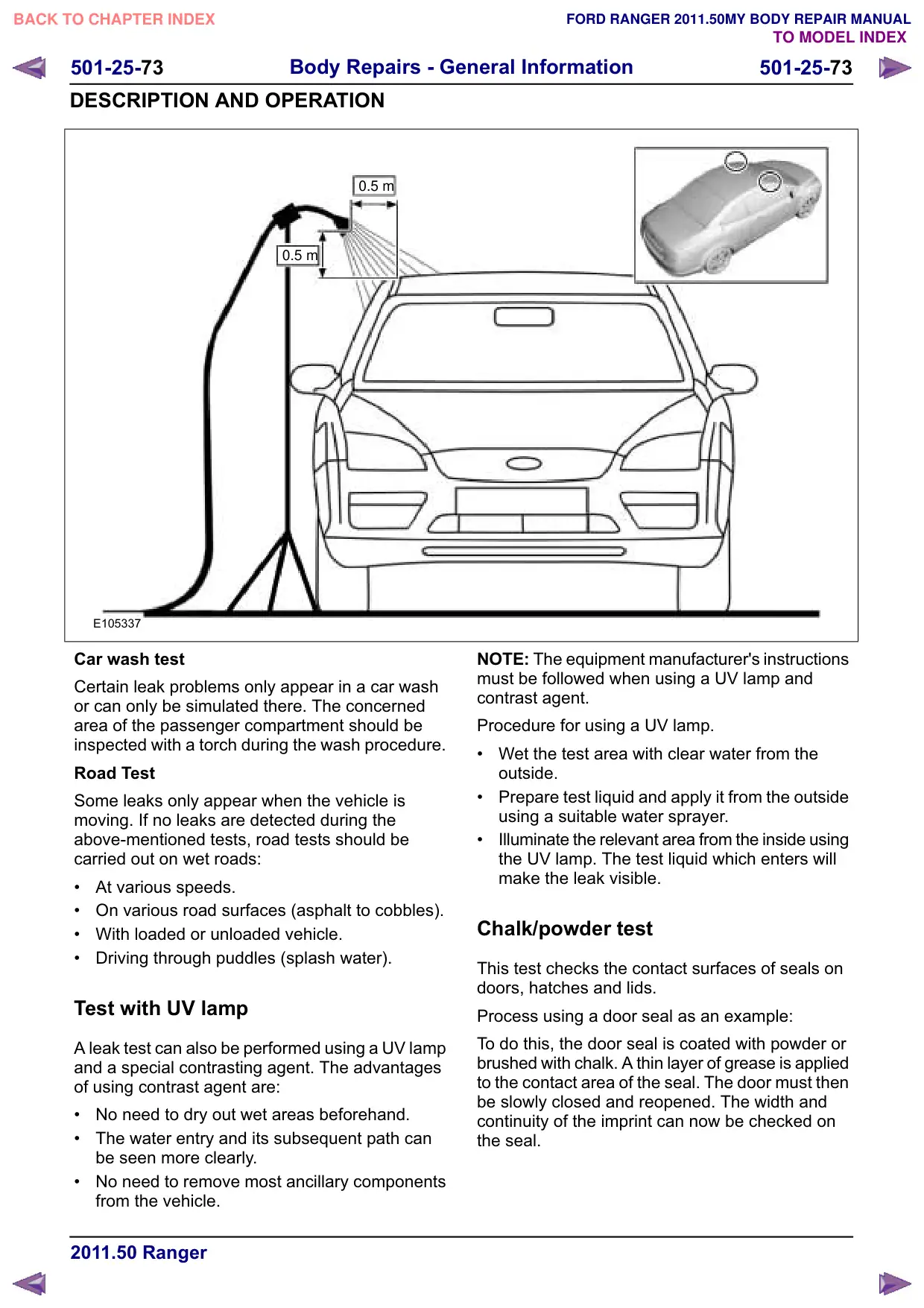
Car wash test
Certain leak problems only appear in a car wash
or can only be simulated there. The concerned
area of the passenger compartment should be
inspected with a torch during the wash procedure.
Road Test
Some leaks only appear when the vehicle is
moving. If no leaks are detected during the
above-mentioned tests, road tests should be
carried out on wet roads:
At various speeds.
On various road surfaces (asphalt to cobbles).
With loaded or unloaded vehicle.
Driving through puddles (splash water).
Test with UV lamp
A leak test can also be performed using a UV lamp
and a special contrasting agent. The advantages
of using contrast agent are:
No need to dry out wet areas beforehand.
The water entry and its subsequent path can
be seen more clearly.
No need to remove most ancillary components
from the vehicle.
NOTE: The equipment manufacturer's instructions
must be followed when using a UV lamp and
contrast agent.
Procedure for using a UV lamp.
Wet the test area with clear water from the
outside.
Prepare test liquid and apply it from the outside
using a suitable water sprayer.
Illuminate the relevant area from the inside using
the UV lamp. The test liquid which enters will
make the leak visible.
Chalk/powder test
This test checks the contact surfaces of seals on
doors, hatches and lids.
Process using a door seal as an example:
To do this, the door seal is coated with powder or
brushed with chalk. A thin layer of grease is applied
to the contact area of the seal. The door must then
be slowly closed and reopened. The width and
continuity of the imprint can now be checked on
the seal.