Chapas da carroceria
Body Sheet Metal
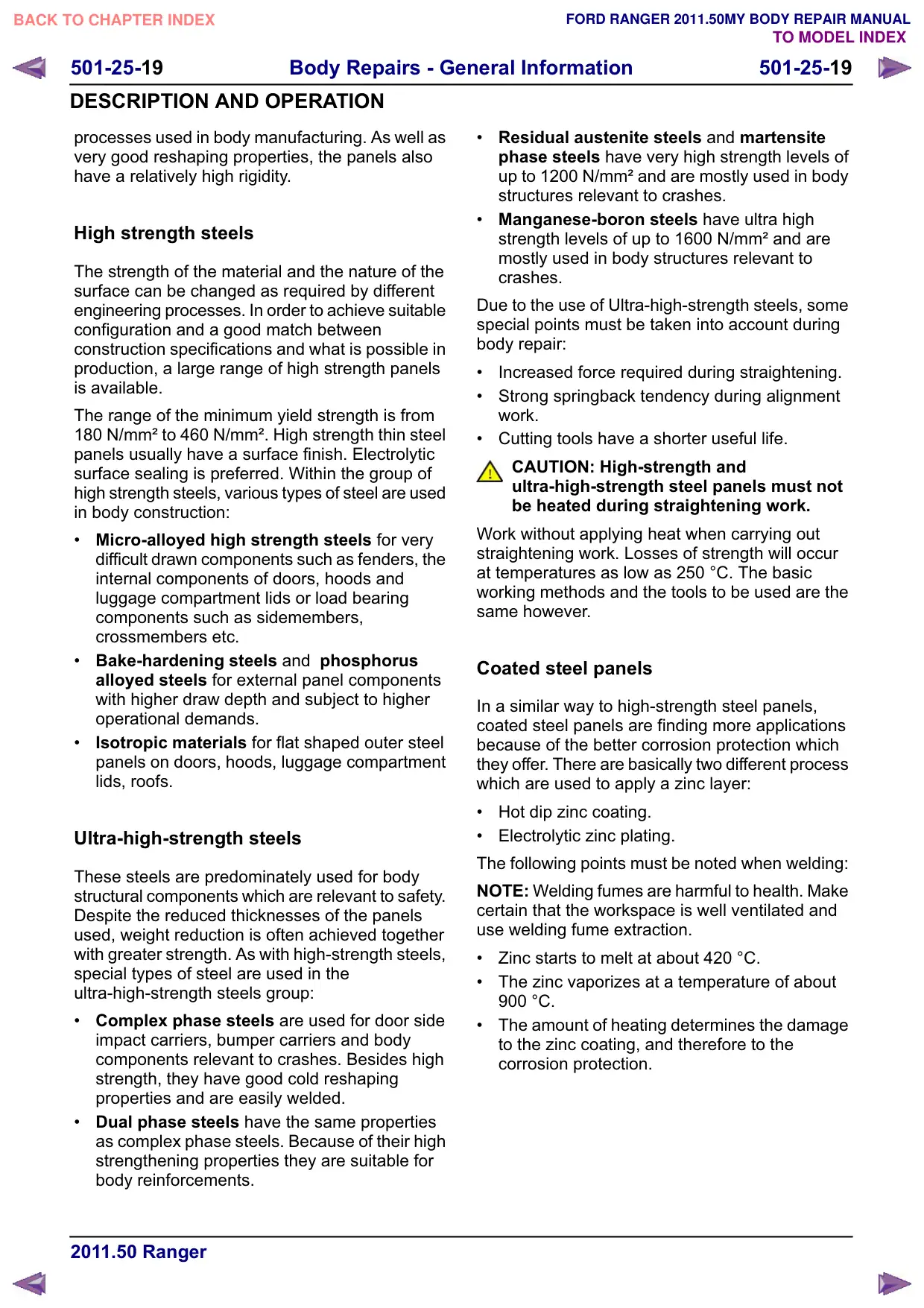
Texto da página
Link desta página: https://ranger.mbrace.com.br/carroceria/277
Imagem: https://ranger.mbrace.com.br/img/carroceria/277.webp
501-25-19
Body Repairs - General Information
501-25-19
DESCRIPTION AND OPERATION
processes used in body manufacturing. As well as
very good reshaping properties, the panels also
have a relatively high rigidity.
High strength steels
The strength of the material and the nature of the
surface can be changed as required by different
engineering processes. In order to achieve suitable
configuration and a good match between
construction specifications and what is possible in
production, a large range of high strength panels
is available.
The range of the minimum yield strength is from
180 N/mm× to 460 N/mm×. High strength thin steel
panels usually have a surface finish. Electrolytic
surface sealing is preferred. Within the group of
high strength steels, various types of steel are used
in body construction:
Micro-alloyed high strength steels for very
difficult drawn components such as fenders, the
internal components of doors, hoods and
luggage compartment lids or load bearing
components such as sidemembers,
crossmembers etc.
Bake-hardening steels and phosphorus
alloyed steels for external panel components
with higher draw depth and subject to higher
operational demands.
Isotropic materials for flat shaped outer steel
panels on doors, hoods, luggage compartment
lids, roofs.
Ultra-high-strength steels
These steels are predominately used for body
structural components which are relevant to safety.
Despite the reduced thicknesses of the panels
used, weight reduction is often achieved together
with greater strength. As with high-strength steels,
special types of steel are used in the
ultra-high-strength steels group:
Complex phase steels are used for door side
impact carriers, bumper carriers and body
components relevant to crashes. Besides high
strength, they have good cold reshaping
properties and are easily welded.
Dual phase steels have the same properties
as complex phase steels. Because of their high
strengthening properties they are suitable for
body reinforcements.
Residual austenite steels and martensite
phase steels have very high strength levels of
up to 1200 N/mm× and are mostly used in body
structures relevant to crashes.
Manganese-boron steels have ultra high
strength levels of up to 1600 N/mm× and are
mostly used in body structures relevant to
crashes.
Due to the use of Ultra-high-strength steels, some
special points must be taken into account during
body repair:
Increased force required during straightening.
Strong springback tendency during alignment
work.
Cutting tools have a shorter useful life.
CAUTION: High-strength and
ultra-high-strength steel panels must not
be heated during straightening work.
Work without applying heat when carrying out
straightening work. Losses of strength will occur
at temperatures as low as 250 °C. The basic
working methods and the tools to be used are the
same however.
Coated steel panels
In a similar way to high-strength steel panels,
coated steel panels are finding more applications
because of the better corrosion protection which
they offer. There are basically two different process
which are used to apply a zinc layer:
Hot dip zinc coating.
Electrolytic zinc plating.
The following points must be noted when welding:
NOTE: Welding fumes are harmful to health. Make
certain that the workspace is well ventilated and
use welding fume extraction.
Zinc starts to melt at about 420 °C.
The zinc vaporizes at a temperature of about
900 °C.
The amount of heating determines the damage
to the zinc coating, and therefore to the
corrosion protection.