General Information
100-00-16
100-00-16
DESCRIPTION AND OPERATION
Symbols Glossary
Symbols are used inside the graphics and in the
text area to enhance the information display.
E88969
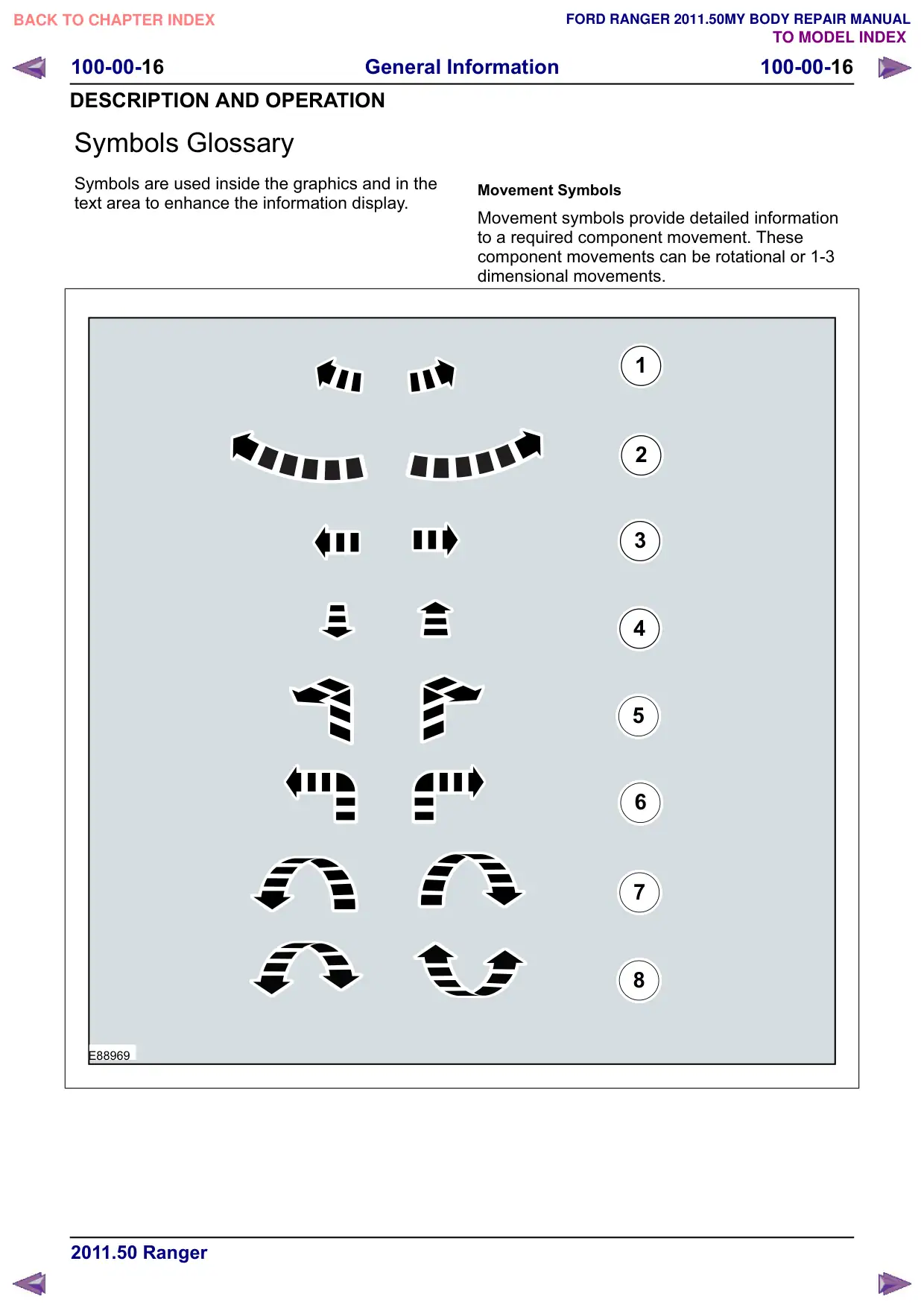
Movement Symbols
Movement symbols provide detailed information
to a required component movement. These
component movements can be rotational or 1-3
dimensional movements.
1
2
3
4
5
6
7
8
General Information
100-00-17
100-00-17
DESCRIPTION AND OPERATION
Item
Description
1
Minor component movement
clockwise/counterclockwise
2
Major component movement
clockwise/counterclockwise
3
Component movement to the
left/right/up/down
4
Component movement towards/away
5
3 dimensional component movement
1
3
5
7
E88970
Item
Description
6
2 dimensional component movement
7
3 dimensional component rotation
8
3 dimensional component cycling
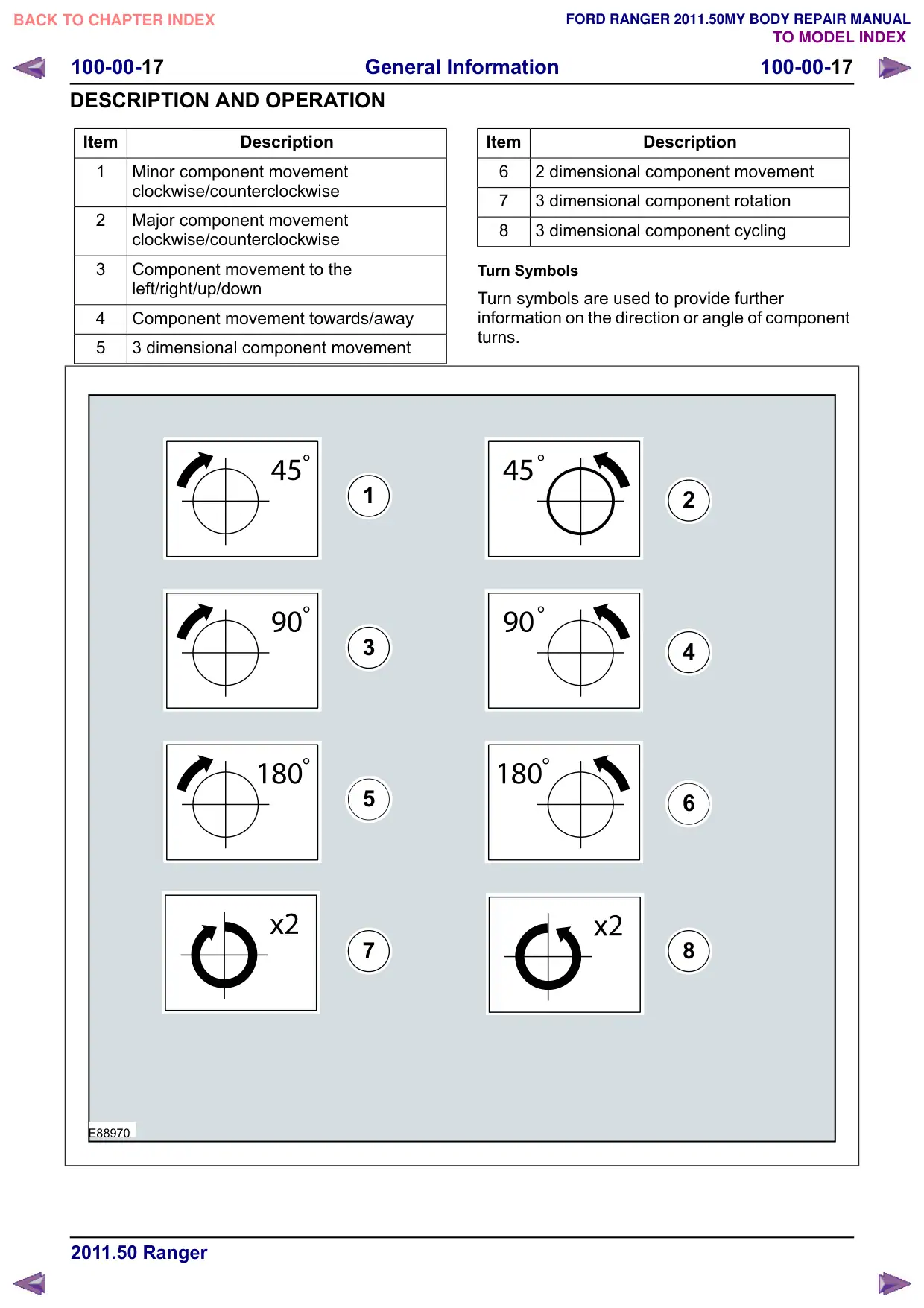
Turn Symbols
Turn symbols are used to provide further
information on the direction or angle of component
turns.
2
4
6
8
General Information
100-00-18
100-00-18
DESCRIPTION AND OPERATION
Item
Description
1
Turn the component clockwise through
45°
2
Turn the component counterclockwise
through 45°
3
Turn the component clockwise through
90°
4
Turn the component counterclockwise
through 90°
5
Turn the component clockwise through
180°
1
4
7
E123751
Item
Description
6
Turn the component counterclockwise
through 180°
7
Turn the component clockwise through 2
complete turns
8
Turn the component counterclockwise
through 2 complete turns
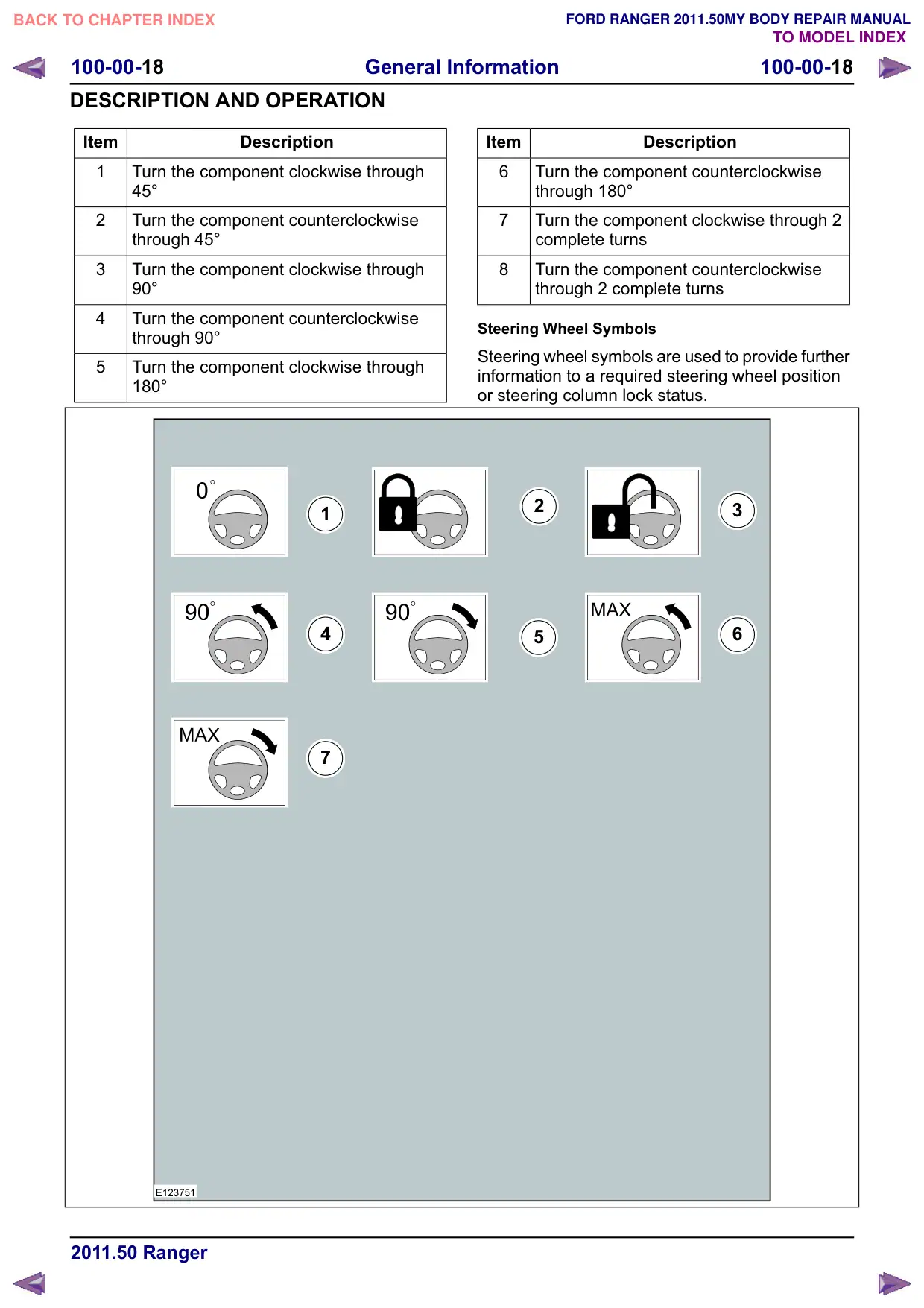
Steering Wheel Symbols
Steering wheel symbols are used to provide further
information to a required steering wheel position
or steering column lock status.
2
3
6
5
General Information
100-00-19
100-00-19
DESCRIPTION AND OPERATION
Item
Description
1
Steering wheel in straight ahead position
2
Steering column lock locked
3
Steering column lock unlocked
4
Turn the steering wheel to the 90° left
position
1
3
5
7
11
E88971
Item
Description
1
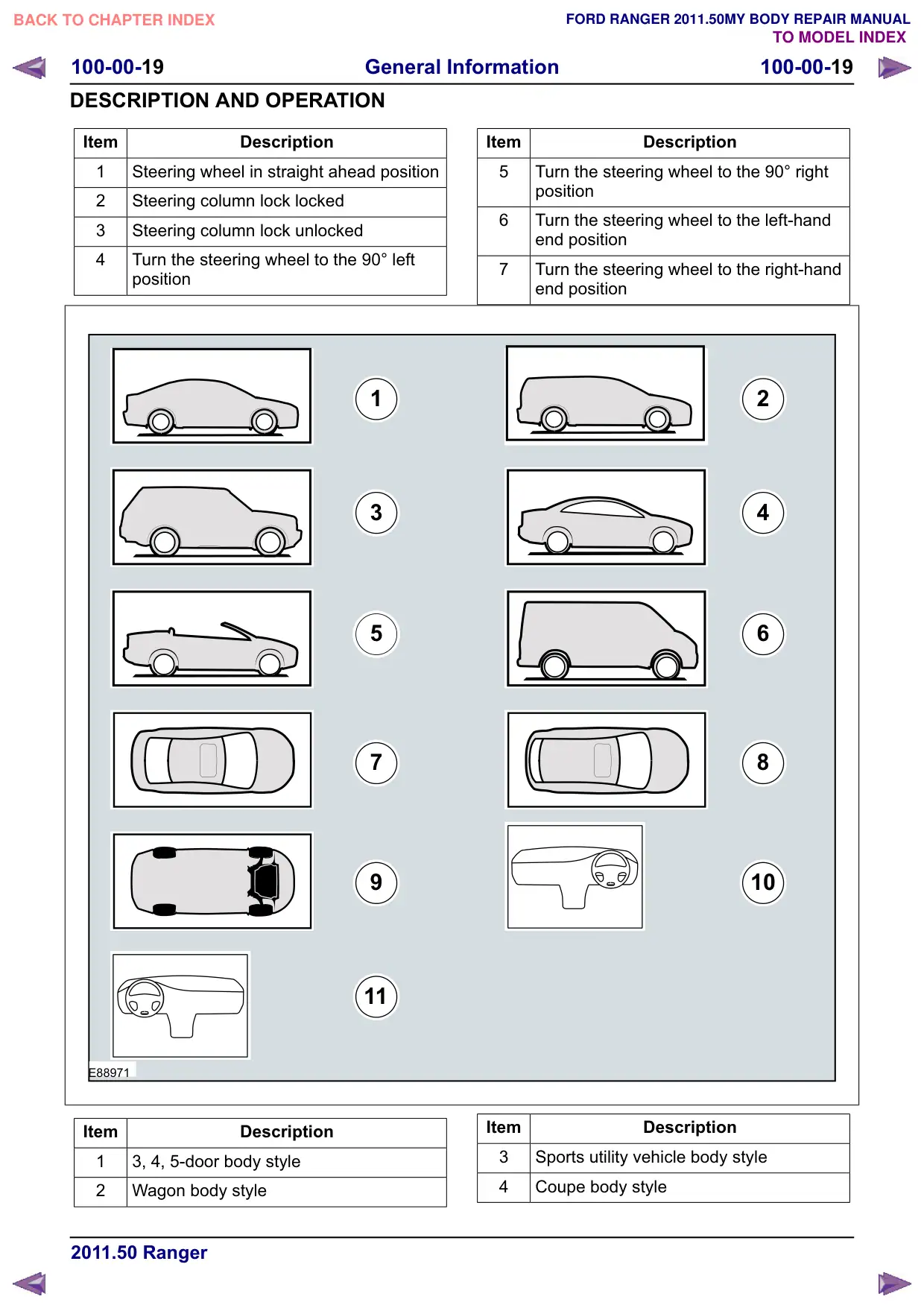
3, 4, 5-door body style
2
Wagon body style
Item
Description
5
Turn the steering wheel to the 90° right
position
6
Turn the steering wheel to the left-hand
end position
7
Turn the steering wheel to the right-hand
end position
2
4
6
8
10
Item
Description
3
Sports utility vehicle body style
4
Coupe body style
General Information
100-00-20
100-00-20
DESCRIPTION AND OPERATION
Item
Description
5
Convertible body style
6
Van body style
7
3, 4, 5-door body style - Top View
8
Wagon body style - Top View
Underview
1
4
7
E88972
Item
Description
10
Right-hand drive (RHD) vehicle
11
Left-hand drive (LHD) vehicle
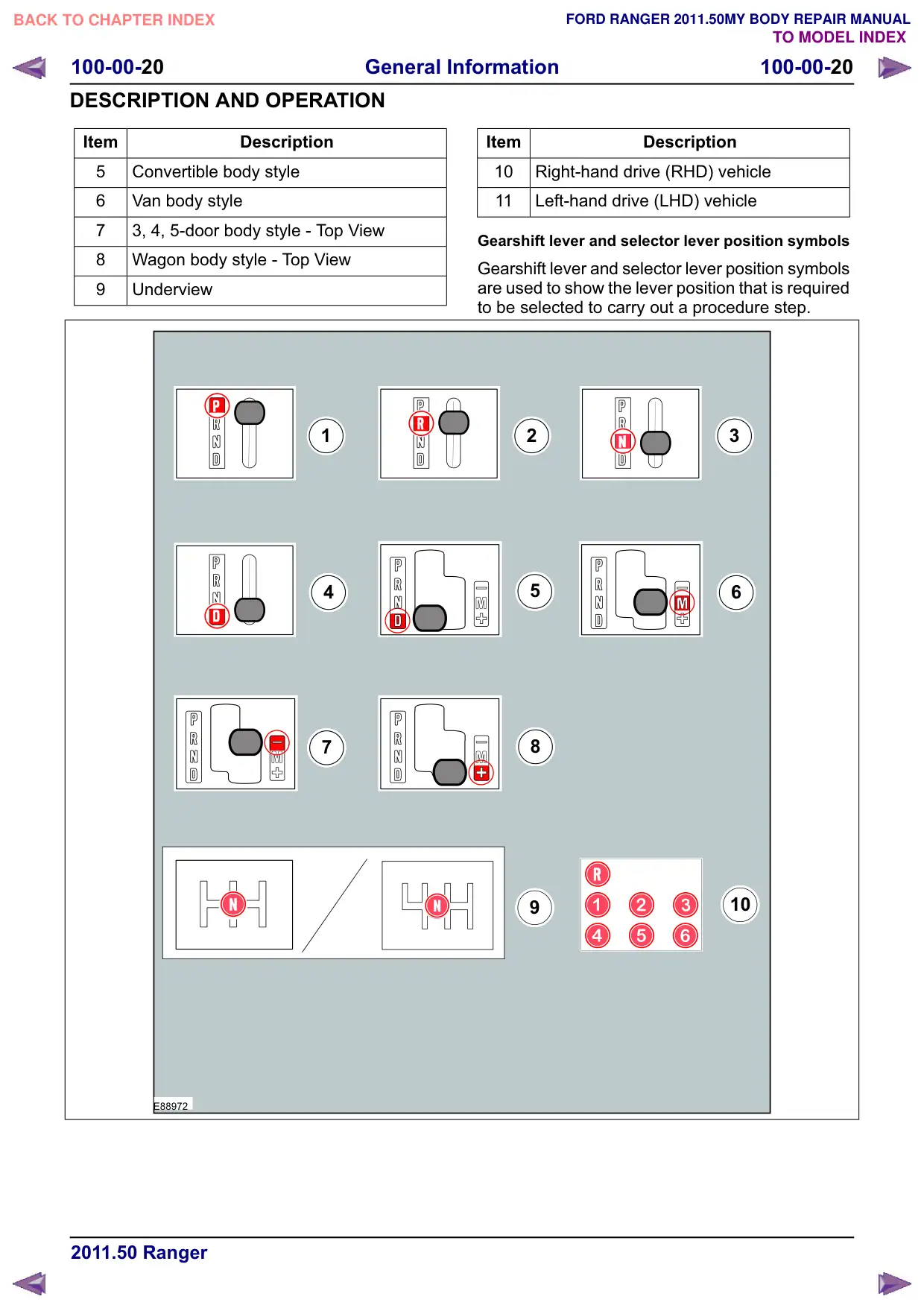
Gearshift lever and selector lever position symbols
Gearshift lever and selector lever position symbols
are used to show the lever position that is required
to be selected to carry out a procedure step.
2
3
5
6
8
10
General Information
100-00-21
100-00-21
DESCRIPTION AND OPERATION
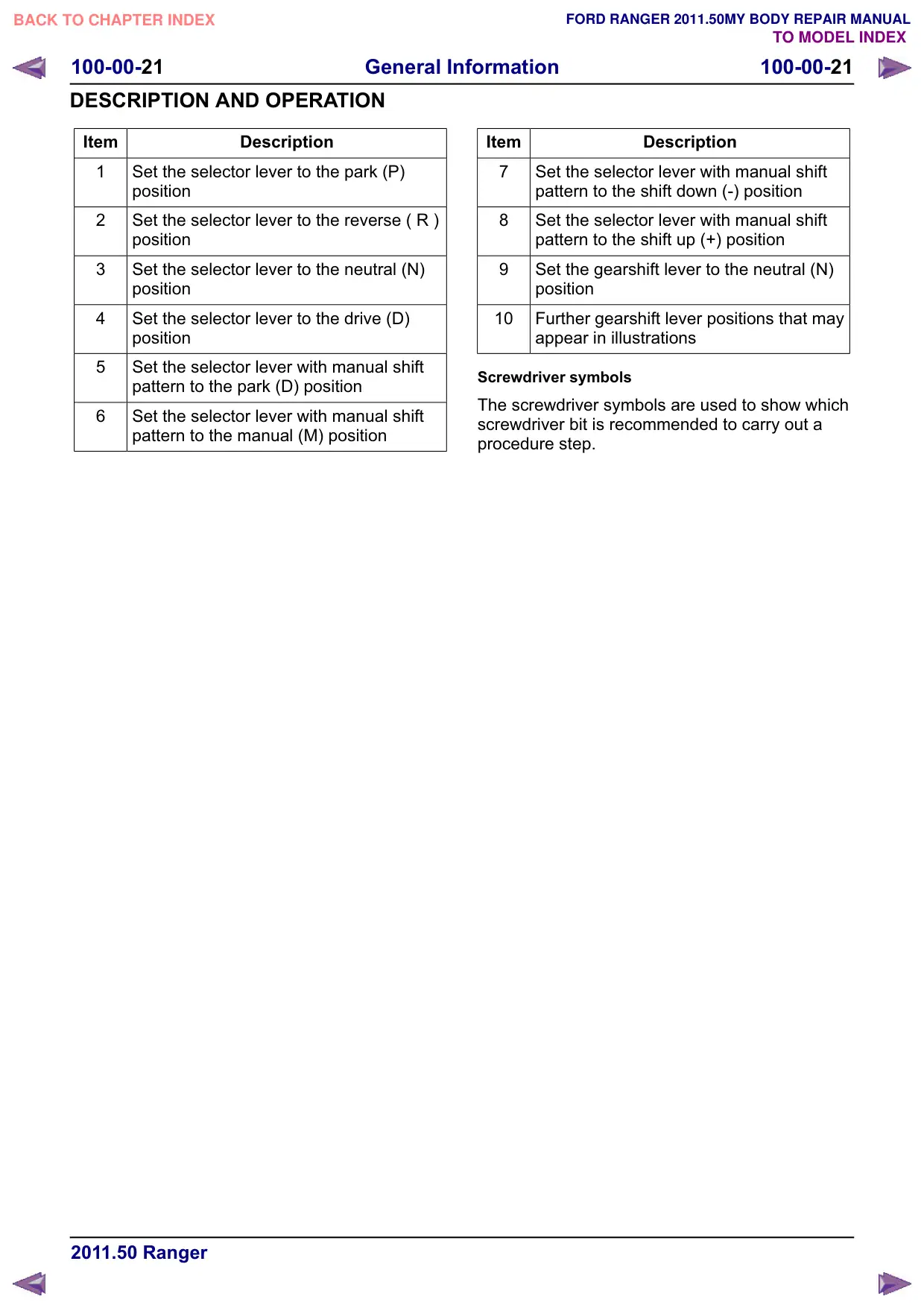
Item
Description
1
Set the selector lever to the park (P)
position
2
Set the selector lever to the reverse ( R )
position
3
Set the selector lever to the neutral (N)
position
4
Set the selector lever to the drive (D)
position
5
Set the selector lever with manual shift
pattern to the park (D) position
6
Set the selector lever with manual shift
pattern to the manual (M) position
Item
Description
7
Set the selector lever with manual shift
pattern to the shift down (-) position
8
Set the selector lever with manual shift
pattern to the shift up (+) position
Set the gearshift lever to the neutral (N)
position
10
Further gearshift lever positions that may
appear in illustrations
Screwdriver symbols
The screwdriver symbols are used to show which
screwdriver bit is recommended to carry out a
procedure step.
General Information
100-00-38
100-00-38
DESCRIPTION AND OPERATION
Health and Safety Precautions
Introduction
Many of the procedures associated with vehicle
maintenance and repair involve physical hazards
or other risks to health. This subsection lists,
alphabetically, some of these hazardous operations
and the materials and equipment associated with
them. Precautions necessary to avoid these
hazards are identified.
The list is not exhaustive and all operations and
procedures, and the handling of materials, should
be carried out with health and safety in mind.
Before using any product the Materials Safety Data
Sheet supplied by the manufacturer or supplier
should be consulted.
Acids and Alkalis
See also Battery Acids.
For example caustic soda, sulphuric acid.
Used in batteries and cleaning materials.
Irritant and corrosive to the skin, eyes, nose and
throat. Cause burns. Can destroy ordinary
protective clothing.
Avoid splashes to the skin, eyes and clothing. Wear
suitable protective impervious apron, gloves and
goggles. Do not breath mists.
Make sure access to eye wash bottles, shower and
soap are readily available for splashing accidents.
Display Eye Hazard sign.
Air Bags
See also Fire, Chemical Materials.
Highly flammable, explosive œ observe No Smoking
policy.
Used as a safety restraint system mounted in the
steering wheel and passenger side of the
instrument panel.
The inflator contains a high-energetic propellant
which, when ignited, produces a VERY HOT GAS
(2500°C).
The gas generant used in air bags is Sodium Azide.
This material is hermetically sealed in the module
and is completely consumed during deployment.
No attempt should be made to open an air bag
inflator as this will lead to the risk of exposure to
Sodium Azide. If a gas generator is ruptured, full
protective clothing should be worn when dealing
with the spillage.
After normal deployment, gloves and safety
goggles must be worn during the handling process.
Deployed air bags should be disposed of in a
plastic bag in accordance with local regulations at
an approved chemical waste site.
Following any direct contact with gas generant.
œ wash affected areas thoroughly with water.
œ seek medical assistance if necessary.
Air Bags - Do's
œ Do store modules in an upright position.
œ Do keep modules dry.
œ Do carry modules with the cover side pointing
away from the body.
œ Do place modules with their cover side upwards.
œ Do carefully inspect modules for damage.
œ Do stand to one side when connecting modules.
œ Do make sure all test equipment is properly
calibrated and maintained.
œ Do wash hands after handling deployed air
bags.
Air Bags - Do Nots
œ Do not store highly flammable material together
with modules or gas generators.
œ Do not store gas generators at temperatures
exceeding 80°C.
œ Do not store modules upside down.
œ Do not attempt to open a gas generator housing.
œ Do not expose gas generators to open flame or
sources of heat.
œ Do not place anything on top of a module cover.
œ Do not use damaged modules.
œ Do not touch a fired module or gas generator
for at least 10 minutes.
œ Do not use any electrical probes on the wiring
circuit.
Air Conditioning Refrigerant
See also Chlorofluorocarbon, Chemical Materials
Highly flammable, combustible œ observe No
Smoking policy.
General Information
100-00-39
100-00-39
DESCRIPTION AND OPERATION
Skin contact may result in frostbite.
Instructions given by the manufacturer must be
followed. Avoid naked lights, wear suitable
protective gloves and goggles.
If refrigerant comes into contact with the skin or
eyes, immediately rinse the affected areas with
water. Eyes should also be rinsed with an
appropriate irrigation solution and should not be
rubbed. SEEK MEDICAL ASSISTANCE IF
NECESSARY.
Air Conditioning Refrigerant - Do Nots
œ Do not expose refrigerant bottles to sunlight or
heat.
œ Do not stand refrigerant bottles upright; when
filling, hold them with the valve downwards.
œ Do not expose refrigerant bottles to frost.
œ Do not drop refrigerant bottles.
œ Do not vent refrigerant to atmosphere under any
circumstance.
œ Do not mix refrigerants, for example R12 (Freon)
and R134a.
Adhesives and Sealers
See also Fire, Chemical Materials.
Highly flammable, flammable, combustible œ
observe No Smoking policy.
Generally should be stored in No Smoking areas.
Cleanliness and tidiness in use should be
observed, for example disposable paper covering
benches; should be dispensed from applicators
where possible; containers, including secondary
containers, should be labeled appropriately.
Solvent-based Adhesives/Sealers - See
Solvents
Follow manufacturers instructions.
Water-based Adhesives/Sealers
Those based on polymer emulsions and rubber
latexes may contain small amounts of volatile toxic
and harmful chemicals. Skin and eye contact
should be avoided and adequate ventilation
provided during use.
Hot Melt Adhesives
In the solid state, they are safe. In the molten state
they may cause burns and health hazards may
arise from the inhalation of toxic fumes.
Use appropriate protective clothing and a
thermostatically controlled heater with a thermal
cut-out and adequate extraction.
Resin-based Adhesives/Sealers, for
example Epoxide and Formaldehyde
Resin-based
Mixing should be carried out in well ventilated
areas, as harmful or toxic volatile chemicals may
be released.
Skin contact with uncured resins and hardeners
can result in irritation, dermatitis, and absorption
of toxic or harmful chemicals through the skin.
Splashes can damage the eyes.
Provide adequate ventilation and avoid skin and
eye contact.
Anaerobic, Cyanoacrylate (super-glues)
and other Acrylic Adhesives
Many are irritant, sensitizing or harmful to the skin
and respiratory tract. Some are eye irritants.
Skin and eye contact should be avoided and the
manufacturers instructions followed.
Cyanoacrylate adhesives (super-glues) MUST NOT
contact the skin or eyes. If skin or eye tissue is
bonded, cover with a clean moist pad and SEEK
IMMEDIATE MEDICAL ATTENTION. Do not
attempt to pull tissue apart. Use in well ventilated
areas as vapors can cause irritation to the nose
and eyes.
For two-pack systems see Resin-based and
Isocyanate Adhesives/Sealers.
Isocyanate (Polyurethane)
Adhesives/Sealers
See also Resin-based Adhesives.
Individuals suffering from asthma or respiratory
allergies should not work with or near these
materials as sensitivity reactions can occur.
Over exposure is irritating to the eyes and
respiratory system. Excessive concentrations may
produce effects on the nervous system including
General Information
100-00-40
100-00-40
DESCRIPTION AND OPERATION
drowsiness. In extreme cases, loss of
consciousness may result. Long term exposure to
vapor concentrations may result in adverse health
effects.
Prolonged contact with the skin may have a
defatting effect which may lead to skin irritation
and in some cases, dermatitis.
Splashes entering the eye will cause discomfort
and possible damage.
Any spraying should preferably be carried out in
exhaust ventilated booths, removing vapors and
spray droplets from the breathing zone.
Wear appropriate gloves, eye and respiratory
protection.
Antifreeze
See also Fire, Solvents.
For example isopropanol, ethylene glycol,
methanol.
Highly flammable, flammable, combustible.
Used in vehicle coolant systems, brake air pressure
systems, screenwash solutions.
Vapors may be given off from coolant antifreeze
(glycol) when heated. Avoid breathing these
vapors.
Antifreeze may be absorbed through the skin in
toxic or harmful quantities. Antifreeze, if swallowed,
can be fatal and MEDICAL ATTENTION SHOULD
BE SOUGHT IMMEDIATELY.
These products must not be used in any cooling
or industrial water system that is connected or
linked to general, food preparation or drinking water
supplies.
Asbestos
See also Warning Symbols on Vehicles at the end
of this subsection.
Breathing asbestos dust may cause lung damage
or, in some cases, cancer.
Used in brake and clutch linings, transmission
brake bands and gaskets.
The use of drum cleaning units, vacuum cleaning
or damp wiping is preferred.
Asbestos dust waste should be dampened, placed
in a sealed container and marked for safe disposal.
If any cutting or drilling is attempted on materials
containing asbestos the item should be dampened
and only hand tools or low speed power tools used.
Battery Acids
See also Acids and Alkalis.
Gases released during charging are explosive.
Never use naked flames or allow sparks near
charging or recently charged batteries.
Make sure there is adequate ventilation.
Brake and Clutch Linings and Pads
See Asbestos.
Brake Fluids (Polyalkylene Glycols)
See also Fire.
Splashes to the skin and eyes are slightly irritating.
Avoid skin and eye contact as far as possible.
Inhalation vapor hazards do not arise at ambient
temperatures because of the very low vapor
pressure.
Brazing
See Welding.
Chemical Materials
See also Legal Aspects.
Chemical materials such as solvents, sealers,
adhesives, paints, resin foams, battery acids,
antifreeze, brake fluids, fuels, oils and grease
should always be used with caution and stored and
handled with care. They may be toxic, harmful,
corrosive, irritant or highly flammable and give rise
to hazardous fumes and dusts.
The effects of excessive exposure to chemicals
may be immediate or delayed; briefly experienced
or permanent; cumulative; superficial; life
threatening; or may reduce life expectancy.
Chemical Materials - Do's
œ Do carefully read and observe hazard and
precaution warnings given on material
containers (labels) and in any accompanying
leaflets, posters or other instructions. Material
General Information
100-00-41
100-00-41
DESCRIPTION AND OPERATION
health and safety data sheets can be obtained
from manufacturers.
œ Do remove chemical materials from the skin
and clothing as soon as practicable after soiling.
Change heavily soiled clothing and have it
cleaned.
œ Do organize work practices and protective
clothing to avoid soiling of the skin and eyes;
breathing vapors, aerosols, dusts or fumes;
inadequate container labeling; fire and explosion
hazards.
œ Do wash before job breaks, before eating,
smoking, drinking or using toilet facilities when
handling chemical materials.
œ Do keep work areas clean, uncluttered and free
of spills.
œ Do store chemical materials according to
national and local regulations.
œ Do keep chemical materials out of the reach of
children.
Chemical Materials - Do Nots
œ Do not mix chemical materials except under the
manufacturers instructions; some chemicals can
form other toxic or harmful chemicals, give off
toxic or harmful fumes or become explosive
when mixed together.
œ Do not spray chemical materials, particularly
those based on solvents, in confined spaces,
for example when people are inside a vehicle.
œ Do not apply heat or flame to chemical materials
except under the manufacturers instructions.
Some are highly flammable and some may
release toxic or harmful fumes.
œ Do not leave containers open. Fumes given off
can build up to toxic, harmful or explosive
concentrations. Some fumes are heavier than
air and will accumulate in confined areas such
as pits.
œ Do not transfer chemical materials to unlabelled
containers.
œ Do not clean hands or clothing with chemicals.
Chemicals, particularly solvents and fuels, will
dry the skin and may cause irritation leading to
dermatitis or be absorbed through the skin in
toxic or harmful quantities.
œ Do not use emptied containers for other
materials except when they have been cleaned
under supervised conditions.
œ Do not sniff or smell chemical materials. Brief
exposure to high concentrations of fumes can
be toxic or harmful.
Chlorofluorocarbons (CFC)
There is concern in the scientific community that
CFCs and Halons are depleting the upper ozone
layer which filters out harmful ultraviolet radiation.
Decreased filtration of ultraviolet radiation may
result in increases in skin cancer, cataracts and
immune system suppression in humans, as well
as decreased productivity of crops and aquatic
systems.
CFCs are used primarily as refrigerants in vehicle
air conditioning systems and as aerosol
propellants. Halons are used as fire extinguishants.
Clutch Fluids
See Brake fluids.
Clutch Linings and Pads
See Asbestos.
Corrosion Protection Materials
See also Solvents, Fire.
Highly flammable, flammable œ observe No
Smoking policy.
These materials are varied and the manufacturers
instructions must be followed. They may contain
solvents, resins or petroleum products. Skin and
eye contact should be avoided. They should only
be sprayed in conditions of adequate ventilation
and not in confined spaces.
Cutting
See Welding.
Dewaxing
See Solvents and Fuels (Kerosene).
General Information
100-00-42
100-00-42
DESCRIPTION AND OPERATION
Dusts
Powder, dusts or clouds may be irritant, harmful
or toxic. Avoid breathing dusts from powdery
chemical materials or those arising from dry
abrasion operations. Wear respiratory protection
if ventilation is inadequate.
Fine dusts of combustible material can present an
explosion hazard. Avoid explosive limits and
sources of ignition.
Electric Shock
Electric shock can result from the use of faulty
electrical equipment or from the misuse of
equipment in good condition.
Make sure that electrical equipment is maintained
in good condition and frequently tested. Faulty
equipment should be labeled and preferably
removed from the workstation.
Make sure that flexes, cables, plugs and sockets
are not frayed, kinked, cut, cracked or otherwise
damaged.
Make sure that electrical equipment and flexes do
not come into contact with water.
Make sure that electrical equipment is protected
by the correct rated fuse.
Never misuse electrical equipment and never use
equipment that is in any way faulty. The results
could be fatal.
Make sure that the cables of mobile electrical
equipment cannot get trapped and damaged, such
as in a vehicle hoist.
Make sure that the designated electrical workers
are trained in basic First Aid.
In cases of electrocution:
œ switch off the power supply before approaching
the victim.
œ if this is not possible push or drag the victim
from the source of electricity using dry
non-conductive material.
œ commence resuscitation if trained to do so.
œ SUMMON MEDICAL ASSISTANCE.
Engine Oils
See Lubricants and Grease.
Exhaust Fumes
These contain asphyxiating, harmful and toxic
chemicals and particles such as carbon oxides,
nitrogen oxides, aldehydes, lead and aromatic
hydrocarbons. Engines should be run only under
conditions of adequate exhaust extraction or
general ventilation and not in confined spaces.
Gasoline (petrol) engine
There may not be adequate warning of odor or of
irritation before toxic or harmful effects arise. These
may be immediate or delayed.
Diesel engine
Soot, discomfort and irritation usually give
adequate warning of hazardous fume
concentrations.
Fibre Insulation
See also Dusts.
Used in noise and sound insulation.
The fibrous nature of surfaces and cut edges can
cause skin irritation. This is usually a physical and
not a chemical effect.
Precautions should be taken to avoid excessive
skin contact through careful organization of work
practices and the use of gloves.
Fire
See also Welding, Foams, Legal Aspects.
Many of the materials found on or associated with
the repair of vehicles are highly flammable. Some
give off toxic or harmful fumes if burnt.
Observe strict fire safety when storing and handling
flammable materials or solvents, particularly near
electrical equipment or welding processes.
Make sure, before using electrical or welding
equipment, that there is no fire hazard present.
Have a suitable fire extinguisher available when
using welding or heating equipment.
General Information
100-00-43
100-00-43
DESCRIPTION AND OPERATION
First Aid
Apart from meeting any legal requirements it is
desirable for someone in the workshop to be
trained in First Aid procedures.
Splashes in the eye should be flushed carefully
with clean water for at least ten minutes.
Soiled skin should be washed with soap and water.
In case of cold burns, from alternative fuels, place
affected area in cool to cold water.
Individuals affected by inhalation of gases and
fumes should be removed to fresh air immediately.
If effects persist, consult a doctor.
If liquids are swallowed inadvertently, consult a
doctor giving him the information on the container
or label. Do not induce vomiting unless this action
is indicated on the label.
Fluoroelastomer
See Viton.
Foams - Polyurethane
See also Fire.
Used in sound and noise insulation. Cured foams
used in seat and trim cushioning.
Follow manufacturers instructions.
Unreacted components are irritating and may be
harmful to the skin and eyes. Wear gloves and
goggles.
Individuals with chronic respiratory diseases,
asthma, bronchial medical problems, or histories
of allergic diseases should not work in or near
uncured materials.
The components, vapors or spray mists can cause
direct irritation, sensitivity reactions and may be
toxic or harmful.
Vapors and spray mists must not be inhaled. These
materials must be applied with adequate ventilation
and respiratory protection. Do not remove the
respirator immediately after spraying; wait until the
vapors/mists have cleared.
Burning of the uncured components and the cured
foams can generate toxic and harmful fumes.
Smoking, naked flames or the use of electrical
equipment during foaming operations and until
vapors/mists have cleared should not be allowed.
Any heat cutting of cured foams or partially cured
foams should be conducted with extraction
ventilation. See also the vehicle Body Repair
Manual.
Freon
See Air Conditioning Refrigerant.
Fuels
See also, Fire, Legal Aspects, Chemicals and
Solvents.
Avoid skin contact with fuel where possible. Should
contact occur, wash the affected skin with soap
and water.
Gasoline (Petrol)
Highly flammable - observe No Smoking policy.
Swallowing can result in mouth and throat irritation
and absorption from the stomach can result in
drowsiness and unconsciousness. Small amounts
can be fatal to children. Aspiration of liquid into the
lungs, through vomiting, is a very serious hazard.
Gasoline dries the skin and can cause irritation
and dermatitis on prolonged or repeated contact.
Liquid in the eye causes severe smarting.
Motor gasoline may contain appreciable quantities
of benzene, which is toxic upon inhalation, and the
concentration of gasoline vapors must be kept very
low. High concentrations will cause eye, nose and
throat irritation, nausea, headache, depression and
symptoms of drunkenness. Very high
concentrations will result in rapid loss of
consciousness.
Make sure there is adequate ventilation when
handling and using gasoline. Great care must be
taken to avoid the serious consequences of
inhalation in the event of vapor build up arising
from spillages in confined spaces.
Special precautions apply to cleaning and
maintenance operations on gasoline storage tanks.
Gasoline should not be used as a cleaning agent.
It must not be siphoned by mouth. See First Aid.
Gas-oil (Diesel Fuel)
Combustible.
General Information
100-00-44
100-00-44
DESCRIPTION AND OPERATION
Gross or prolonged skin contact with high boiling
point gas oils may also cause serious skin
disorders including skin cancer.
Kerosene (Paraffin)
Used also as heating fuel, solvent and cleaning
agent.
Flammable - observe No Smoking policy.
Irritation of the mouth and throat may result from
swallowing. The main hazard from swallowing
arises if liquid aspiration into the lungs occurs.
Liquid contact dries the skin and can cause
irritation or dermatitis. Splashes in the eye may be
slightly irritating.
In normal circumstances the low volatility does not
give rise to harmful vapors. Exposure to mists and
vapors from kerosene at elevated temperature
should be avoided (mists may arise in dewaxing).
Avoid skin and eye contact and make sure there
is adequate ventilation.
Alternative Fuel
Highly flammable. Observe ``NO SMOKING" signs.
Make sure there is adequate ventilation when
working on alternative fuelled vehicles. Great care
must be taken to avoid the serious consequences
of inhalation in the event of vapor build up in
confined spaces.
Inhalation in high concentrations may cause
dizziness, headache, nausea and loss of
co-ordination. Very high concentrations may result
in loss of consciousness.
Contact with liquefied petroleum gas (LPG) or
compressed natural gas (CNG) to the skin may
cause cold burns and frost bite.
Long sleeved cotton overalls, steel toe capped
safety boots and rubber neoprene gloves should
be worn during removal and installation of
LPG/CNG fuel system components.
LPG/CNG fuel leaks could cause a fire and be a
hazard to health that can lead to personal injury,
illness or even death.
If a leak is detected, under no circumstances
attempt to seal the leak by tightening the
union/connection until the fuel in the system or
component is depressurized. Once tightened the
system should be checked for integrity following
the specified procedures.
If the fuel tank is to be removed for service or repair
the fuel must be evacuated using dedicated
equipment and following the specified procedures.
Gas Cylinders
See also Fire.
Gases such as oxygen, acetylene, argon and
propane are normally stored in cylinders at
pressures of up to 138 bar (2000 psi) and great
care should be taken in handling these cylinders
to avoid mechanical damage to them or to the valve
gear attached. The contents of each cylinder
should be clearly identified by appropriate
markings.
Cylinders should be stored in well-ventilated
enclosures, and protected from ice and snow, or
direct sunlight. Fuel gases, for example acetylene
and propane, should not be stored in close
proximity to oxygen cylinders.
Care should be exercised to prevent leaks from
gas cylinders and lines, and to avoid sources of
ignition.
Only trained personnel should undertake work
involving gas cylinders.
Gases
See Gas Cylinders.
Gaskets (Fluoroelastomer)
See Viton.
General Workshop Tools and
Equipment
It is essential that all tools and equipment are
maintained in good condition and that the correct
safety equipment is used where required.
Never use tools or equipment for any purpose other
than that for which they were designed. Never
overload equipment such as hoists, jacks, axle and
chassis stands or lifting slings. Damage caused by
overloading is not always immediately apparent
and may result in a fatal failure the next time that
the equipment is used.
Do not use damaged or defective tools or
equipment, particularly high-speed equipment such
as grinding wheels. A damaged grinding wheel can
General Information
100-00-45
100-00-45
DESCRIPTION AND OPERATION
disintegrate without warning and cause serious
injury.
Wear suitable eye protection when using grinding,
chiseling or sand blasting equipment.
Wear a suitable breathing mask when using
abrasive blasting equipment, working with
asbestos-based materials or using spraying
equipment.
Make sure there is adequate ventilation to control
dusts, mists and fumes.
High Pressure Air, Lubrication and Oil
Test Equipment
See also Lubricants and Greases.
Always keep high-pressure equipment in good
condition, and regularly maintained, particularly at
joints and unions.
Never direct a high-pressure nozzle, for example
diesel injector, at the skin as the fluid may
penetrate to the underlying tissue, and cause
serious injury.
Halon
See CFCs.
Legal Aspects
There are many laws and regulations relating to
health and safety in the use and disposal of
materials and equipment in a workshop.
For a safe working environment and to avoid
environmental pollution, workshops should be
familiar, in detail, with the many health and safety
laws and regulations within their country, published
by both national and local authorities.
Lubricants and Greases
Avoid all prolonged and repeated contact with
mineral oils. All lubricants and greases may be
irritating to the eyes and skin.
Transmission Fluids
Safety instructions
Certain Transmission and Power Steering fluids
supplied to Ford may contain additives which have
the potential to cause skin disease (dermatitis) to
exposed persons. The dermatitis may be irritant
or allergic in nature. Risks are higher where
prolonged or repeated skin contact with a fluid may
occur. These fluids are used for vehicle initial fill
and service purposes. This sub-section is to:
Inform Service personnel who may come into
contact with these vehicle fluids (hazard
communication).
Summarise appropriate workplace control
measures and personal protective equipment
requirements.
Draw attention to the existence of Material
Safety Datasheets (MSDS's) for the fluids
(available from Ford Customer Service Division).
These MSDS's contain detailed information on
hazards and appropriate controls.
Control measures
Workplace risk assessments made under national
chemical control regulations should identify
operations involving the fluids as potentially
hazardous and specify workplace control and
worker awareness measures. In such
circumstances, the relevant Material Safety
Datasheet (see the details specified below) which
specifies hazards and control measures in detail
should be made available for guidance.
Avoid unprotected skin contact with the fluids, and
in particular, avoid prolonged or repeated skin
contact. Work practices should be organised so as
to minimise the potential for skin contact. This may
include the use of drip trays, absorbents, correct
fluid handling equipment (funnels etc), and
workplace housekeeping measures such as the
cleaning of contaminated surfaces.
Personnel engaged in operations where skin
contact could occur (such as fluid draining or filling)
should wear impervious gloves made from nitrile
rubber, certified to a chemical protection standard,
e.g. Europe Standard EN374. This glove type is
widely available from reputable suppliers of gloves
for chemical protection [including the manufacturers
Ansell-Admont (Solvex Range), North Safety
products (North Nitrile Latex Gloves range), and
General Information
100-00-66
100-00-66
DESCRIPTION AND OPERATION
Supplemental Restraint System (SRS) Health and Safety
Precautions
WARNINGS:
Only qualified technicians are allowed to
work on pyrotechnic components.
INHALED: Exposure to pyrotechnic residue
may cause low blood pressure, severe
headache, irritation of mucous membranes,
fainting, shortness of breath or rapid pulse.
Move a victim to fresh air. Seek immediate
medical attention.
EYE CONTACT: Exposure to unburned
pyrotechnic residue may cause irritation,
burning and etching of the eyes. Flush
immediately with plenty of cold running
water for at least 15 minutes. Seek
immediate medical attention.
EYE CONTACT: Exposure to burned
pyrotechnic residue may cause irritation,
burning and etching of the eyes. Flush
immediately with diluted boric acid
solution. Seek immediate medical
attention.
SKIN CONTACT: Unburned pyrotechnic
residue may be rapidly absorbed through
the skin in toxic quantities. Wash
immediately with plenty of soap and water.
Seek medical attention.
SKIN CONTACT: Burned pyrotechnic
residue may be rapidly absorbed through
the skin in toxic quantities. Wash with
plenty of water. Do not use soap. Seek
medical attention.
SWALLOWED: Unburned pyrotechnic
residue is extremely toxic. If conscious
drink plenty of water then induce vomiting.
Seek immediate medical attention. If
unconscious, or in convulsions do not
attempt to induce vomiting or give
anything by mouth. Seek immediate
medical attention.
SWALLOWED: Burned pyrotechnic residue
is extremely toxic. Drink plenty of water
and seek immediate medical attention.
The deployment key must only be
accessible to authorized personnel.
Make sure that the deployment key remains
removed from the deployment equipment
except during deployment.
If permenantly disabling or enabling the
passenger air bag a new seat belt for
vehicles without or with a passenger air
bag must be installed.
Undeployed pyrotechnic components must
not be deployed in the vehicle.
Pyrotechnic components must be deployed
following local regulations.
Check thoroughly that no loose objects
can be spread during the deployment of
pyrotechnic components.
Pyrotechnic components must be
transported following local regulations.
Never carry out any electrical measurement
on disconnected, undeployed pyrotechnic
components.
Pyrotechnic components must not be
disassembled.
Pyrotechnic components are not
interchangeable between vehicles.
Always carry a live air bag module away
from the body with the air bag or trim cover
pointing upwards.
Live air bag modules must be placed in a
suitable cage when removed from the
vehicle. The air bag or trim cover must be
facing upwards.
Do not install a rearward facing child safety
seat to the passenger seat with an
activated passenger air bag.
CAUTIONS:
Pyrotechnic components must not be
subjected to temperatures higher than
110°C.
Never install aftermarket accessories to
the vehicle on or adjacent to the
supplemental restraint system module.