Sangria do sistema da embreagem – Veículos com: MT-75
Clutch System Bleeding – Vehicles With: MT-75
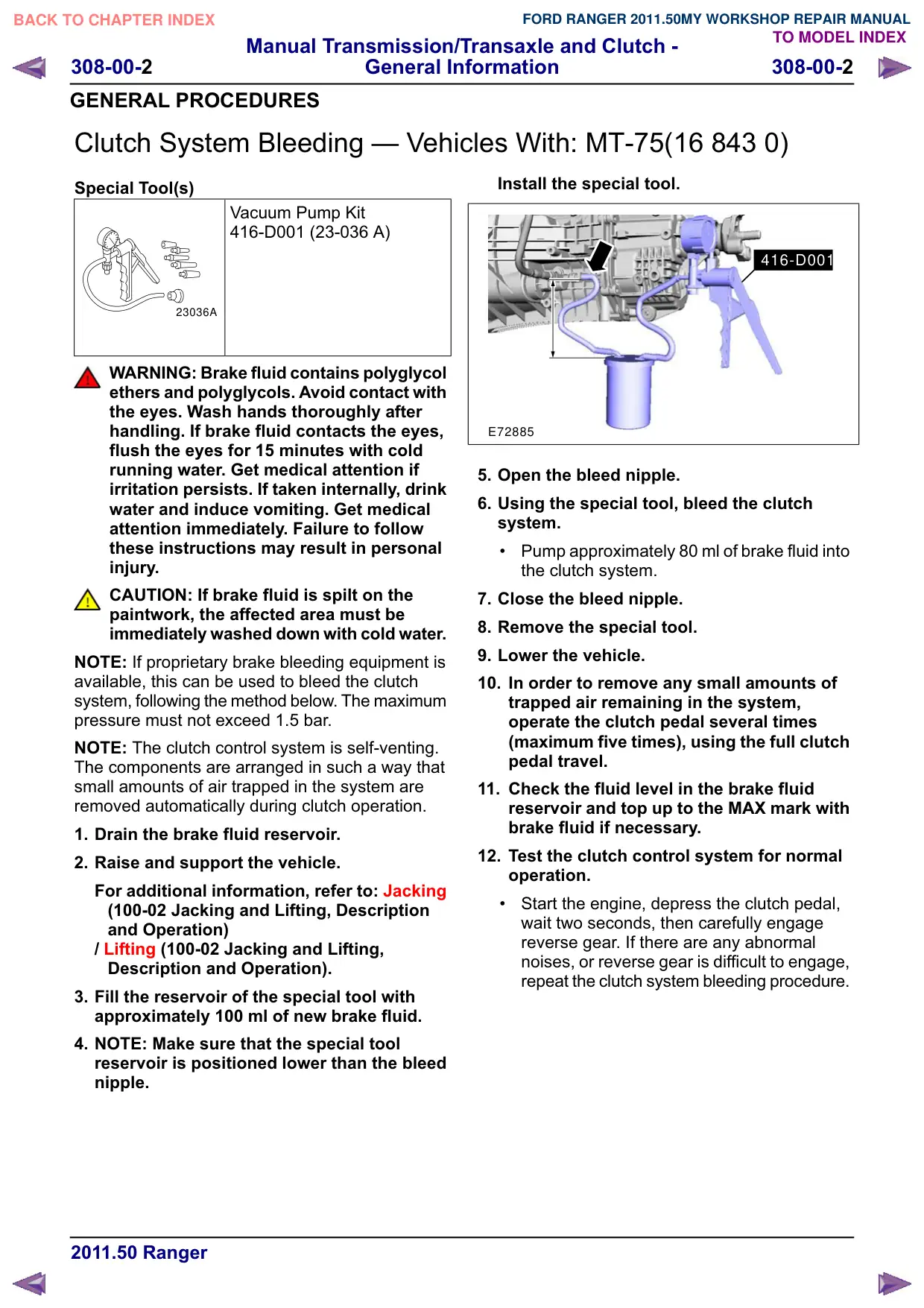
Texto da página
Link desta página: https://ranger.mbrace.com.br/oficina/934
Imagem: https://ranger.mbrace.com.br/img/oficina/934.webp
Manual Transmission/Transaxle and Clutch -
General Information
308-00-2
308-00-2
GENERAL PROCEDURES
Clutch System Bleeding – Vehicles With: MT-75(16 843 0)
Special Tool(s)
Vacuum Pump Kit
416-D001 (23-036 A)
23036A
WARNING: Brake fluid contains polyglycol
ethers and polyglycols. Avoid contact with
the eyes. Wash hands thoroughly after
handling. If brake fluid contacts the eyes,
flush the eyes for 15 minutes with cold
running water. Get medical attention if
irritation persists. If taken internally, drink
water and induce vomiting. Get medical
attention immediately. Failure to follow
these instructions may result in personal
injury.
CAUTION: If brake fluid is spilt on the
paintwork, the affected area must be
immediately washed down with cold water.
NOTE: If proprietary brake bleeding equipment is
available, this can be used to bleed the clutch
system, following the method below. The maximum
pressure must not exceed 1.5 bar.
NOTE: The clutch control system is self-venting.
The components are arranged in such a way that
small amounts of air trapped in the system are
removed automatically during clutch operation.
1. Drain the brake fluid reservoir.
2. Raise and support the vehicle.
For additional information, refer to: Jacking
(100-02 Jacking and Lifting, Description
and Operation)
/ Lifting (100-02 Jacking and Lifting,
Description and Operation).
3. Fill the reservoir of the special tool with
approximately 100 ml of new brake fluid.
4. NOTE: Make sure that the special tool
reservoir is positioned lower than the bleed
nipple.
Install the special tool.
416-D001
E72885
5. Open the bleed nipple.
6. Using the special tool, bleed the clutch
system.
Pump approximately 80 ml of brake fluid into
the clutch system.
7. Close the bleed nipple.
8. Remove the special tool.
9. Lower the vehicle.
10. In order to remove any small amounts of
trapped air remaining in the system,
operate the clutch pedal several times
(maximum five times), using the full clutch
pedal travel.
11. Check the fluid level in the brake fluid
reservoir and top up to the MAX mark with
brake fluid if necessary.
12. Test the clutch control system for normal
operation.
Start the engine, depress the clutch pedal,
wait two seconds, then carefully engage
reverse gear. If there are any abnormal
noises, or reverse gear is difficult to engage,
repeat the clutch system bleeding procedure.