Alimentação de combustível e controles
Fuel Charging and Controls
Texto da página
Link desta página: https://ranger.mbrace.com.br/oficina/746
Imagem: https://ranger.mbrace.com.br/img/oficina/746.webp
Fuel Charging and Controls – 2.2L Duratorq-TDCi (88kW/120PS)
303-04B-2
303-04B-2
- Puma/2.2L Duratorq-TDCi (96kW/130PS) - Puma/2.2L Duratorq-TDCi (110kW/150PS) - Puma
DESCRIPTION AND OPERATION
Fuel Charging and Controls
Overview
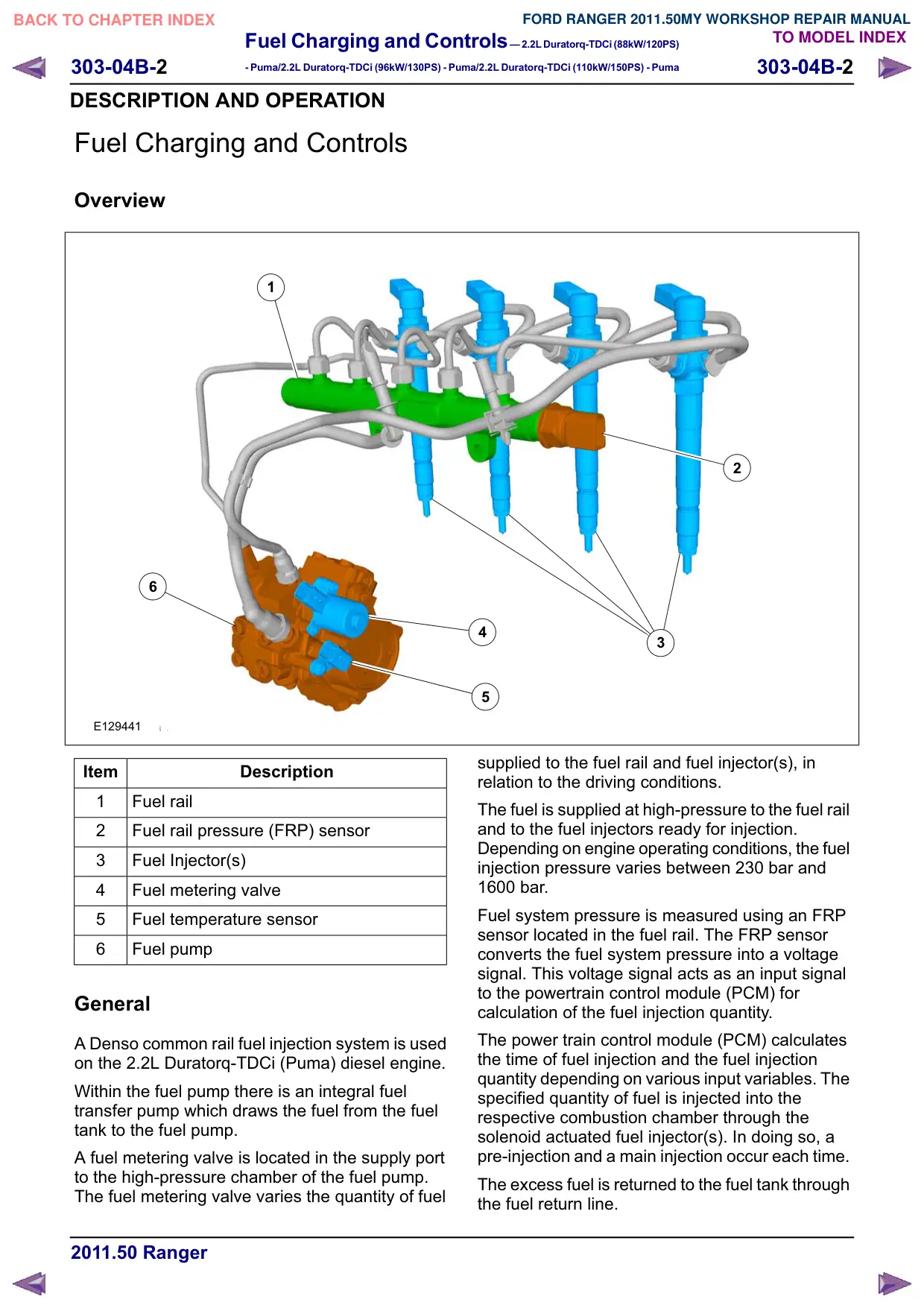
1
6
E129441
Item
Description
1
Fuel rail
2
Fuel rail pressure (FRP) sensor
3
Fuel Injector(s)
4
Fuel metering valve
5
Fuel temperature sensor
6
Fuel pump
General
A Denso common rail fuel injection system is used
on the 2.2L Duratorq-TDCi (Puma) diesel engine.
Within the fuel pump there is an integral fuel
transfer pump which draws the fuel from the fuel
tank to the fuel pump.
A fuel metering valve is located in the supply port
to the high-pressure chamber of the fuel pump.
The fuel metering valve varies the quantity of fuel
2
4
3
5
supplied to the fuel rail and fuel injector(s), in
relation to the driving conditions.
The fuel is supplied at high-pressure to the fuel rail
and to the fuel injectors ready for injection.
Depending on engine operating conditions, the fuel
injection pressure varies between 230 bar and
1600 bar.
Fuel system pressure is measured using an FRP
sensor located in the fuel rail. The FRP sensor
converts the fuel system pressure into a voltage
signal. This voltage signal acts as an input signal
to the powertrain control module (PCM) for
calculation of the fuel injection quantity.
The power train control module (PCM) calculates
the time of fuel injection and the fuel injection
quantity depending on various input variables. The
specified quantity of fuel is injected into the
respective combustion chamber through the
solenoid actuated fuel injector(s). In doing so, a
pre-injection and a main injection occur each time.
The excess fuel is returned to the fuel tank through
the fuel return line.