Precauções de saúde e segurança do sistema de ar-condicionado (A/C)
Air Conditioning (A/C) System Health and Safety Precautions
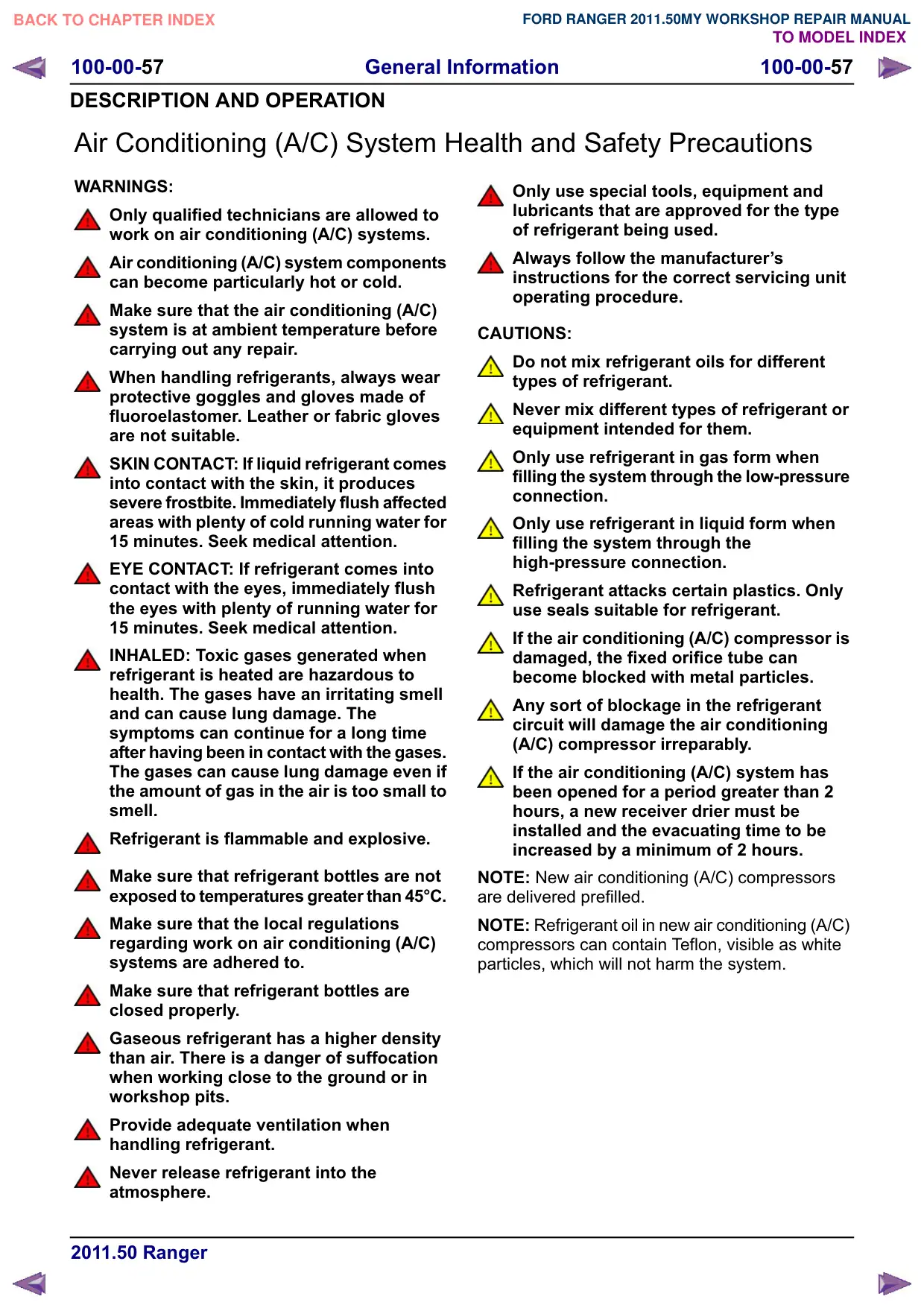
Texto da página
Link desta página: https://ranger.mbrace.com.br/oficina/62
Imagem: https://ranger.mbrace.com.br/img/oficina/62.webp
General Information
100-00-57
100-00-57
DESCRIPTION AND OPERATION
Air Conditioning (A/C) System Health and Safety Precautions
WARNINGS:
Only qualified technicians are allowed to
work on air conditioning (A/C) systems.
Air conditioning (A/C) system components
can become particularly hot or cold.
Make sure that the air conditioning (A/C)
system is at ambient temperature before
carrying out any repair.
When handling refrigerants, always wear
protective goggles and gloves made of
fluoroelastomer. Leather or fabric gloves
are not suitable.
SKIN CONTACT: If liquid refrigerant comes
into contact with the skin, it produces
severe frostbite. Immediately flush affected
areas with plenty of cold running water for
15 minutes. Seek medical attention.
EYE CONTACT: If refrigerant comes into
contact with the eyes, immediately flush
the eyes with plenty of running water for
15 minutes. Seek medical attention.
INHALED: Toxic gases generated when
refrigerant is heated are hazardous to
health. The gases have an irritating smell
and can cause lung damage. The
symptoms can continue for a long time
after having been in contact with the gases.
The gases can cause lung damage even if
the amount of gas in the air is too small to
smell.
Refrigerant is flammable and explosive.
Make sure that refrigerant bottles are not
exposed to temperatures greater than 45°C.
Make sure that the local regulations
regarding work on air conditioning (A/C)
systems are adhered to.
Make sure that refrigerant bottles are
closed properly.
Gaseous refrigerant has a higher density
than air. There is a danger of suffocation
when working close to the ground or in
workshop pits.
Provide adequate ventilation when
handling refrigerant.
Never release refrigerant into the
atmosphere.
Only use special tools, equipment and
lubricants that are approved for the type
of refrigerant being used.
Always follow the manufacturer‘s
instructions for the correct servicing unit
operating procedure.
CAUTIONS:
Do not mix refrigerant oils for different
types of refrigerant.
Never mix different types of refrigerant or
equipment intended for them.
Only use refrigerant in gas form when
filling the system through the low-pressure
connection.
Only use refrigerant in liquid form when
filling the system through the
high-pressure connection.
Refrigerant attacks certain plastics. Only
use seals suitable for refrigerant.
If the air conditioning (A/C) compressor is
damaged, the fixed orifice tube can
become blocked with metal particles.
Any sort of blockage in the refrigerant
circuit will damage the air conditioning
(A/C) compressor irreparably.
If the air conditioning (A/C) system has
been opened for a period greater than 2
hours, a new receiver drier must be
installed and the evacuating time to be
increased by a minimum of 2 hours.
NOTE: New air conditioning (A/C) compressors
are delivered prefilled.
NOTE: Refrigerant oil in new air conditioning (A/C)
compressors can contain Teflon, visible as white
particles, which will not harm the system.