Práticas padrão de oficina
Standard Workshop Practices
Texto da página
Link desta página: https://ranger.mbrace.com.br/oficina/57
Imagem: https://ranger.mbrace.com.br/img/oficina/57.webp
General Information
100-00-52
100-00-52
DESCRIPTION AND OPERATION
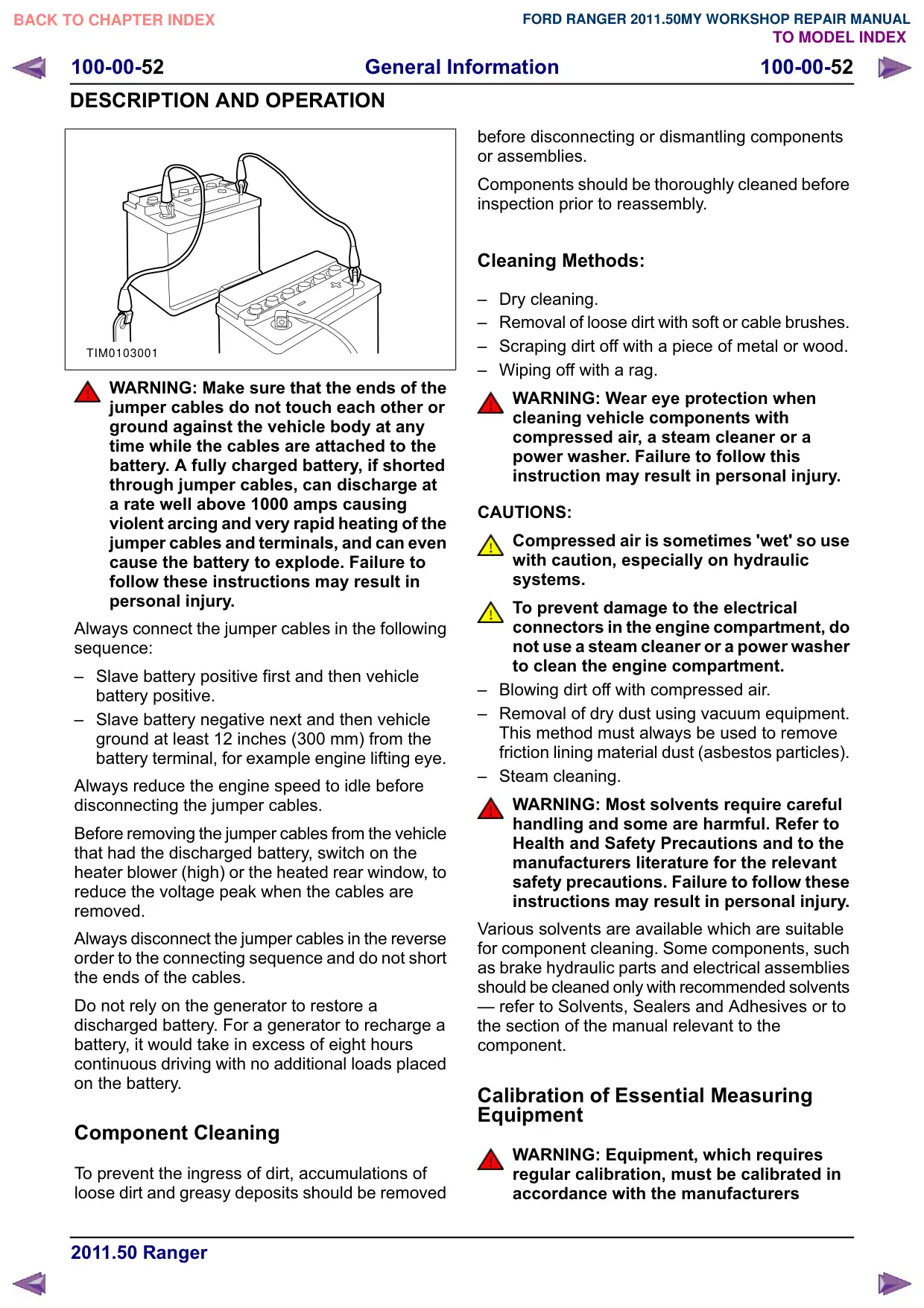
TIM0103001
WARNING: Make sure that the ends of the
jumper cables do not touch each other or
ground against the vehicle body at any
time while the cables are attached to the
battery. A fully charged battery, if shorted
through jumper cables, can discharge at
a rate well above 1000 amps causing
violent arcing and very rapid heating of the
jumper cables and terminals, and can even
cause the battery to explode. Failure to
follow these instructions may result in
personal injury.
Always connect the jumper cables in the following
sequence:
œ Slave battery positive first and then vehicle
battery positive.
œ Slave battery negative next and then vehicle
ground at least 12 inches (300 mm) from the
battery terminal, for example engine lifting eye.
Always reduce the engine speed to idle before
disconnecting the jumper cables.
Before removing the jumper cables from the vehicle
that had the discharged battery, switch on the
heater blower (high) or the heated rear window, to
reduce the voltage peak when the cables are
removed.
Always disconnect the jumper cables in the reverse
order to the connecting sequence and do not short
the ends of the cables.
Do not rely on the generator to restore a
discharged battery. For a generator to recharge a
battery, it would take in excess of eight hours
continuous driving with no additional loads placed
on the battery.
Component Cleaning
To prevent the ingress of dirt, accumulations of
loose dirt and greasy deposits should be removed
before disconnecting or dismantling components
or assemblies.
Components should be thoroughly cleaned before
inspection prior to reassembly.
Cleaning Methods:
œ Dry cleaning.
œ Removal of loose dirt with soft or cable brushes.
œ Scraping dirt off with a piece of metal or wood.
œ Wiping off with a rag.
WARNING: Wear eye protection when
cleaning vehicle components with
compressed air, a steam cleaner or a
power washer. Failure to follow this
instruction may result in personal injury.
CAUTIONS:
Compressed air is sometimes 'wet' so use
with caution, especially on hydraulic
systems.
To prevent damage to the electrical
connectors in the engine compartment, do
not use a steam cleaner or a power washer
to clean the engine compartment.
œ Blowing dirt off with compressed air.
œ Removal of dry dust using vacuum equipment.
This method must always be used to remove
friction lining material dust (asbestos particles).
œ Steam cleaning.
WARNING: Most solvents require careful
handling and some are harmful. Refer to
Health and Safety Precautions and to the
manufacturers literature for the relevant
safety precautions. Failure to follow these
instructions may result in personal injury.
Various solvents are available which are suitable
for component cleaning. Some components, such
as brake hydraulic parts and electrical assemblies
should be cleaned only with recommended solvents
– refer to Solvents, Sealers and Adhesives or to
the section of the manual relevant to the
component.
Calibration of Essential Measuring
Equipment
WARNING: Equipment, which requires
regular calibration, must be calibrated in
accordance with the manufacturers