Rede de comunicação – Visão geral
Communications Network œ Overview
Texto da página
Link desta página: https://ranger.mbrace.com.br/oficina/1294
Imagem: https://ranger.mbrace.com.br/img/oficina/1294.webp
418-00-7
Module Communications Network
418-00-7
DESCRIPTION AND OPERATION
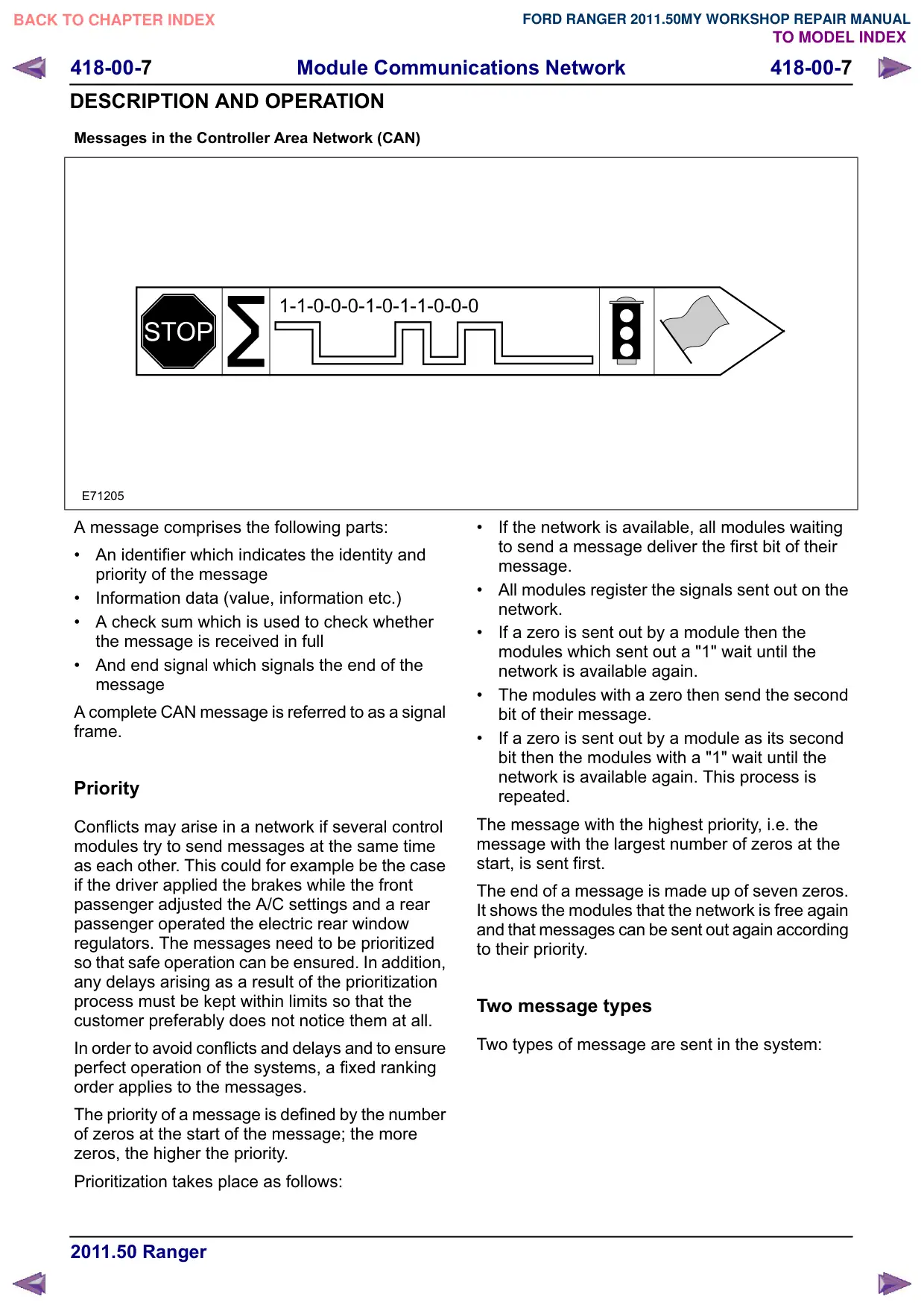
Messages in the Controller Area Network (CAN)
E71205
A message comprises the following parts:
An identifier which indicates the identity and
priority of the message
Information data (value, information etc.)
A check sum which is used to check whether
the message is received in full
And end signal which signals the end of the
message
A complete CAN message is referred to as a signal
frame.
Priority
Conflicts may arise in a network if several control
modules try to send messages at the same time
as each other. This could for example be the case
if the driver applied the brakes while the front
passenger adjusted the A/C settings and a rear
passenger operated the electric rear window
regulators. The messages need to be prioritized
so that safe operation can be ensured. In addition,
any delays arising as a result of the prioritization
process must be kept within limits so that the
customer preferably does not notice them at all.
In order to avoid conflicts and delays and to ensure
perfect operation of the systems, a fixed ranking
order applies to the messages.
The priority of a message is defined by the number
of zeros at the start of the message; the more
zeros, the higher the priority.
Prioritization takes place as follows:
If the network is available, all modules waiting
to send a message deliver the first bit of their
message.
All modules register the signals sent out on the
network.
If a zero is sent out by a module then the
modules which sent out a "1" wait until the
network is available again.
The modules with a zero then send the second
bit of their message.
If a zero is sent out by a module as its second
bit then the modules with a "1" wait until the
network is available again. This process is
repeated.
The message with the highest priority, i.e. the
message with the largest number of zeros at the
start, is sent first.
The end of a message is made up of seven zeros.
It shows the modules that the network is free again
and that messages can be sent out again according
to their priority.
Two message types
Two types of message are sent in the system: