Ar-condicionado
Air Conditioning
Texto da página
Link desta página: https://ranger.mbrace.com.br/oficina/1178
Imagem: https://ranger.mbrace.com.br/img/oficina/1178.webp
412-01-7
Climate Control
412-01-7
DESCRIPTION AND OPERATION
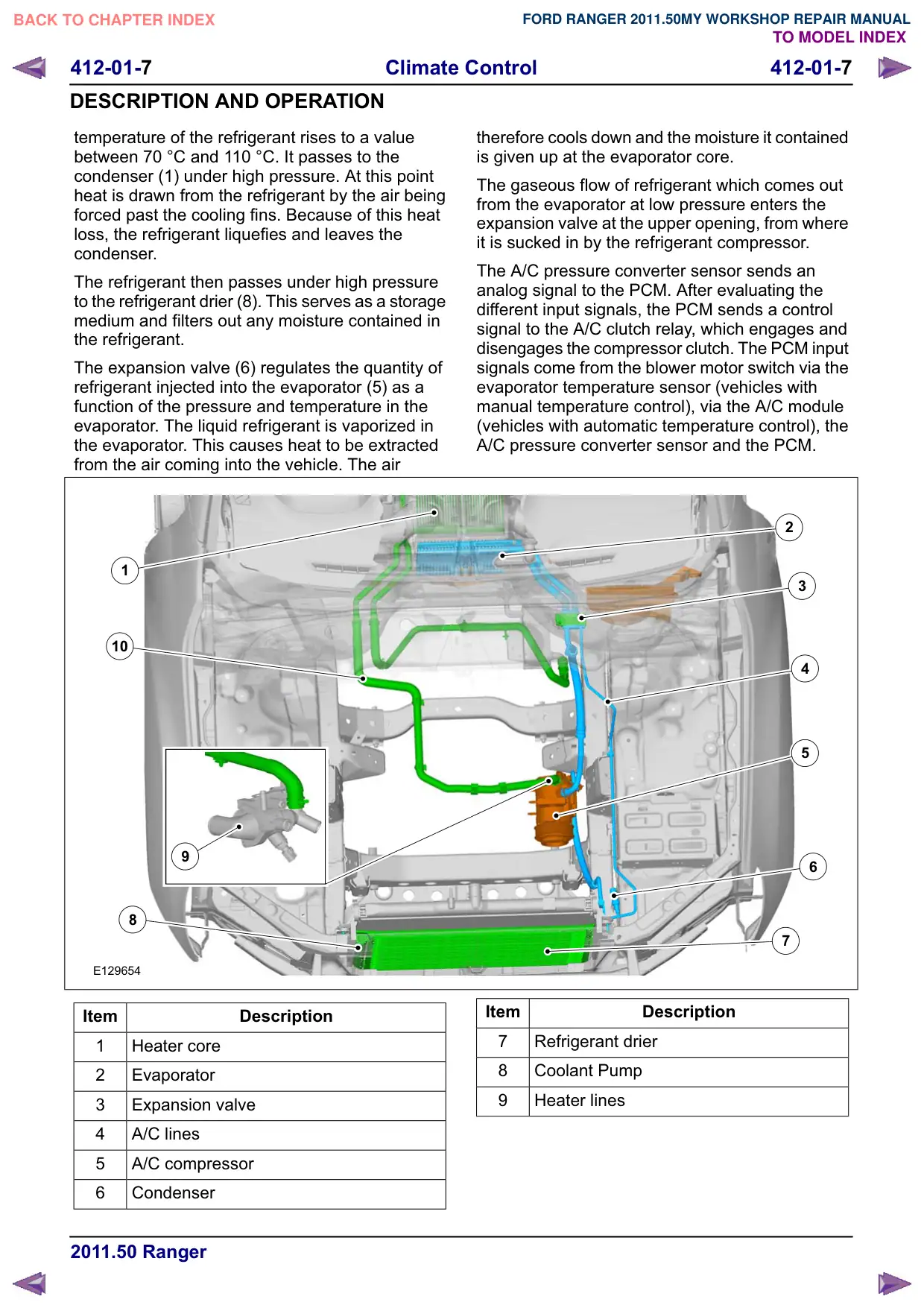
temperature of the refrigerant rises to a value
between 70 °C and 110 °C. It passes to the
condenser (1) under high pressure. At this point
heat is drawn from the refrigerant by the air being
forced past the cooling fins. Because of this heat
loss, the refrigerant liquefies and leaves the
condenser.
The refrigerant then passes under high pressure
to the refrigerant drier (8). This serves as a storage
medium and filters out any moisture contained in
the refrigerant.
The expansion valve (6) regulates the quantity of
refrigerant injected into the evaporator (5) as a
function of the pressure and temperature in the
evaporator. The liquid refrigerant is vaporized in
the evaporator. This causes heat to be extracted
from the air coming into the vehicle. The air
1
10
8
E129654
Item
Description
1
Heater core
2
Evaporator
3
Expansion valve
4
A/C lines
5
A/C compressor
6
Condenser
therefore cools down and the moisture it contained
is given up at the evaporator core.
The gaseous flow of refrigerant which comes out
from the evaporator at low pressure enters the
expansion valve at the upper opening, from where
it is sucked in by the refrigerant compressor.
The A/C pressure converter sensor sends an
analog signal to the PCM. After evaluating the
different input signals, the PCM sends a control
signal to the A/C clutch relay, which engages and
disengages the compressor clutch. The PCM input
signals come from the blower motor switch via the
evaporator temperature sensor (vehicles with
manual temperature control), via the A/C module
(vehicles with automatic temperature control), the
A/C pressure converter sensor and the PCM.
2
3
4
5
6
7
Item
Description
7
Refrigerant drier
8
Coolant Pump
Heater lines