Ruído do vento
Wind Noise
Texto da página
Link desta página: https://ranger.mbrace.com.br/carroceria/344
Imagem: https://ranger.mbrace.com.br/img/carroceria/344.webp
501-25-86
Body Repairs - General Information
501-25-86
DESCRIPTION AND OPERATION
6WD
to test
Res
Reference or
ge
XOW
Action
7th
Check the
Yes
Renew the seal
vehicle for inad-
or perform the
equate or
appropriate
damaged seals.
repair as neces-
The sealing of a
sary. Check
vehicle can be
whether the
checked using
measures have
the stethoscope,
been successful.
the powder test,
the smoke test
and the ultra-
sonic detector.
(See under test
method.) Could
a leak be
detected?
No
Step 8.
8th
Under certain
circumstances
there may be a
constructional
problem which is
not yet known
about. Record
the problem in
an Express
Service Report
and send it on by
the usual
method.
Possible concerns with corrective
measures
NOTE: Instructions on general noise are
summarized separately in the Noise, Vibration and
Harshness section. These can be useful when
searching for the causes of wind noises.
There follows an outline of the possible concerns
relating to wind noises. Selected examples are
given showing the causes of wind noises and the
ways in which they can be eliminated. They are
intended to provide troubleshooting tips and
suggestions for the user but do not represent an
exhaustive faults list. The topics are subdivided by
the different groups of components.
The test procedures described in the Noise,
Vibration and Harshness section can be used when
troubleshooting.
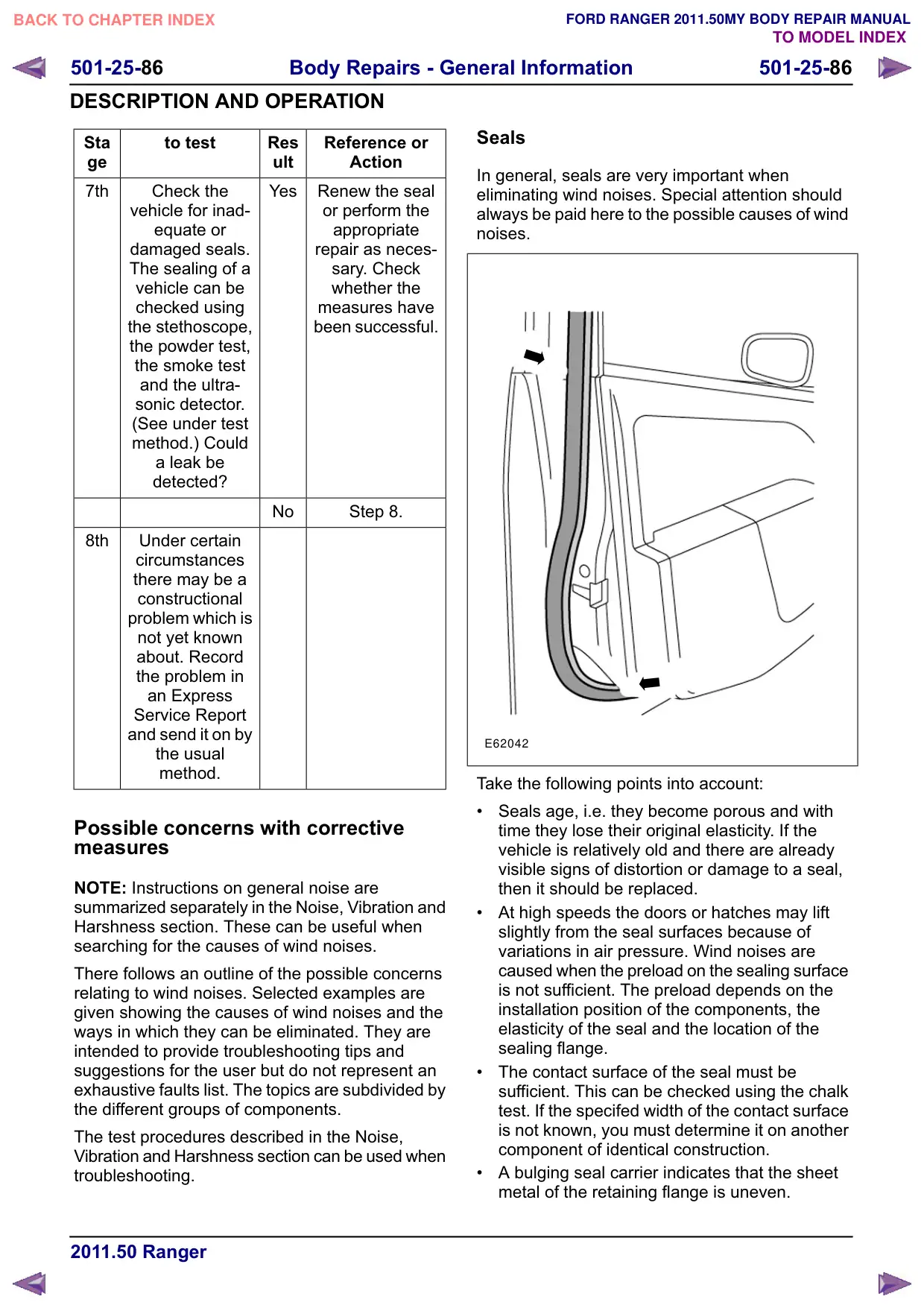
Seals
In general, seals are very important when
eliminating wind noises. Special attention should
always be paid here to the possible causes of wind
noises.
E62042
Take the following points into account:
Seals age, i.e. they become porous and with
time they lose their original elasticity. If the
vehicle is relatively old and there are already
visible signs of distortion or damage to a seal,
then it should be replaced.
At high speeds the doors or hatches may lift
slightly from the seal surfaces because of
variations in air pressure. Wind noises are
caused when the preload on the sealing surface
is not sufficient. The preload depends on the
installation position of the components, the
elasticity of the seal and the location of the
sealing flange.
The contact surface of the seal must be
sufficient. This can be checked using the chalk
test. If the specifed width of the contact surface
is not known, you must determine it on another
component of identical construction.
A bulging seal carrier indicates that the sheet
metal of the retaining flange is uneven.