Reparos em plástico
Plastic Repairs
Texto da página
Link desta página: https://ranger.mbrace.com.br/carroceria/308
Imagem: https://ranger.mbrace.com.br/img/carroceria/308.webp
501-25-50
Body Repairs - General Information
501-25-50
DESCRIPTION AND OPERATION
Plastic Repairs
General
The proportion of plastics used in vehicle
construction continues to rise. Up to now damaged
plastic components often had to be replaced.
These days, plastic repairs are becoming more
and more widely accepted because of the
increasing cost of spare parts.
NOTE: Plastic adhesives are chemical products
and are subject to the safety instructions of the
manufacturer.
In repair work, the material properties of plastics
are highly significant. There are two main groups:
Thermoplastics.
Thermosets.
NOTE: Elastomers make up a third group of
plastics. These are not mentioned below because
they have no plastics repair applications.
Thermoplastics
Heat causes thermoplastics (also called TP
polymers) to transform from the solid state into the
thermoelastic state and then into the thermoplastic
state. When thermoplastics are cooled, they return
to solid state.
Brief
Plastic
descrip-
WLRQ
ABS
Acrylonitrile butadiene styrene
copolymer
PA
Polyamide
3&
Polycarbonate
33
Polypropylene
PP/EPDM
Polypropylene/ethylene propylene
diene copolymer
PC/PBT
Polycarbonate/polybutylene tereph-
WKDODWH
Hard PVC
Polyvinylchloride
/ soft PVC
Thermosets
Thermosets (also called TS polymers) are much
harder and more brittle than thermoplastics. Their
strength remains largely unchanged when they are
heated. Thermosets are destroyed when heated
above the critical temperature. Also, the original
state will no longer be restored on cooling.
Brief
Plastic
descrip-
WLRQ
*53
Glass reinforced plastic
385
Close-meshed cross-linked poly-
urethane
385
Wide-meshed cross-linked poly-
urethane
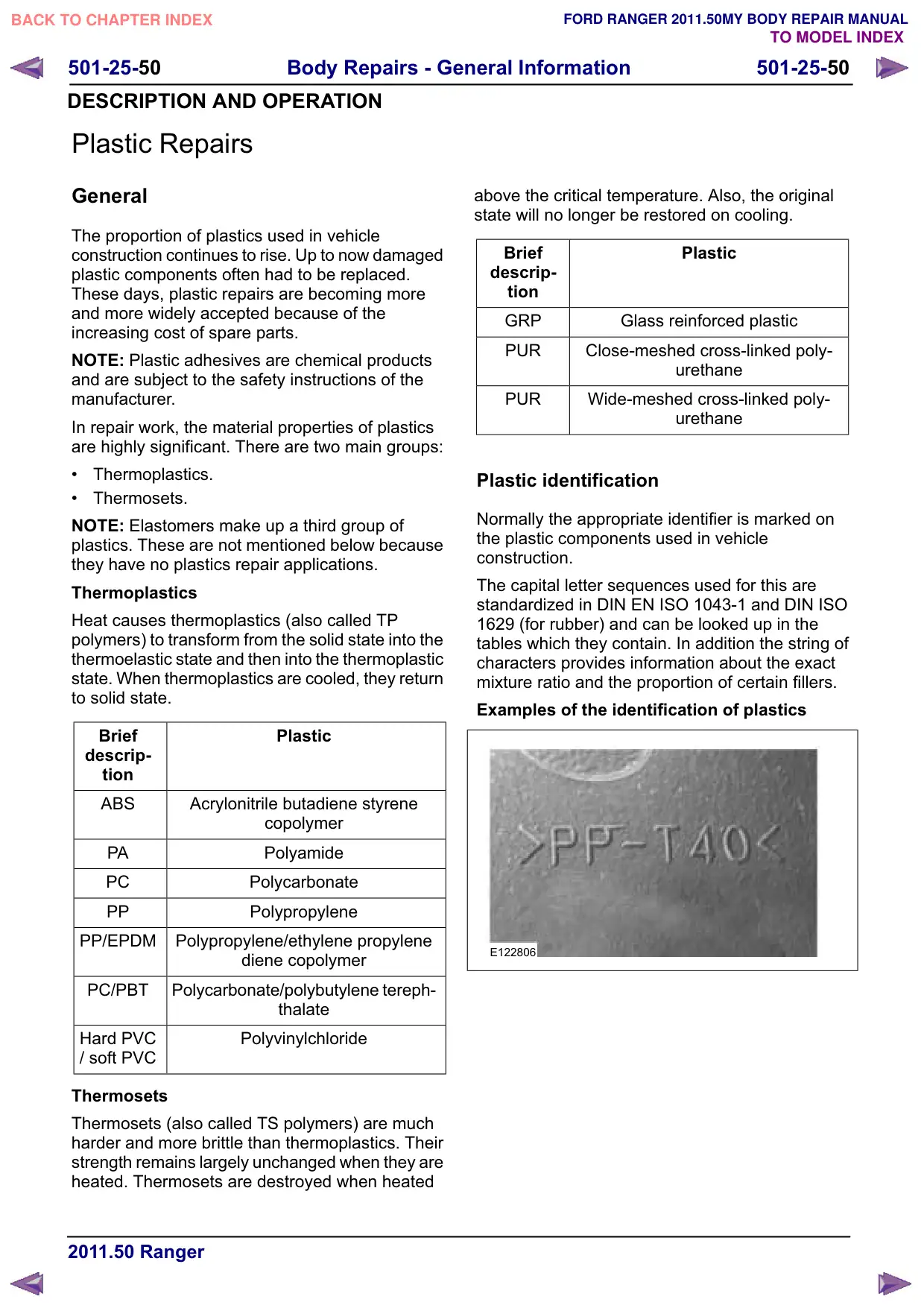
Plastic identification
Normally the appropriate identifier is marked on
the plastic components used in vehicle
construction.
The capital letter sequences used for this are
standardized in DIN EN ISO 1043-1 and DIN ISO
1629 (for rubber) and can be looked up in the
tables which they contain. In addition the string of
characters provides information about the exact
mixture ratio and the proportion of certain fillers.
Examples of the identification of plastics
E122806