Técnica de funilaria e reparos rápidos
Panel Beating Technique and Smart Repairs
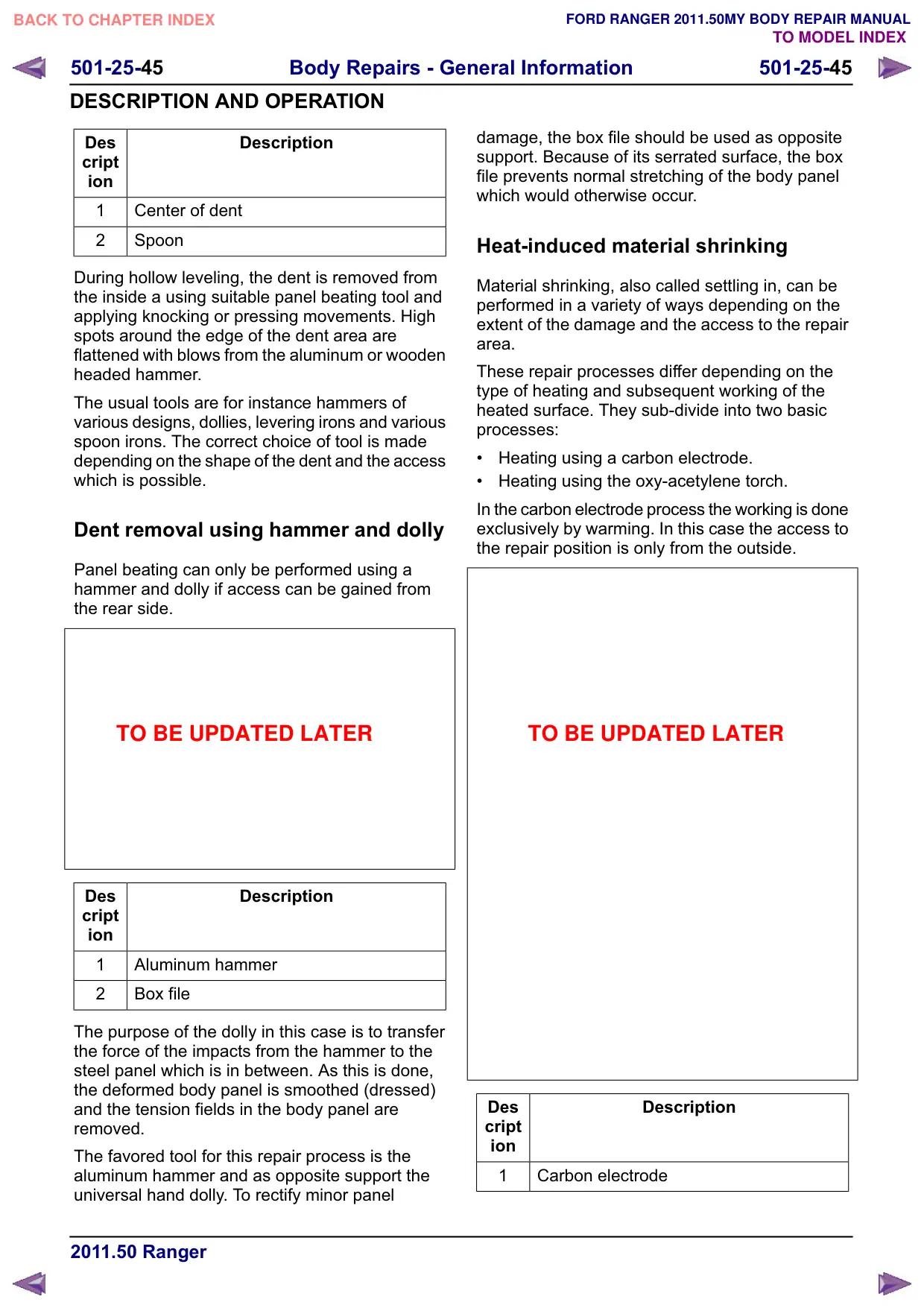
Texto da página
Link desta página: https://ranger.mbrace.com.br/carroceria/303
Imagem: https://ranger.mbrace.com.br/img/carroceria/303.webp
501-25-45
Body Repairs - General Information
501-25-45
DESCRIPTION AND OPERATION
Des
Description
FULSW
ion
1
Center of dent
2
Spoon
During hollow leveling, the dent is removed from
the inside a using suitable panel beating tool and
applying knocking or pressing movements. High
spots around the edge of the dent area are
flattened with blows from the aluminum or wooden
headed hammer.
The usual tools are for instance hammers of
various designs, dollies, levering irons and various
spoon irons. The correct choice of tool is made
depending on the shape of the dent and the access
which is possible.
Dent removal using hammer and dolly
Panel beating can only be performed using a
hammer and dolly if access can be gained from
the rear side.
TO BE UPDATED LATER
Des
Description
FULSW
ion
1
Aluminum hammer
2
Box file
The purpose of the dolly in this case is to transfer
the force of the impacts from the hammer to the
steel panel which is in between. As this is done,
the deformed body panel is smoothed (dressed)
and the tension fields in the body panel are
removed.
The favored tool for this repair process is the
aluminum hammer and as opposite support the
universal hand dolly. To rectify minor panel
damage, the box file should be used as opposite
support. Because of its serrated surface, the box
file prevents normal stretching of the body panel
which would otherwise occur.
Heat-induced material shrinking
Material shrinking, also called settling in, can be
performed in a variety of ways depending on the
extent of the damage and the access to the repair
area.
These repair processes differ depending on the
type of heating and subsequent working of the
heated surface. They sub-divide into two basic
processes:
Heating using a carbon electrode.
Heating using the oxy-acetylene torch.
In the carbon electrode process the working is done
exclusively by warming. In this case the access to
the repair position is only from the outside.
TO BE UPDATED LATER
Des
Description
FULSW
ion
1
Carbon electrode