Construção da carroceria
Body Construction
Texto da página
Link desta página: https://ranger.mbrace.com.br/carroceria/272
Imagem: https://ranger.mbrace.com.br/img/carroceria/272.webp
501-25-14
Body Repairs - General Information
501-25-14
DESCRIPTION AND OPERATION
is usually made of plastic or alloy. This type of
construction is also common in touring car racing
for instance.
Special features of non-monocoque bodywork
construction:
Partly large surface panels and high volume
shaped parts.
Thicker materials and greater reinforcements
in the frame area.
Floor pan as frame structure with high torsional
rigidity and flexural strength.
Side panels only make a small contribution to
the overall stability of the body.
Instructions for repair:
A different repair technique is necessary during
repairs. A deformed frame structure requires high
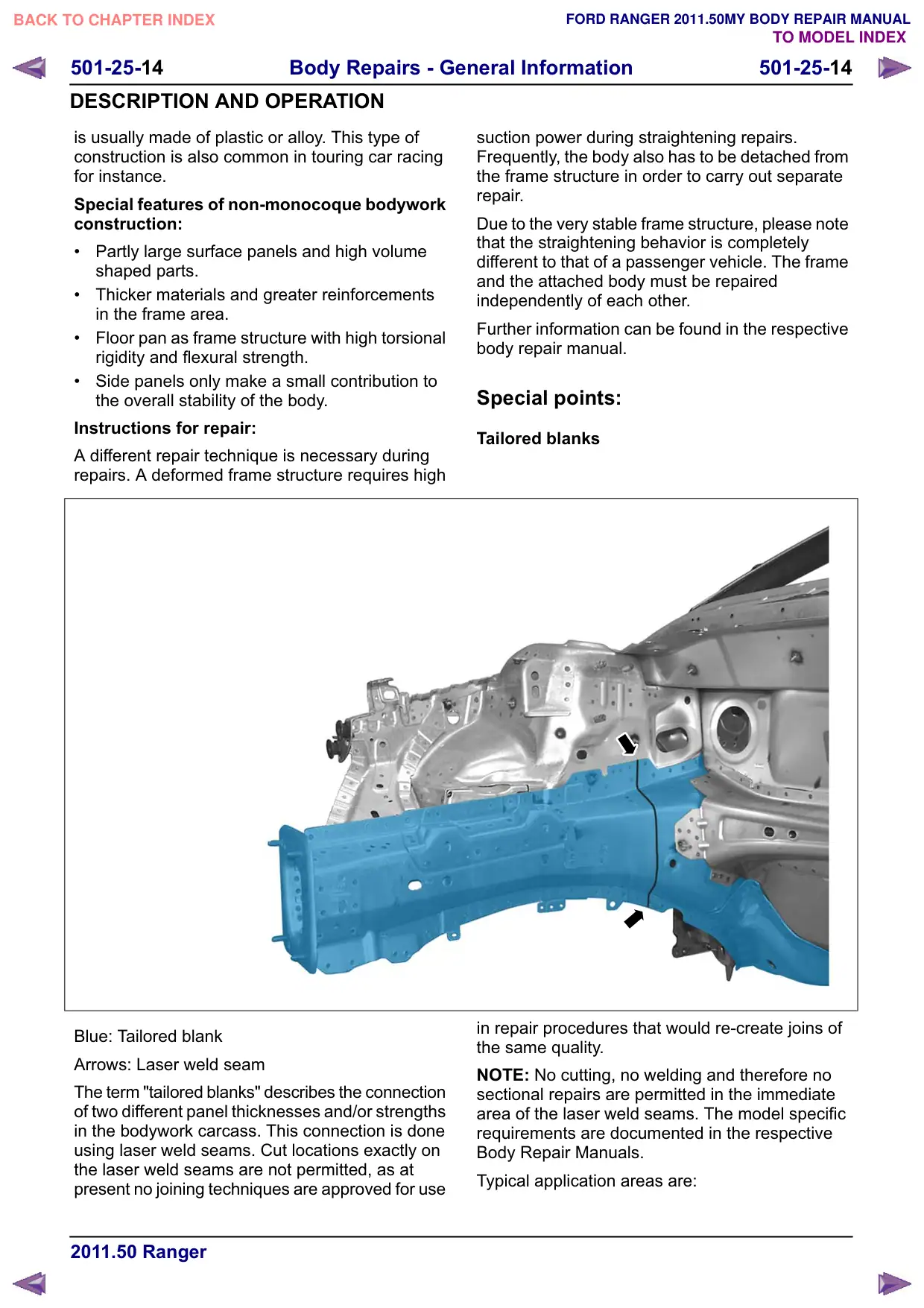
Blue: Tailored blank
Arrows: Laser weld seam
The term "tailored blanks" describes the connection
of two different panel thicknesses and/or strengths
in the bodywork carcass. This connection is done
using laser weld seams. Cut locations exactly on
the laser weld seams are not permitted, as at
present no joining techniques are approved for use
suction power during straightening repairs.
Frequently, the body also has to be detached from
the frame structure in order to carry out separate
repair.
Due to the very stable frame structure, please note
that the straightening behavior is completely
different to that of a passenger vehicle. The frame
and the attached body must be repaired
independently of each other.
Further information can be found in the respective
body repair manual.
Special points:
Tailored blanks
in repair procedures that would re-create joins of
the same quality.
NOTE: No cutting, no welding and therefore no
sectional repairs are permitted in the immediate
area of the laser weld seams. The model specific
requirements are documented in the respective
Body Repair Manuals.
Typical application areas are: