206-09B ABS – controle de tração
Texto completo da seção, página por página. Toque no título para ver a página com a imagem.
Página 212 · Índice da seção
Contents
https://ranger.mbrace.com.br/oficina/212 · imagem: https://ranger.mbrace.com.br/img/oficina/212.webp
Anti-Lock Control - Traction Control
206-09B-1
206-09B-1
.
SECTION 206-09B Anti-Lock Control - Traction Control
VEHICLE APPLICATION: 2011.50 Ranger
CONTENTS
DESCRIPTION AND OPERATION
Anti-Lock Control - Traction Control...................................................................................
PAGE
206-09B-2
Página 213 · Controle antitravamento - controle de tração
Anti-Lock Control - Traction Control
https://ranger.mbrace.com.br/oficina/213 · imagem: https://ranger.mbrace.com.br/img/oficina/213.webp
Anti-Lock Control - Traction Control
206-09B-2
206-09B-2
DESCRIPTION AND OPERATION
Anti-Lock Control - Traction Control
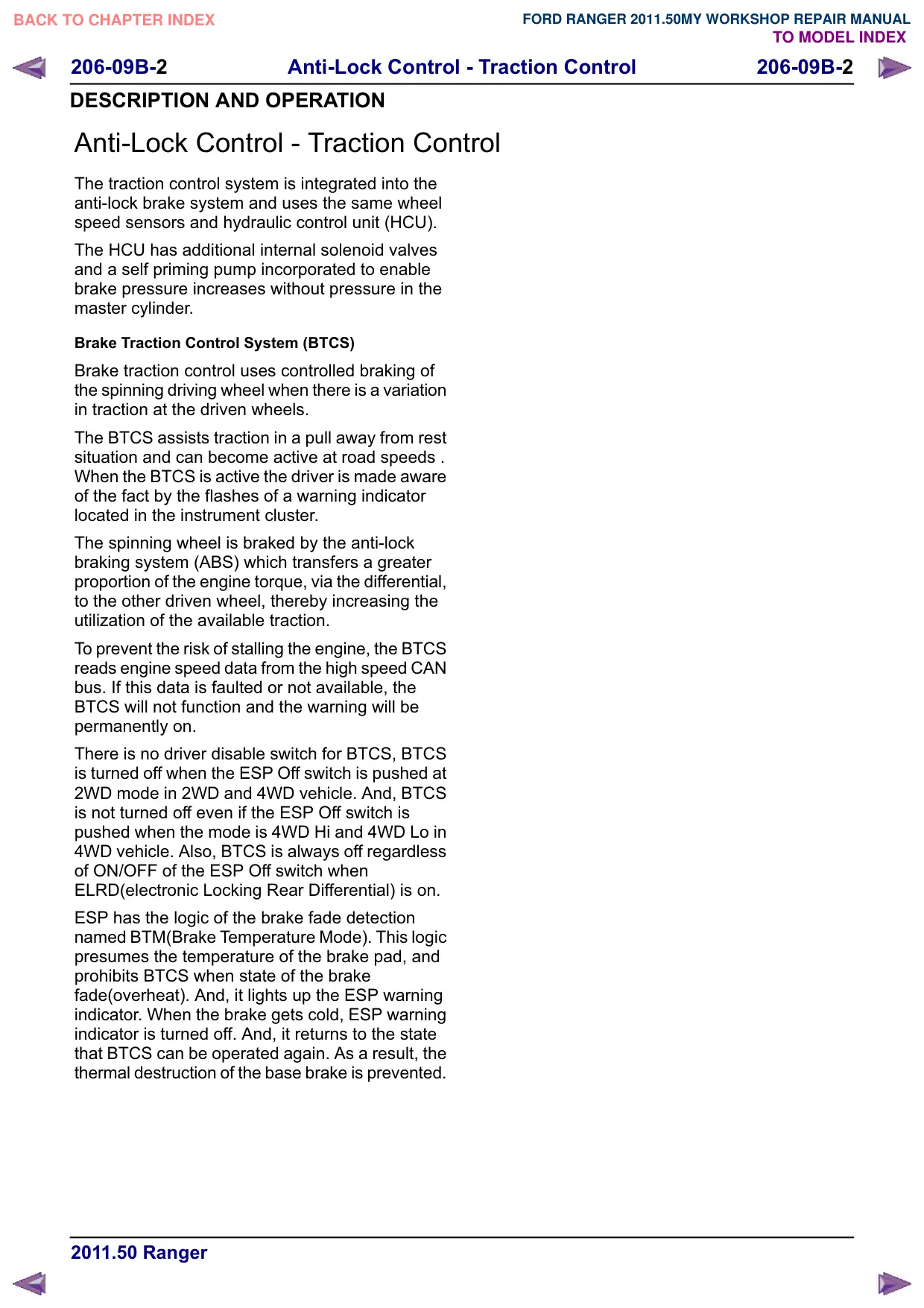
The traction control system is integrated into the
anti-lock brake system and uses the same wheel
speed sensors and hydraulic control unit (HCU).
The HCU has additional internal solenoid valves
and a self priming pump incorporated to enable
brake pressure increases without pressure in the
master cylinder.
Brake Traction Control System (BTCS)
Brake traction control uses controlled braking of
the spinning driving wheel when there is a variation
in traction at the driven wheels.
The BTCS assists traction in a pull away from rest
situation and can become active at road speeds .
When the BTCS is active the driver is made aware
of the fact by the flashes of a warning indicator
located in the instrument cluster.
The spinning wheel is braked by the anti-lock
braking system (ABS) which transfers a greater
proportion of the engine torque, via the differential,
to the other driven wheel, thereby increasing the
utilization of the available traction.
To prevent the risk of stalling the engine, the BTCS
reads engine speed data from the high speed CAN
bus. If this data is faulted or not available, the
BTCS will not function and the warning will be
permanently on.
There is no driver disable switch for BTCS, BTCS
is turned off when the ESP Off switch is pushed at
2WD mode in 2WD and 4WD vehicle. And, BTCS
is not turned off even if the ESP Off switch is
pushed when the mode is 4WD Hi and 4WD Lo in
4WD vehicle. Also, BTCS is always off regardless
of ON/OFF of the ESP Off switch when
ELRD(electronic Locking Rear Differential) is on.
ESP has the logic of the brake fade detection
named BTM(Brake Temperature Mode). This logic
presumes the temperature of the brake pad, and
prohibits BTCS when state of the brake
fade(overheat). And, it lights up the ESP warning
indicator. When the brake gets cold, ESP warning
indicator is turned off. And, it returns to the state
that BTCS can be operated again. As a result, the
thermal destruction of the base brake is prevented.